Oh to be me.
What is a like to be a 31 year old woman with chronic illness? Here are some snippets from my life lately:
Today I went to my local food co-op because the fridge was getting to be too empty. I felt tired, worn down, but thought I could handle a 40 minute round trip out of the house. I get the store, start shopping, the next thing I know I can't stand up in one spot without starting to see the blackness forming on the peripherals of my vision. My legs started to shake and tingle. I decided there was no sense in sitting down on the floor of the store, so I decided to just keep walking. That worked. I learned I could make it as long as I kept moving, so I couldn't stop to look at products, just had to grab as I walked by. I made about 3 laps around the store to shop this way. And guess what? They were completely out of the few things I needed most! A normal person might shrug it off and go to a different store before heading home. Me? My energy was spent. Had to go home without what I needed.
...That's a big reason why I shop online as much as I do. Except that I never received one of 3 boxes from my Vitacost order. I need to sort that out, but do I really have to put the energy into it? Seriously? Why can't it just sort itself out like magic and let me just sit here zoning out?
The cashier asked me how I was doing. I bluntly, with no tact or thought, said, "Not good, I didn't sleep last night." She asked if I was stressed and I said, "No, I just have a chronic illness and it decided to flare last night." She didn't have much else to say to me after that. lol. Poor cashier.
Why didn't I sleep last night? Oh, because PMS decided to start, and I was in full bitch mode. At 2 am. I wasn't upset about anything, nothing to be angry at. No person was irritating me. My mood just decided to be as aggressive and irritable as possible, which kept me up, tossing and turning. Then when I was sleeping here and there my dreams were very aggressive. I dreamed about my friend who attempted to commit suicide several months ago, which woke me up because I felt stressed out about it. I never really recovered from her telling me she failed her attempt.
I woke up to throbbing shoulder muscles, shooting and pins and needles pains in my legs, and adrenaline pounding through me.
And I realized how this is pretty much how every day goes for me, but it's so much worse during the winter. I'm never really sure if I'll sleep. I'm never really sure if I'll feel decently. I'm never really sure if I'll have the energy to be able to hold a conversation. I'm never really sure if my depression will let me actually care about what someone is telling me. I just have to figure out what I need to do with myself, moment by moment.
So what's the problem? Well I found a ton of mold growing on my new windows, for starters. Winter condensation that freezes when it's below zero outside causes it. The outside temperature went from -6 degrees to 47 degrees within a day, and we all know how the barometric pressure messes me up. We did just shampoo the downstairs carpets with Biokleen shampoo, which I didn't react to while doing it, but later got a mild version the hives around my eyes that citrus essential oils tends to give me. Plus we disturbed all that dirt in the house. I also went to church. Perfume! And then my monthly cycle just hit the worst phase... and I've been spotting, so who knows, maybe I'm anemic or something. I seem to be very prone to Blood Deficiency.
You see, I just can't win, especially not in the winter. When I feel decently it's purely by chance.
So...
If I spent my entire day playing video games on my phone, so what? At least I'm engaging with people there. At least I feel like I'm accomplishing something, even if progress in that game doesn't affect my real life in any way. At least I'm mentally stimulated rather than just rotting away watching TV. I can't just watch TV, I need to be engaged with something, and video games work perfectly when I'm too tired to do anything else. I'm often pretty bad at the game because I don't have the mental energy to think through what I'm doing, but it is what it is.
I will work at my job, do chores, and contribute to society when I'm capable. I have days when I'm just not capable. A lot of days. I'm not lazy. It's not an addiction to video games. I just can't function normally. Believe me, I'd much rather be raising children, own my own business, going out with friends, working towards buying our own house. I have to deal with these desires every day. If I were lazy, I wouldn't want to be living my life fully. I'd be happy to just settle in to a fun addiction rather than working on progressing in life.
So let me leave you with this article about environmental toxicants causing depression, pain, and chronic fatigue.
Showing posts with label toxicity. Show all posts
Showing posts with label toxicity. Show all posts
Friday, January 4, 2019

Thursday, October 12, 2017
What A Night of Sleep Looks Like During MCS Reaction
I'm not keeping up with this blog, so long story short, I've been using an Oura Ring since August. I want to give some detailed attention to this at some point, but I can't right now. Way too exhausted. In short, it is a highly advanced sleep tracker that has generally received good ratings as far as accuracy goes, but I'll dig into that topic later. It's not like a Fit Bit or other trackers - it uses different technology and can read a lot more.
I want to show you what a night after a chemical exposure looks like for me. I came home from work feeling angry, fidgety, uncomfortable, and wanting to beat something up and smash it to pieces. I'm not totally sure what I was reacting to - normally I know right away if something is causing me reactivity, then will get a the worst reaction later on (delayed.) The fact that I was off my pills for 1.5 weeks and had only taken bare minimum to get by at work in the past 4 days has meant more reactions and reacting to lower exposures. Regardless, I was definitely reacting and was very uncomfortable. I went to bed with a resting heart rate jumping constantly between 95-120 while just laying still in bed.
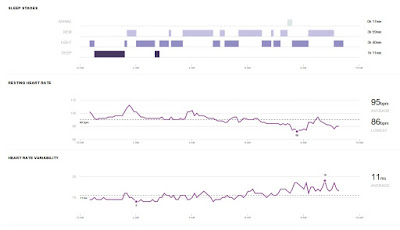
https://drive.google.com/file/d/1olRRgWgc-rXaF2KlDJ6Zi238W9sXiQ-zeA/view?usp=sharing
You will need to click the link below the photo to see it full size to be able to read it. Blogger has some serious formatting limitations and will not allow me to turn the image into a link unless I feel like coding it in HTML, but their HTML is one wall of text, not formatted so that I can easily find where to edit. I'm feeling way too lazy to deal with that.
First problem: 4 hours of REM sleep!? I've read that high REM can mean high stress levels on the body. More than 2 hours tends to be high, from what I've read. I'll link to the articles when I have the energy.
Second problem: Heart rate. Okay, my resting heart rate tends to be high anyway (and I'm getting officially tested for POTS soon, but a few medical practitioners have told me they've seen it when reading my pulse), but this is a bit absurd. During the first two weeks of my menstrual cycle my lowest heart rate of the night tends to be in the upper 60's to low 70's, with average in the 70's, sometimes low 80's. My lowest last night was 86 BPM. Average was 95 BPM. Highest was just below 110 (I wish it would give an exact number.) My body managed to lower my resting heart rate during sleep, but it still stayed too high. And I took pills that should calm my heart rate down - I did need herbs to fall asleep last night.
Third problem: My heart rate variability is super LOW. The higher the number, the better off you are. In my Oura Ring user group many people are reporting that they are generally in the 70's - 90's for average HRV. I have never been above 30 for as long as I've been recording, but 11!? My body was clearly very stressed.
The ring also showed me that my average respiration rate was 18.0, which is high, but I'm usually that high. And it told me that my body temp dropped half a degree Celsius last night, but my body temp is different every night. My temp is up and down and all over the place.
To compare, here's a couple more average nights when I wasn't feeling abnormally terrible:

https://drive.google.com/file/d/1H1-ljVIHp1_0d0Ay58z0qUjQkC8yI5LIcA/view?usp=sharing

https://drive.google.com/file/d/1KChhS7TcjuJ5GWrrGPXEU8rTp4xMiCgX4w/view?usp=sharing
Something to keep in mind with REM: it's not restful. It's called Rapid Eye Movement because the body is working to repair and reset during that time. The more you need, the more your body is trying to repair. That's how it was explained to me. So when I have these nights with high REM, even though I got 9 hours of sleep, it was not restful sleep. If I can at least get and hour of deep sleep I do okay, regardless of REM. So I'm exhausted. I couldn't bring myself out of bed until 11 am. I just wanted to lay there. But eventually I started to shiver and I realized I needed food really badly, so I forced myself up.
Beef Bacon is amazing, by the way. I'm sick of turkey bacon (had it too often), and I can't have pork. I actually hate pork, so I don't mind not being able to have it. But a local grass-fed (mostly) beef company makes beef bacon with just beef and sea salt. It's amazing. So incredibly delicious.
Tuesday, June 6, 2017
Mental Health Part 2
I won't apologize for my last post in which I worried some of you. Thank you to those of you who reached out and expressed concern. I believe the post was important to write because I needed to express how much I was suffering. The way my illnesses affect my mental health is important to solving my illnesses, and hopefully helps others make sense of their illnesses.
Last month I flew out to see my doctor again. It was a long overdue much needed appointment. I believe the therapies I had done in the clinic stirred up some toxins in my body, which probably contributed to that bought of severe depression I just went through. It certainly made a difference in my body - I can feel less of a toxic body burden weighing me down. But I did stir up toxicity nonetheless.
I'm doing better again. Anxiety attacks have calmed down, and the brain fog has lifted enough that I no longer am stuck in depression. I don't know if it's due to my body calming down after the therapies, or perhaps it's because the sun finally came out. Suddenly, literally over night, the temps went from 60's to 90's. It's been in the 90's all week. The sun feels AMAZING. What's interesting about that is that my lab test results came back, and it said my vitamin D level is at 88. 88!!! It's taken 3 years to raise my level to where it's almost supposed to be (I should be in the 90's according to my doctor.) 3 years of 15,000iu a day!! The reason the sun helps me so much must not be the vitamin D it gives me. It must be something else. I believe I have Seasonal Affective Disorder, and winter is like a slow mild poison to my mental health. Mix that with stirring up toxins in my body and it's a disaster.
But there's also the other elephant in the room: stress! Stress is constant. Stress prevents recovery and rest. Stress makes me spend energy I don't have, wearing me out further. Stress puts my body into depression. The worse my adrenals, the worse my mental health. I lose the ability to spend energy on thinking. Memory recall, planning, dreaming/brainstorming, problem solving, learning... yep, it all shuts down. The more stressed I am, the less brain power I have. Stress is pure poison to me, and I get so frustrated and angry when people don't respect this fact. When people give me more problems, tasks to accomplish, or worries to worry about it actually makes my brain work less well and diminishes my ability to do what they tell me to do. The anger at others not understanding this problem stresses me further. I shut down. I ignore problems and tasks. It's fight or flight, but flight is the only option because there's no energy to fight. I simply cannot tolerate stress. Yes, I really do need to live in a bubble, and people don't understand this need either. Give me enough time to rest in my bubble and my body will recharge and I'll have energy to spend on working through stress again. But I'm burn out mode. I have NOTHING to give. So naturally, my husband wanting me to look for lodging that will work for me so we can go on a 10 year anniversary trip... sigh, stress.
I appreciate those of you who reached out to me and told me I can talk about my depression with you. It's very kind of you, and I need to know I have that kind of love and support in my life. This might sound backwards to you, but this is the truth: There's nothing to talk about. It's not a depression due to problems. It's a depression due to lack of energy and brain power. So talking would make it worse. It would use up energy I need to rest with. I know that some types of depression are solved with friend therapy and support from others, but mine is the type that requires me to be alone. I'm not entering further into the darkness through isolation. I'm letting myself recharge. Once a phone's battery is down to 10%, trying to use it only drains the battery faster, and the only solution is to stop using it and plug it in. I'm that phone at 10%. Well, I was. I'm probably at 25 % now. I'm no longer in "battery saving mode," but I'm on the verge of it. Let me charge more. :)
I know there's a lot to update you all on in this blog. I need to finish my mattress part 3 post, write about the new organic hemp sleeping bag I bought, talk about my new lab results, and go into a blood pressure and heart rate issue I have. I want to talk about some other product reviews too. I'll probably write about it all eventually, if I'm up to it. I can't take the pressure, so if it happens it happens. I only write in this blog when I need the therapy that comes from writing, so bear with me. :)
Last month I flew out to see my doctor again. It was a long overdue much needed appointment. I believe the therapies I had done in the clinic stirred up some toxins in my body, which probably contributed to that bought of severe depression I just went through. It certainly made a difference in my body - I can feel less of a toxic body burden weighing me down. But I did stir up toxicity nonetheless.
I'm doing better again. Anxiety attacks have calmed down, and the brain fog has lifted enough that I no longer am stuck in depression. I don't know if it's due to my body calming down after the therapies, or perhaps it's because the sun finally came out. Suddenly, literally over night, the temps went from 60's to 90's. It's been in the 90's all week. The sun feels AMAZING. What's interesting about that is that my lab test results came back, and it said my vitamin D level is at 88. 88!!! It's taken 3 years to raise my level to where it's almost supposed to be (I should be in the 90's according to my doctor.) 3 years of 15,000iu a day!! The reason the sun helps me so much must not be the vitamin D it gives me. It must be something else. I believe I have Seasonal Affective Disorder, and winter is like a slow mild poison to my mental health. Mix that with stirring up toxins in my body and it's a disaster.
But there's also the other elephant in the room: stress! Stress is constant. Stress prevents recovery and rest. Stress makes me spend energy I don't have, wearing me out further. Stress puts my body into depression. The worse my adrenals, the worse my mental health. I lose the ability to spend energy on thinking. Memory recall, planning, dreaming/brainstorming, problem solving, learning... yep, it all shuts down. The more stressed I am, the less brain power I have. Stress is pure poison to me, and I get so frustrated and angry when people don't respect this fact. When people give me more problems, tasks to accomplish, or worries to worry about it actually makes my brain work less well and diminishes my ability to do what they tell me to do. The anger at others not understanding this problem stresses me further. I shut down. I ignore problems and tasks. It's fight or flight, but flight is the only option because there's no energy to fight. I simply cannot tolerate stress. Yes, I really do need to live in a bubble, and people don't understand this need either. Give me enough time to rest in my bubble and my body will recharge and I'll have energy to spend on working through stress again. But I'm burn out mode. I have NOTHING to give. So naturally, my husband wanting me to look for lodging that will work for me so we can go on a 10 year anniversary trip... sigh, stress.
I appreciate those of you who reached out to me and told me I can talk about my depression with you. It's very kind of you, and I need to know I have that kind of love and support in my life. This might sound backwards to you, but this is the truth: There's nothing to talk about. It's not a depression due to problems. It's a depression due to lack of energy and brain power. So talking would make it worse. It would use up energy I need to rest with. I know that some types of depression are solved with friend therapy and support from others, but mine is the type that requires me to be alone. I'm not entering further into the darkness through isolation. I'm letting myself recharge. Once a phone's battery is down to 10%, trying to use it only drains the battery faster, and the only solution is to stop using it and plug it in. I'm that phone at 10%. Well, I was. I'm probably at 25 % now. I'm no longer in "battery saving mode," but I'm on the verge of it. Let me charge more. :)
I know there's a lot to update you all on in this blog. I need to finish my mattress part 3 post, write about the new organic hemp sleeping bag I bought, talk about my new lab results, and go into a blood pressure and heart rate issue I have. I want to talk about some other product reviews too. I'll probably write about it all eventually, if I'm up to it. I can't take the pressure, so if it happens it happens. I only write in this blog when I need the therapy that comes from writing, so bear with me. :)
Saturday, January 14, 2017
Iron and Acne
What an obnoxious winter so far! We've had about 60" of snow in just over a month. It's been a blizzard almost every Monday! Between the snow blowing, shoveling, roof raking, salting, being unable to leave the driveway for days waiting for snow plows to free our street, and trying to get hours in at work... you get the picture, between all of this I've been rather burnt out and exhausted. It's been actually very hard for me to even move some days due to the burn out. Instead of working on Part 3 of my mattress series, which I'll finish up soonish, I'm going to write about something a little easier: iron and acne.
My naturopathic doctor had me start taking pasture raised liver capsules 3x a day about a month ago. He wanted me to simply try eating liver first, but my tongue couldn't handle it and it made my stomach churn a bit. If you can tolerate liver, more power to you! The reason for the liver is to raise my iron level. Without telling him, I tried taking Black Strap Molasses with 29 mg of elemental iron. I've tried taking iron in the past during my teen years and it did help me feel way more stable and in control, so I decided to try it again to see what would happen. What happened was that I didn't feel any different at all (except for a little sugar high at times, and my yeast issues increased), but my lab values showed much better numbers:
End of 2015, Iron at 66:

If you go by Stop The Thyroid Madness's book/ support group, I was too low:

So after one month on those iron pills, my iron and CBC looked better than ever (almost everything was actually in range for the first time in years):

According to Stop the Thyroid Madness, my labs still are not optimal here, but they look much better.
My doctor received this lab and sounded a bit confused, and I told him I was on the iron. He wasn't happy with me. And THIS is why you listen to your doctor! He explained that I was "pushing" my iron without all the co-factors, which I understand to mean is disruptive to other minerals and nutrients in my body. He said if I'm going to push my iron I need to do it with all the co-factors, and the best way to do that is to take pasture-raised liver.
I've been on the liver for a little more than a month, but I have not had new labs drawn yet. I would like to do so soon so I can see what is happening. What I can tell you is that it's working. Taking the iron pills did not change how I felt. Taking the liver is changing how I feel. I haven't felt anemic and faint since taking them! I've felt weak from not being able to breathe well, low blood sugar, and maybe even low blood volume, but not the anemia-like weakness. I feel strong even while fatigued and exhausted. I'm not used to feeling strength below the tired.
There have been plenty of side effects, though. The liver pills are certainly stirring up my liver, which is not in great condition. I've had lots of rashes, acne, nasty prolonged PMS, and a much heavier period. This makes sense considering the liver does help make sex hormones. It also is the first detoxer in the body. My stirred up liver is pushing toxins out through my skin, causing the rashes and acne. Add hormone issues to acne issues and I get super acne issues. It's not been fun. The majority of this acne has been under my jaw near lymph nodes, which also makes sense to me.
So what do I do about acne? What helps?
STOP EATING SUGAR! Sugar does nothing positive for the body, only negative. It's highly acidic, makes the pancreas and liver work overtime, feeds bad bacteria and yeasts, feeds infections, penetrates a weak gut lining, usually goes right into fat storage, causes hormonal imbalances... and the body tries to detox it through the skin.
Figure out your food intolerances. For me, dairy and grains both gave me acne and I didn't figure that out until I first went gluten free for a year, then dairy free for a while. My skin improved so much. Then I met my doctor, who had me cut all starches, grains, dairy, sugar, moldy foods, and nightshades. I stopped getting acne except around my period, and it cleared up very quickly after my period started.
Okay, got those down? Good, now what to do about acne that defies preventative causes:
Aztec Indian Healing Clay mixed with Bragg's Apple Cider Vinegar as a mask:

The darker areas are where it went on heavier. I simply pour about a quarter sized amount of clay in to my palm then pour just enough vinegar in my palm to make it fizz and turn into paste. Then I rub the paste in my hands and spread it all over my face and neck. I let it sit for 20 minutes, then typically shower to wash it off, but a wet warm cloth to scrub it off will do. It pulses my skin in the process, and after I wash it off it feels like my skin is breathing. The vinegar leaves my skin pink/ red for about 20 minutes, then my skin looks so refreshed! This stuff sucks junk out of pours with a magnetic bond. It feels amazing. The vinegar feeds the skin nutrients and kills bad bacteria. I love this stuff.
Note: French Green Clay is supposed to be the best kind of clay for acne, but I haven't tried it.
Desert Essence Blemish Stick
This is one that I reserve for bigger, more painful acne that I want to get rid of faster. It does work well, but it's a bit drying and irritating to my skin. It features tea tree (and this brand makes a high quality trustworth tea tree, it's not a knock-off or low quality version that other brands use.) Tea Tree is antibacterial and it does help clear up rashes and acne for me. I use this brand's tea tree soap for rashes. It does work, I just have to be careful not to over do it.
Badger Balm Beauty Balm
I'm a huuuuugggeeee fan of Badger Balm products in general. They're mostly organic and use safe low doses of extracts and essential oils that are strictly for a purpose, not a fragrance. I can't tolerate their orange oils, but I've done very well with all their other aromatherapy products, when I don't tolerate many essential oils in general. I typically stick to their unscented line anyway since I don't care for fragrances anymore, even when I don't react to them.
This beauty balm is ultra moisturizing, but doesn't clog pores. It has seabuckthorn, an oil known for healing skin blemishes. I find that this balm is anti-itch, soothing, cooling, very moisturizing, and noticeably healing. I when I'm broken out I use it as my face moisturizer, let it soak in for 15 minutes, then apply my Lauren Brookes Cosmetiques or Mineral Fusion make up.
Organic India's Amalaki
Make sure you're getting enough real whole food vitamin C. I really like Organic India's Amalaki, which is rick in vitamin C and has the ability to pull out oestrogens. Basic abscorbic acid (what's used for "vitamin C" in synthetics) is often made from mold, yeast, or with high VOC chemicals like formaldehyde. It's also incomplete - it needs bioflavanoids to complete the vitamin C, so why not just take a whole food version that doesn't have to be reconstructed?
I keep reading about Camu Camu being a great source of vitamin C too, but I like the alma berry (Amalaki) better because it has the oestrogen balancing effect.
Additionally:
Let me know in the comments if you have more good advice!
My naturopathic doctor had me start taking pasture raised liver capsules 3x a day about a month ago. He wanted me to simply try eating liver first, but my tongue couldn't handle it and it made my stomach churn a bit. If you can tolerate liver, more power to you! The reason for the liver is to raise my iron level. Without telling him, I tried taking Black Strap Molasses with 29 mg of elemental iron. I've tried taking iron in the past during my teen years and it did help me feel way more stable and in control, so I decided to try it again to see what would happen. What happened was that I didn't feel any different at all (except for a little sugar high at times, and my yeast issues increased), but my lab values showed much better numbers:
End of 2015, Iron at 66:

If you go by Stop The Thyroid Madness's book/ support group, I was too low:

So after one month on those iron pills, my iron and CBC looked better than ever (almost everything was actually in range for the first time in years):

According to Stop the Thyroid Madness, my labs still are not optimal here, but they look much better.
My doctor received this lab and sounded a bit confused, and I told him I was on the iron. He wasn't happy with me. And THIS is why you listen to your doctor! He explained that I was "pushing" my iron without all the co-factors, which I understand to mean is disruptive to other minerals and nutrients in my body. He said if I'm going to push my iron I need to do it with all the co-factors, and the best way to do that is to take pasture-raised liver.
I've been on the liver for a little more than a month, but I have not had new labs drawn yet. I would like to do so soon so I can see what is happening. What I can tell you is that it's working. Taking the iron pills did not change how I felt. Taking the liver is changing how I feel. I haven't felt anemic and faint since taking them! I've felt weak from not being able to breathe well, low blood sugar, and maybe even low blood volume, but not the anemia-like weakness. I feel strong even while fatigued and exhausted. I'm not used to feeling strength below the tired.
There have been plenty of side effects, though. The liver pills are certainly stirring up my liver, which is not in great condition. I've had lots of rashes, acne, nasty prolonged PMS, and a much heavier period. This makes sense considering the liver does help make sex hormones. It also is the first detoxer in the body. My stirred up liver is pushing toxins out through my skin, causing the rashes and acne. Add hormone issues to acne issues and I get super acne issues. It's not been fun. The majority of this acne has been under my jaw near lymph nodes, which also makes sense to me.
So what do I do about acne? What helps?
STOP EATING SUGAR! Sugar does nothing positive for the body, only negative. It's highly acidic, makes the pancreas and liver work overtime, feeds bad bacteria and yeasts, feeds infections, penetrates a weak gut lining, usually goes right into fat storage, causes hormonal imbalances... and the body tries to detox it through the skin.
Figure out your food intolerances. For me, dairy and grains both gave me acne and I didn't figure that out until I first went gluten free for a year, then dairy free for a while. My skin improved so much. Then I met my doctor, who had me cut all starches, grains, dairy, sugar, moldy foods, and nightshades. I stopped getting acne except around my period, and it cleared up very quickly after my period started.
Okay, got those down? Good, now what to do about acne that defies preventative causes:
Aztec Indian Healing Clay mixed with Bragg's Apple Cider Vinegar as a mask:

The darker areas are where it went on heavier. I simply pour about a quarter sized amount of clay in to my palm then pour just enough vinegar in my palm to make it fizz and turn into paste. Then I rub the paste in my hands and spread it all over my face and neck. I let it sit for 20 minutes, then typically shower to wash it off, but a wet warm cloth to scrub it off will do. It pulses my skin in the process, and after I wash it off it feels like my skin is breathing. The vinegar leaves my skin pink/ red for about 20 minutes, then my skin looks so refreshed! This stuff sucks junk out of pours with a magnetic bond. It feels amazing. The vinegar feeds the skin nutrients and kills bad bacteria. I love this stuff.
Note: French Green Clay is supposed to be the best kind of clay for acne, but I haven't tried it.
Desert Essence Blemish Stick
This is one that I reserve for bigger, more painful acne that I want to get rid of faster. It does work well, but it's a bit drying and irritating to my skin. It features tea tree (and this brand makes a high quality trustworth tea tree, it's not a knock-off or low quality version that other brands use.) Tea Tree is antibacterial and it does help clear up rashes and acne for me. I use this brand's tea tree soap for rashes. It does work, I just have to be careful not to over do it.
Badger Balm Beauty Balm
I'm a huuuuugggeeee fan of Badger Balm products in general. They're mostly organic and use safe low doses of extracts and essential oils that are strictly for a purpose, not a fragrance. I can't tolerate their orange oils, but I've done very well with all their other aromatherapy products, when I don't tolerate many essential oils in general. I typically stick to their unscented line anyway since I don't care for fragrances anymore, even when I don't react to them.
This beauty balm is ultra moisturizing, but doesn't clog pores. It has seabuckthorn, an oil known for healing skin blemishes. I find that this balm is anti-itch, soothing, cooling, very moisturizing, and noticeably healing. I when I'm broken out I use it as my face moisturizer, let it soak in for 15 minutes, then apply my Lauren Brookes Cosmetiques or Mineral Fusion make up.
Organic India's Amalaki
Make sure you're getting enough real whole food vitamin C. I really like Organic India's Amalaki, which is rick in vitamin C and has the ability to pull out oestrogens. Basic abscorbic acid (what's used for "vitamin C" in synthetics) is often made from mold, yeast, or with high VOC chemicals like formaldehyde. It's also incomplete - it needs bioflavanoids to complete the vitamin C, so why not just take a whole food version that doesn't have to be reconstructed?
I keep reading about Camu Camu being a great source of vitamin C too, but I like the alma berry (Amalaki) better because it has the oestrogen balancing effect.
Additionally:
- Eat your fats: drink bone broth, eat coconut oil, drink collagen, eat gelatin, eat the fattiest cut of steak, eat avocados, use real butter, etc. Your skin and brain need good healthy fats in order to function. Make sure you're feeding yourself what your skin needs.
- Drink organic fair trade green tea (certifications are important since non-organic green tea can contain high amounts of fluoride, aluminum, and pesticides.) It's a natural antioxidant. Then press the used wet green tea bag against your acne!
- Get chiropractic adjustments. Freeing up nerves that can't communicate well due to a spine that's out of alignment can significantly increase circulation in your body, and better blood flow means faster healing.
- Use a pimple popping tool for the ones that are ready to pop. In my experience, popping the ones that are ready with this tool doesn't leave scarring or bleeding.
Let me know in the comments if you have more good advice!
Tuesday, November 22, 2016
Latex Mattress Review Part 2: The Bed and Bedding Review (Updated!)
The Pillow: Malouf Convoluted Contour Latex Pillow
(Click the link to see the pillow on the company's website)
Yep, the name is a mouthful, as my husband was quick to point out, but bear with me! After too many dollars and too much neck pain from buying several different pillows online, I decided to try something novel: going into an actual store and trying out pillows before I bought them! The problem is that I can't step foot into most stores without getting sick. Thankfully for me, Sleep On Mattress is a store in Bismarck, ND, where I live, that caters to people like me. They offer natural synthetic-free bedding, and they're located in a mall that isn't heavily scented (like most malls are - I normally would never dare step foot into a mall.) I learned about them because they advertised their organic latex beds through the health products store I work at, Terry's Health Products. Amazingly, the very first contoured latex pillow I tried in the store ended up being a winner! It's a Malouf pillow, but done right (I tried others of this brand first, which I'll get into in Part 3.) It is made from natural talalay latex in a polyester case, so I removed the polyester case and replaced it with an organic cotton zippered case:

The latex on the pillow falls apart very easily, and that is my only complaint. It needs to be treated gently. Sorry folks, this will not work in a pillow fight. In simply switching out the cases I lost lots of small chunks of latex. You can see in the photo that some of the points are missing. I haven't had any problems with losing latex since then, and it hasn't affected how comfortable and supportive the pillow has been for me.
The FoundationI do not have a brand name on this foundation, my apologies. This was the hardest part of purchasing the new bed. Let me back up a bit. My husband was willing to try a new mattress if it meant improving my health, but he did not want to lose the frame we already owned. It's an upholstered queen size frame with a built-in head board that looks very nice. I also like it, so I agreed we could keep it (even though it's all synthetic and probably has plenty of flame retardants, it's old enough where it has off-gassed, the mattress doesn't actually touch the frame at any point, and we hardly ever lean up against it.) That meant we needed to buy a traditional foundation to support the mattress, because the frame is meant to hold a foundation.
(Latex and Memory Foam mattresses cannot use a box spring. They need to be supported by a foundation with no more than 3-4" between each slat. The mattress will wear out too quickly on the wrong type of foundation or on a box spring, because they'll allow the mattress to sink in when it should never sink in at any point.)
I looked into a couple of different options: a Savvy Rest Insert without any synthetic material concerns (sold by Sleep On Mattress), a much cheaper basic wooden foundation with a removable synthetic cover that had flame retardants (I don't have a brand name on this) (also sold by Sleep On Mattress), and a solid wooden Amish foundation that was on sale on Amazon.com. If money were not a barrier, I would have chosen the Savvy Rest Insert without question. It really was the right choice for us, but our finances said otherwise. The basic affordable wooden foundation with the removable cover made me a bit nervous - did the wood absorb some of the flame retardants? For someone without MCS it would have been a great option. The Amish foundation on Amazon looked like it would fit my needs very well, but there were just enough reviews cautioning me against buying it. Then we were presented with a new option: Sleep On Mattress had one metal and wood collapsible foundation for sale. The price was right at $130, it appeared to be right for our needs, and it was easy to transport because of the collapsible frame. My husband chose to go with it. Sleep On Mattress does not normally carry it, but I bet they can order it for you if you're interested.
The foundation has been working just fine, but if I were to make the decision over again, I probably would have tried to convince my husband to get the Savvy Rest Insert instead.

Setting this foundation up was not at all as easy as it was supposed to be. This photo shows the foundation after we opened it up from the collapsed form. We then attempted to put the two horizontal support bars on. The idea is that the end of the bars go into holes - they should slide right in. The reality is that the fit was very tight and they required a cloth and a hammer to force in.

Then we inserted the wooden boards across the top. The ends of the boards have plastic caps with two little pegs in them. The pegs go into holes in the metal frame to support the boards. 3 of these pegs were broken off. The construction was fairy poor on these pegs, and I wouldn't be surprised if most of them break off in tearing down the foundation - if we ever do that.


We then put an old sheet over the top of it as the cover. It came with a synthetic flame retardant infested cover, but the cover came separately so we simply didn't put it on.
Even though the wooden slats are flexible and look thin, the foundation has worked well. It is supporting our 150 lb latex mattress.
...But it's also a bit squeaky. This was my greatest concern when buying a metal foundation, and it proved to be a bit of an issue. The squeaking is only on my side of the bed, and I only hear it when I get in and out of bed. Thankfully it never squeaks once I'm already on the mattress. A wooden foundation can squeak too, but squeaky metal tends to be higher pitched and it echos through the rest of the foundation.
The Mattress: Sleep On Mattress's own Latex Mattress
The mattress we chose to go with is Sleep On Mattress's own brand of a 9" Dunlop Latex mattress with an organic cotton and wool casing. The wool is the fireproofing that brings it up to industry standard, so they didn't have to add synthetic flame retardants. They have it manufactured for their own store. They explained to me that they were searching for a natural latex mattress comparable to Savvy Rest (an organic latex mattress company that's top tier), but with a lower price tag. Making their own ended up being the most economical, and the mattress is therefore more affordable than the Savvy Rest. It is normally $2,000 for the queen size, but in exchange for this review I was given a reduced price. If you are interested in this mattress, but are not from Bismarck, don't despair! They will ship!
I was told that they are in the process of making different models of their own store brand of latex mattress, some with gel and foam added in, and with different heights. So if the mattress we bought from them doesn't sound right for you, ask about their other models. The owners are interested in working with you to find what you need instead of pushing their agenda on you. They'll help you find what you need, and they do understand the issues between natural and synthetic mattresses!
When we purchased the mattress I expected this review was going to be very easy to write. I expected within a week I'd be able to write all about it with ease, but that hasn't been the case. 3 weeks later and we're still trying to make a decision on the mattress! This isn't a bad thing, and I'll explain:
First and foremost, is the mattress solving my MCS problem? Was it worth purchasing a natural mattress to better my health? YES! On the old memory foam mattress I regularly fought a rising heart rate every night I went to bed, and if I couldn't fall asleep before my heart rate skyrocketed, I'd be doomed to toss and turn and take even more herbal sleeping pills to try to knock myself out. I regularly had stress dreams and nightmares. I would often feel high anxiety as I was trying to fall asleep and again when I woke up. I experienced more fibromyaliga pain in that bed than anywhere else. I also had more skin rashes when I slept in that bed.
I haven't had a single nightmare or stress dream since sleeping on this new latex mattress. I have not experienced the skyrocketing heart rate on most nights (but I had the problem on a few nights after a food reaction or being in a public place where I was reacting.) I'm waking up feeling peaceful, not on high alert. The fibromyaliga pain has been greatly reduced, and I'm feeling it more after eating the wrong foods and not so much in bed. My skin rashes are reduced, but not gone (but there are other causes, such as the mycotoxins in my body.) Yes, I feel SO MUCH BETTER on this mattress, and my sleep is higher quality.
Secondly, is it comfortable? Yes... The floor model of this mattress was softer than the one we received. The floor model was about right for us, in that it was firm enough to give support, but comfortably soft around pressure points. My hips and shoulder sank in the right amount. The mattress we received was definitely more firm. It didn't let our pressure points sink in much, and my husband and I both woke up stiff and sore for the first week. The longer we sleep on it, however, the softer it gets. We've had it for 3 weeks and both of us are less stiff and sore, and I'm feeling my hips and shoulders sink in further. At first we were seriously discussing buying a topper to soften it up. Sleep On Mattress offers a soft dunlop latex topper in 2" or 3" that is of the same quality as the mattress itself. We chose not to purchase the topper because the mattress continued to soften up. It's still not as soft as the store model. I went back into the store and tried it out and I could immediately feel the difference. It is, however, finally feeling comfortable for me.
One adjustment I had to make to reduce my shoulder pain on the new mattress was lift my pillow up a bit. I'm a side sleeper, so a little more loft was all it took. I did this by adding a homemade organic cotton pillow under my latex pillow. I made it a while back to try to add loft to other pillows I was trying to make work for me, but that failed because the pillows I was trying to make work were simply wrong for me. I made the pillow very flat, so it only adds about half an inch, but that was enough in this case. I'm noticing that as the mattress softens up with use the pillow is starting to feel a little unnecessarily high, so it might continue to soften up enough that I no longer need to use the second pillow.
Third, how easy was it to set up? Well, let me be clear: this is a 150 lb mattress that comes compressed and rolled up into a tube. It's not easy to transport due to the weight and awkward length. Once it's unrolled, it's like trying to move a queen sized piece of Jello that weighs 150 lbs. Once the mattress is set up, leave it set up. Don't plan to move it. My husband and I were able to carry it out of my truck, up the stairs, down the hallway, and into the bedroom. By "carry" I mean slide on the carpet as much as possible. We were able to unroll it, get a full encasement allergy cover on it, and then get it in place on the bed. Nether of us are that strong. Neither of us want to do it again. But it was well worth it, and we quickly forgot about the hassle after a few nights of sleeping on it. And if setting it up yourself really bothers you, have the guys at the store do it for you. ;)
It came in an awkward box:

It was plastic wrapped to keep it rolled up and compressed:

Removing the plastic made it quickly decompress and unroll, before we could control the process. First thing we did was slide this allergy protector on it, which was the biggest pain of all. I'll explain which allergy cover I got in Part 3. We had to lift the mattress and pull up the cover an inch at a time, which was very tedious and difficult. I forgot to get a photo of the mattress before the cover was put on, so I pulled back the cover for this photo so that you can see the organic cotton and wool casing. Notice how the mattress falls like jello off the end of the foundation to the floor:


Final verdict (which I will update in another few weeks to see if it softens up more):
The mattress was worth it! While I would prefer it to be a bit softer, it is comfortable now that it's had time to soften up. I love that we have the option to add a latex topper of the same quality if we choose to soften it up more. The latex feels better than the memory foam in that I can adjust my sleeping position on it easily, whereas the memory foam mattress wrapped around my shape a bit too much to make it easy to move. I love that I'm getting better, deeper, more restful sleep on it! I'm not reacting to the mattress at all, so my body can actually relax at night!
If you're intrigued by all the benefits of this mattress, but the firmness worries you a bit, Sleep On Mattress does sell other latex mattress options. They carry a Talalay line that has some synthetics, but is mostly natural. They also carry the top-of-the-line Savvy Rest mattresses, which are certified organic latex mattresses. They had a couple options in the store to try in this line, and they have different feels. Again, this store is awesome because they will work with you. And they do ship! You don't have to live in Bismarck to buy from them!
UPDATE 12/22/16 - Latex Topper:The mattress continued to soften up and my body began to adjust to it. I actually found it to be comfortable and would have been happy with it as it was. My husband, however, still found it to be too firm, so we ordered the 3" soft topper. He decided against the 2" because he wanted to make sure we bought the best topper and not take a chance on a thinner model that might not have been enough for him.
I'm being sincere when I say that the mattresses was comfortable before the topper. But I'm also being sincere when I say that the topper is an AMAZING addition! I was worried it was going to soften it up too much, but this latex is amazing in that it softened it up a lot for my husband (who is obviously heavier than I am) and didn't soften it up much for me. The topper is very supportive, but lets pressure points sink in easily. I was worried about losing support by going softer, but I didn't lose any support while gaining pressure point relief! I stated in the original post that I needed to prop up my pillow so that my shoulder wasn't squished on the original mattress. I do not need to prop it up now. This topper lets my shoulder sink in the perfect amount and my head rests perfectly on the pillow. My husband went to the chiropractor, finally, and got rid of his back pain (for now - he needs go to regularly.) So he can say for sure that this mattresses and topper is not giving him back pain. He's sleeping very well, waking up feeling good (not stiff and achy like on the mattress before the topper), and is actually starting to compliment the bed!
This topper is normally about $400. Don't fear the price tag: it's worth it. Remember that latex can last 15-20 years if you take care of it. Most mattresses only last about 5-8 before you really should look into replacing them. So investing an additional $400 into a bed that is safe, healthy, won't make you sick, very supportive and comfortable, and very long-lasting is an excellent deal.
The ONLY thing I'm a bit sad about it is that we now have a 12" mattress + topper. Many of you might think this is better - it all comes down to preference. My husband likes the height better. For me it just makes it a tiny bit more challenging to put my sheets on. They are now a snug fit. I'm only 5'5", so I have to jump up a bit to crawl into bed.
I, of course, have photos to share:
It came in a much less awkward box. They were able to fold the topper in half before compressing it and rolling it up, so the box was actually very manageable. I could carry it up the stairs into the bedroom myself.

I was able to unroll it on the bed because because it wasn't awkward, unlike the mattress. The mattress was difficult to set up, but this was very easy.

It unrolled folded in half. What you can see in this photo (which I forget to get a good photo of for the mattress itself) is the organic cotton cover. This is the exact same cover (and type of latex) as the mattress has.

It does add some height, as you can see. You can also see how much padding it gives in order to soften up the mattress. Thinner versions are available (they're also cheaper), but I think it's good to see what the full size looks like when making a decision.

(Sorry, excuse all my pill bottles in the background. I meant to clean up the bedroom before taking photos, but I only had enough energy to set up the topper.)
The Savvy Rest Cotton Mattress Pad:
I didn't purchase this with the mattress. I understood the benefits of it, but I thought the allergen cover might be enough for my needs. What changed my mind was reading up on how to care for a latex mattress, and I kept seeing that body sweat and heat can slowly deteriorate latex over time. I want this mattress to last me as long as possible (I've read 15-20 years when cared for correctly,) and I decided that I really don't want to have to wash the allergen any more often than necessary because it is such a pain to get on. The mattress pad is very easy to take off and wash, and it will collect any body fluids that get through the sheets. What really put me over the edge and made me buy the pad is when someone told me that they had a latex mattresses that molded. This really confused me, because latex is naturally mold resistant, and that was one of my biggest reasons for choosing latex over another natural mattress. She was not using a mattress pad. I wouldn't be surprised if the latex wasn't molding, but body fluid that got into the mattress was molding. She had mold toxicity in the past, and mycotoxins do sweat out of out of people with mold in their bodies. Either way, this made me decide to buy the topper. I do have a mycotoxin issue in my body, and I don't want mold to grow in my new safe mattress.
The topper is very nice: it's 100% undyed organic cotton with a stitching pattern to keep it from bunching. It is made slightly over sized so that it has room to shrink after washing. I washed mine in cold water with plant-based non-toxic detergent, and then I dried it by draping it over two dining room chairs and placing my air purifier under it. The air purifier creates quite the breeze on the high setting. Even after washing it properly, it did shrink to exactly the same size as the mattress. So that wasn't a problem, and it was very easy to care for.
I thought it might add a soft layer to the mattress, but it did not. At first it actually made the mattress more firm, but that was because I tied it too tight. After loosening the grip of the ties the mattress felt the same as it did without the pad.

Thank you for reading my review! Comment with any questions, and I'll be happy to answer them. You can look forward to Part 3, which will be on the bedding (blankets, sheets, etc) in a week or so. Let me get past Thanksgiving first. :) (Update - that might come after Christmas. This month is too stressful for me!)
Thank you so very much to Robert and Mike at Sleep On Mattress for this amazingly healthy mattress and for your wonderful high quality service! I've really enjoyed working with you both, and I cannot recommend your store enough!
Friday, November 18, 2016
Latex Mattress Review Part 1: Addressing the Need for a Non-Toxic Bed
This is part one of a two part blog review on the new natural latex bed in our bedroom. Part one is about the need for a non-toxic mattress. Part two will be the review of the mattress we chose.
Did you know we spend, on average, a quarter of our lives sleeping? That's around 25 years in bed. When we spend such a significant amount of time in one place, shouldn't we make sure it's a healthy safe place to be? Then you should think about your bed.
4 years ago, when my husband and I moved to North Dakota, we needed a new bed. An old spring mattress was left for us to use, but it was giving us backaches that made it too unhealthy to keep using. So we did what any other poor young couple would do: we went searching for the most affordable new bed. We ended up deciding on a Paula Deen 12" thick memory foam mattress that was on sale at Big Lots. The mattress, foundation, and plush upholstered frame cost us a combine total of $500, which is relatively very affordable. The bed was very comfortable. It was firm in all the right areas, but let pressure points sink in comfortably. No more backaches!
... And then we fast forward a couple of years. Every time I laid in the bed at night to fall asleep my heart rate would slowly increase more and more. If I didn't manage to fall asleep before my heart rate got too high, my heart rate would be the reason I couldn't sleep. I started tossing and turning more and more. I would experience more fibromyalgia pain in that bed than anywhere else. My health was deteriorating enough that it was difficult to know if the bed was causing the problems or if other health problems were causing my problems. I eventually had to quit my job due to chronic illness. I was in chronic pain, fought severe chronic fatigue, and lost a good amount of brain function. I ended up spending most of my time in bed, where I could not improve.
I have a condition called "Multiple Chemical Sensitives," or MCS for short. It's also known as Environmental Illness (EI) or 20th Century Illness. It can also be a part of Sick Building Syndrome, which generally refers to mold (but I do have mold illness too - that's another story.) What this means is that when I encounter synthetic chemicals in the air, such as perfumes, cleaners, paint, cigarette smoke, car exhaust, flame retardants, and so on, my body has an allergic-like reaction. I have several types of reactions: heartburn, headache, severe sudden fatigue, gut ache, skin rashes, fibromyalgia flare (widespread pain in my muscles and joints), blurred vision (sometimes vertigo), rapid heart rate, difficultly breathing, sinus infections, tinnitus, nerve pain, and more. I react more strongly to synthetic chemicals than most other people, but that does not imply that healthy people are not affected by the synthetic chemicals. Many people with this condition refer to themselves as "canaries," referring to the Canary in the Coal Mine. We get hurt by these toxins before other people do, and we see our reactions as warning signs to those who are healthier. The implication is that even healthy people who are exposed to too much of these synthetic (and sometimes natural) toxins will eventually have health problems from the exposure.
Our memory foam mattress, as comfortable as it was, was made from 100% synthetic chemicals. We purchased this mattress before I developed full MCS, and I question if it was part of the reason that I developed MCS. Something to consider is what the University of Rochester found in a sleep study. They found that the body clears out toxins from the brain during sleep. If our body uses sleep as at time to clear out toxins, isn't it counter productive to be sleeping on a bed that is full of toxins? In my case, after many dollars and tests later, we've discovered that my body's normal detox pathways do not function well. I do not make or use gluathione well, the body's master antioxidant (which binds to things the body considers toxic and pulls them out through our bowel). Imagine the scenario in which my body is unable to process toxins normally, and then I sleep on a mattress full of toxins for years. The toxins would build up in my body because it can't keep up, right? That would cause health problems, right? Yes, my thoughts exactly. I can't prove anything, but I have good scientific reasons to believe this was the case. Now imagine you, a hopefully healthy person with a normally functioning detox pathways in your body, regularly polluting your body with toxins. You eat artificial ingredients in your food, apply synthetic ingredients to your skin and hair (your skin absorbs most of what you put on it into your blood stream,) you wear clothes treated with formaldehyde and flame retardants and made from synthetic polyester, you breath in car exhaust and cigarette smoke while in public, you encounter artificial fragrances on other people and in the stores you shop in, you're surrounded by synthetic cleaning products in your work place... and then you go to sleep on a synthetic mattress. How much do you expect your body to take until all of these regular daily exposures wear out your body and cause health problems? What if you could sleep on a non-toxic bed that allowed your body to actually detox during sleep, like it is meant to, instead of fighting more foreign toxins?
"Heather Stapleton, an environmental chemist at Duke University, says there's simply not enough data to determine whether low levels of these chemicals will eventually make people sick. "It's the dose that makes the poison," she says. "If they're not getting out, maybe it's not a problem—but we don't know. There are plenty of lab studies that show that these compounds are harmful. It's just a question of what levels people are exposed to.""
What is memory foam made of and do we really have proof of its toxicity? Due to the fact that I could easily write a whole book on this topic, I'm going to point you in the direction of people who have already written on this topic:
1. http://www.sleepjunkie.org/are-memory-foam-mattresses-safe/
"So what are those “additional chemicals”? What do we know about memory foam?
3. http://articles.mercola.com/sites/articles/archive/2015/12/30/mattress-toxic-chemicals.aspx
So, knowing what you know now, do you think it's a good idea to consider purchasing a non-toxic mattress? That leads us to the next question: what does non-toxic mean? For me, in my condition, it means one specific thing: made from natural materials without any added synthetic chemicals. In my case natural materials do not cause me to react (I am allergic to many natural things, but that's an entirely different issue.)
There are several different options of non-toxic bedding: organic or natural cotton, wool, down, dunlop latex, or talalay latex. Each option has a different price point, comfort level, and function. Each option has different advantages and disadvantages. For instance, organic cotton mattresses tend to wear out quickly, even though they're the least allergenic. Wool mattresses tend to last longest, but they're most expensive when you want one that offers good support. Talalay latex is known as a softer latex than Dunlop, but it generally goes through a more synthetic processing to make, making Dunlop more natural.
I chose to go with a natural dunlop latex mattress for several reasons. First, my naturopathic doctor introduced me to the latex pillow and it worked very well for me, so I knew I'd be safe with a full latex mattress. Second, it's the most similar to memory foam, which is what we were used to sleeping on. Third, it's the most economical for our needs. Most importantly, Robert from Sleep On Mattress in Bismarck, ND gave me an offer I couldn't refuse on a natural dunlop latex mattress. His offer was the best I'll ever get and it came at the right time.
I will review Sleep On Mattress and the pillow and mattress I bought from them in Part Two, but here's a sneak peak of the process of setting it up (we were able to get a natural cotton allergen cover on it, which is always a good sign of a good mattress):

For further information, I highly recommend these detailed and scientific documentaries:
Stink!
Toxic Hot Seat
Did you know we spend, on average, a quarter of our lives sleeping? That's around 25 years in bed. When we spend such a significant amount of time in one place, shouldn't we make sure it's a healthy safe place to be? Then you should think about your bed.
4 years ago, when my husband and I moved to North Dakota, we needed a new bed. An old spring mattress was left for us to use, but it was giving us backaches that made it too unhealthy to keep using. So we did what any other poor young couple would do: we went searching for the most affordable new bed. We ended up deciding on a Paula Deen 12" thick memory foam mattress that was on sale at Big Lots. The mattress, foundation, and plush upholstered frame cost us a combine total of $500, which is relatively very affordable. The bed was very comfortable. It was firm in all the right areas, but let pressure points sink in comfortably. No more backaches!
... And then we fast forward a couple of years. Every time I laid in the bed at night to fall asleep my heart rate would slowly increase more and more. If I didn't manage to fall asleep before my heart rate got too high, my heart rate would be the reason I couldn't sleep. I started tossing and turning more and more. I would experience more fibromyalgia pain in that bed than anywhere else. My health was deteriorating enough that it was difficult to know if the bed was causing the problems or if other health problems were causing my problems. I eventually had to quit my job due to chronic illness. I was in chronic pain, fought severe chronic fatigue, and lost a good amount of brain function. I ended up spending most of my time in bed, where I could not improve.
I have a condition called "Multiple Chemical Sensitives," or MCS for short. It's also known as Environmental Illness (EI) or 20th Century Illness. It can also be a part of Sick Building Syndrome, which generally refers to mold (but I do have mold illness too - that's another story.) What this means is that when I encounter synthetic chemicals in the air, such as perfumes, cleaners, paint, cigarette smoke, car exhaust, flame retardants, and so on, my body has an allergic-like reaction. I have several types of reactions: heartburn, headache, severe sudden fatigue, gut ache, skin rashes, fibromyalgia flare (widespread pain in my muscles and joints), blurred vision (sometimes vertigo), rapid heart rate, difficultly breathing, sinus infections, tinnitus, nerve pain, and more. I react more strongly to synthetic chemicals than most other people, but that does not imply that healthy people are not affected by the synthetic chemicals. Many people with this condition refer to themselves as "canaries," referring to the Canary in the Coal Mine. We get hurt by these toxins before other people do, and we see our reactions as warning signs to those who are healthier. The implication is that even healthy people who are exposed to too much of these synthetic (and sometimes natural) toxins will eventually have health problems from the exposure.
Our memory foam mattress, as comfortable as it was, was made from 100% synthetic chemicals. We purchased this mattress before I developed full MCS, and I question if it was part of the reason that I developed MCS. Something to consider is what the University of Rochester found in a sleep study. They found that the body clears out toxins from the brain during sleep. If our body uses sleep as at time to clear out toxins, isn't it counter productive to be sleeping on a bed that is full of toxins? In my case, after many dollars and tests later, we've discovered that my body's normal detox pathways do not function well. I do not make or use gluathione well, the body's master antioxidant (which binds to things the body considers toxic and pulls them out through our bowel). Imagine the scenario in which my body is unable to process toxins normally, and then I sleep on a mattress full of toxins for years. The toxins would build up in my body because it can't keep up, right? That would cause health problems, right? Yes, my thoughts exactly. I can't prove anything, but I have good scientific reasons to believe this was the case. Now imagine you, a hopefully healthy person with a normally functioning detox pathways in your body, regularly polluting your body with toxins. You eat artificial ingredients in your food, apply synthetic ingredients to your skin and hair (your skin absorbs most of what you put on it into your blood stream,) you wear clothes treated with formaldehyde and flame retardants and made from synthetic polyester, you breath in car exhaust and cigarette smoke while in public, you encounter artificial fragrances on other people and in the stores you shop in, you're surrounded by synthetic cleaning products in your work place... and then you go to sleep on a synthetic mattress. How much do you expect your body to take until all of these regular daily exposures wear out your body and cause health problems? What if you could sleep on a non-toxic bed that allowed your body to actually detox during sleep, like it is meant to, instead of fighting more foreign toxins?
"Heather Stapleton, an environmental chemist at Duke University, says there's simply not enough data to determine whether low levels of these chemicals will eventually make people sick. "It's the dose that makes the poison," she says. "If they're not getting out, maybe it's not a problem—but we don't know. There are plenty of lab studies that show that these compounds are harmful. It's just a question of what levels people are exposed to.""
What is memory foam made of and do we really have proof of its toxicity? Due to the fact that I could easily write a whole book on this topic, I'm going to point you in the direction of people who have already written on this topic:
1. http://www.sleepjunkie.org/are-memory-foam-mattresses-safe/
"Memory Foam & Polyurethane Foam Components
- Polyols – the binder/bulk ingredient. Usually composed of petroleum oil-derived ingredients, but may also include botanical sources like soy or castor beans.
- Diisocyanates – the reactive ingredient. Reacts with the polyols and blowing agent to produce a flexible polyurethane foam. The most commonly used sources are MDI and TDI, which alone in raw forms can cause respiratory and dermal sensitization and may be carcinogenic. MDI is regarded as the safer and less toxic option, and is known to be the least hazardous organic isocyanate. The primary hazard with these compounds is during manufacturing; after reacting they are inert but can offgas.
- Blowing Agents – introduces carbon to create the foam. Used to use CFCs, though today manufacturers may use water, HFC or other agents."
"So what are those “additional chemicals”? What do we know about memory foam?
- There have been legal consequences for memory foam companies which claimed their products are free of volatile organic compounds (VOCs).
- Some memory foam mattresses contain toxic chemicals such as formaldehyde, benzene, and naphthalene.
- Memory foam contains isocyanates which (according to the Occupational Safety and Health Administration) can cause irritation of the eyes, nose, throat, and skin.
- Exposure to isocyanates can lead to chest tightness and asthma. According to Yale University, continued exposure to isocyanates can lead to “regular asthma, and asthma attacks that are triggered in many environments, not just by isocyanate exposure.”
- Isocyanates contain compounds classified as potential human carcinogens (Occupational Safety and Health Administration)."
3. http://articles.mercola.com/sites/articles/archive/2015/12/30/mattress-toxic-chemicals.aspx
"Why Flame Retardant Chemicals in Your Mattress Could Be Dangerous
The primary filling material used in most conventional mattresses is polyurethane foam — a highly flammable petroleum-based material. Because of its high flammability, polyurethane foam must be treated or wrapped with fire retardant chemicals.It's a lot to consider, and a lot of this probably sounds like a conspiracy theory. Companies can't make products that are harmful, right? There's regulations to prevent toxic products from being sold, right? It's not that simple or easy. We live in a consumerist society where synthetic chemicals are considered safe until proven harmful, and who is going to take the time, resources, and energy to test all the new chemicals being invented?
Flame-retardant chemicals have been linked to serious health risks, including infertility, birth defects, neurodevelopmental delays, reduced IQ scores and behavioral problems in children, hormone disruptions, and various forms of cancer.
The risks may be especially dangerous to children, as research revealed that children born to women who were exposed to high levels of PBDEs during pregnancy had, on average, a 4.5 point decrease in IQ.4 Such children are also more prone to hyperactivity disorders.
Remember, these chemicals don't "stay put" in the mattress. They migrate out and collect in house dust. As a result, an estimated 90 percent of Americans have some level of flame-retardant chemicals in their bodies.
Long-term residents of California, which was the first state to use flame retardant chemicals, tend to have far higher levels.
This is no small concern. Flame retardant chemicals have even been identified as one of 17 "high priority" chemical groups that should be avoided to reduce your risk of breast cancer.5
Adding to the conundrum of using flame retardant chemicals, when on fire, objects doused in flame retardants (yes, they can still catch fire) give off higher levels of carbon monoxide, soot, and smoke than untreated objects.
These three things are more likely to kill a person in a fire than burns, which means flame retardant chemicals may actually make fires more deadly."
So, knowing what you know now, do you think it's a good idea to consider purchasing a non-toxic mattress? That leads us to the next question: what does non-toxic mean? For me, in my condition, it means one specific thing: made from natural materials without any added synthetic chemicals. In my case natural materials do not cause me to react (I am allergic to many natural things, but that's an entirely different issue.)
There are several different options of non-toxic bedding: organic or natural cotton, wool, down, dunlop latex, or talalay latex. Each option has a different price point, comfort level, and function. Each option has different advantages and disadvantages. For instance, organic cotton mattresses tend to wear out quickly, even though they're the least allergenic. Wool mattresses tend to last longest, but they're most expensive when you want one that offers good support. Talalay latex is known as a softer latex than Dunlop, but it generally goes through a more synthetic processing to make, making Dunlop more natural.
I chose to go with a natural dunlop latex mattress for several reasons. First, my naturopathic doctor introduced me to the latex pillow and it worked very well for me, so I knew I'd be safe with a full latex mattress. Second, it's the most similar to memory foam, which is what we were used to sleeping on. Third, it's the most economical for our needs. Most importantly, Robert from Sleep On Mattress in Bismarck, ND gave me an offer I couldn't refuse on a natural dunlop latex mattress. His offer was the best I'll ever get and it came at the right time.

For further information, I highly recommend these detailed and scientific documentaries:
Stink!
Toxic Hot Seat
Monday, October 3, 2016
Stink! Movie Review and Link to Watch it for Free
https://stinkmovie.com/

Why are they streaming it for free? Because it's Breast Cancer Awareness Month, and nothing says you support breast cancer better than Susan G. Komen, right? After all, the "charity" raises money by selling perfumes, lotions, clothing, shoes, hair products, and more all containing known human carcinogens and endocrine disruptors, known to cause breast cancer. Yes, you read that right. Susan G. Komen raises money and support to find a cure for breast cancer through products that cause breast cancer... with whatever is money is left after salary. This movie is meant to educate you on how to avoid getting breast cancer by avoiding those ingredients that are known human carcinogens.
Stink! is another in a line of documentaries about the actual science and politics behind using untested, unregulated synthetic chemicals in the majority of the products in our country today. I can't say "in our world today" because most other countries actually regulate these same synthetic chemicals and refuse to allow them to be used in their countries. Because they're not proven safe. Two great documentaries that came before Stink! are The Human Experiment (by Sean Penn) and Toxic Hot Seat. The Human Experiment was a very basic, not hard hitting introduction to the problem of untested, unregulated synthetic chemicals that are not proven safe being in most of our everyday products. I was happy it was made, but it won't convert any skeptics. Toxic Hot Seat focuses on the rate of sickness and death in firefighters since flame retardant chemicals have been added to all of our furniture. It was a bit too long and too dense, as if it were an actual PubMed study in film version, but it goes to show how much there is to say on the matter and how complicated the politics are. Even if you just watch the first 30 minutes of it you'll have enough information to make better furniture choices - it's that hard-hitting.
But Stink! is easily my favorite of them all so far. It's by a father and husband who lost his wife to breast cancer and wants to protect his two daughters from developing cancer too. He bought his children pajamas from the store Justice for Christmas, but when they opened the pajamas they were assaulted with a powerful smell. He wanted to know what the synthetic smell was, so he made many phone calls to Justice and they refused to tell him what ingredients are added to the clothing or for what purpose. So he sent the pajamas to a lab to be tested, and the results showed synthetic chemicals that are known human carcinogens and actually banned. The movie goes from there, exploring the dangers in perfumes, cleaners, body care products, car wash, clothing, furniture, etc. He shows interviews from C-Span in which John Kerry and other well known politicians grill people in the chemical industry. He personally interviews politicians and those working in the chemical industry. He personally interviews the CEO of Justice who refuses to apologize or acknowledge any dangers in his clothing line. You'll come to understand the politics very well. He did an excellent job in this film!
So please, for your own health and for the health of everyone around you, please watch this film. It's FREE for the month of October. You can't tell me you're too busy to find time for this movie in an entire month. You can't tell me you're not interested, because if you're alive you need to be interested in this massive assault on human health. Why am I so passionate? Because cancer isn't the only illness that these unsafe synthetic chemicals cause. I personally have been affected. I have a disease called Multiple Chemical Sensitives that's at the heart of my chronic illnesses. I have a difficult time going in public without getting sick due to all the toxins people wear and are in most buildings, meaning I can't just go on living my life normally. It's impossible.
Monday, July 25, 2016
Book Reveiw: Tox-Sick by Suzanne Somers
It took me months to read this book. Between the brain fog, fatigue, inflammation, and generally feeling unwell, I've been finding it very difficult to read at all over the past couple of years. I read this book faster than any others since I've become sick. It was very engaging for a book on health, and my brain was hungry to learn more about how to heal. I read a couple of chapters about 3 times before I understood what they said, but it was worth struggling through processing the words. Understanding this, I hope you forgive me if I forget something or misrepresent something in this review.
I highly recommend that everyone reads this book, even if you're not sick. It will open your eyes to how you can protect not only your health, but the health of those around you. If you care about and respect humans, you'll want to read this book. It's certainly not the only book with this type of information, but it might be the easiest to read and understand. The entire message of the book boils down to the dangers of environmental toxicity common in our every day lives, how toxins are the root cause of most chronic illnesses (even affecting genes that cause illness), and how to protect yourself in this toxic world we've created. It sounds like a conspiracy theory until you read about the actual science behind it - there's actually quite a bit of research, much of which even the CDC and WHO acknowledge.
As I first started reading I was a bit worried it wouldn't be anything new, other than her personal stories of mold and toxin exposure causing her cancer and bloating. She spends many many pages slowly prepping the reader for what's to come later in the book, gently asking you health questions and lifestyle questions to motivate you to want to change your habits in order to become healthier. Because so much of this long introduction wasn't new to me since I've already been living in an environmental health nightmare, I ended up skimming over the rest of it.
What was helpful to me in this introduction was her granddaughter's story. Her 14-year-old granddaughter went to a clinic in Florida that I had been curious about. I quickly found out that only celebrities can afford the clinic, but the way they treat patients is something I hope other clinics can learn from. Her granddaughter's story was heartbreaking, but she was able to recover because of this clinic.
The majority of the book is long interviews with doctors. She interviews Nick Gonzalez, M.D. (may he RIP); Sherry Rogers, M.D.; Stephen Sinatra, M.D.; Gary Gorden, M.D.; Ritchie Shoemaker, M.D.; and Walter Crinnion, N.D. While the topic of each interview might not be new to people with environmental illness, many of the details were. I learned quite a bit from each of these doctors, even though I've read up on some of them before reading this book. Each of these doctors explains some root causes they've found in patients as well as offering advice for recovery. I'll include a photo of a page from most of the interviews, so you can get a taste of what the doctors have to offer in these interviews.
Dr. Nick Gonzalez's interview made me want to see him as a patient, but sadly, he's one of the over 50 holistic doctors that have been murdered in the past year (you can read more about this on the link in the last paragraph.) As a cancer doctor, he talked quite a bit about organ health. He digs into gut health, especially the role of bacteria in fighting and preventing cancer. He explains how environmental toxins, especially mercury, messes with our gut bacteria and stem cells that we need to sustain our life, which promotes the growth of cancer cells. He digs into the concept of "leaky brain," which is an issue of a compromised blood-brain barrier. His suggestions for healing are mostly focused on liver cleanses, and so he's a big fan of bentonite clay and coffee enemas. I was a bit skeptical of these suggestions at first, mainly due to assumptions about lead in the clay and coffee enemas being harsh on the colon, but it inspired me to do further reading on the subject. I'm much less skeptical the more I read up on these treatments, but I think that's for another post.

After his interview she digs into the rising issue of gluten sensitivities, borrowing research from some of the leaders such as Dr. Perlmutter (author of Grain Brain.)
This leads into an interview with Dr. Sherry Rogers on Environmental Illness. Her back story is very interesting. She went into Environmental Heath after formaldehyde poisoning from working on cadavers in medical school. She later was told that as a 35-year-old her bones looked like those of a 78-year-old's. She found out that the only way to manage her chronic pain was to eliminate all nightshades from her diet, even the spices like paprika. She had been through a lot, and it lead her to writing the book Detoxify or Die, which I'm interested in reading. She digs into Multiple Chemical Sensitivities, thyroid lab tests showing normal results when the thyroid is sick, nutrition problems such as with magnesium, and more.

Next, she moves into a chapter on the heart. This is the chapter that many people are going to feel most resistant to because it gives advice that's opposite of what our government's nutritional advice says. She digs into the necessity of eating saturated fats and the role of cholesterol. But don't just take her word for it or the word of the research she borrows from, read her interview with Cardiologist and Psychotherapist Dr. Stephen Sinatra. He explains how the low-fat craze all started when President Eisenhower had a heart attack. Ansel Keys conducted his Seven Countries Study and found that people who consumed the lowest amount of fat and the least heart disease, and that Eisnenhower ate a high fat diet. Dr. Sinatra then explains that Ansel Keys cherry picked his data to draw this conclusion, not being fully honest in the study, in order to prove his hypothesis. George McGovern was the secretary of health at the time and decided to set into motion the low-fat craze across the nation, based solely on Ansel Key's "research." This is when margarine was invented and "heart healthy" oils like corn oils took over the market. Then the Framingham study came out, showing correlation between high cholesterol and cardiovascular events. The correlation caused a mass assumption that cholesterol was a risk factor in heart disease. Dr. Sinatra then explains that this is when drug companies first started making statins to lower cholesterol. Dr. Sinatra was a spokesperson for statins, being paid very very well to promote their use. He said after a few years of promoting them, he started to see problems.
"Well, after a few years, we were realizing that something was wrong; we made all these changes to our diets, yet the incidence of heart disease was skyrocketing... Because of the food. Corn oil, margarine, and all the other new foods that were trans fats; we had not realized that these fake foods and poor quality oils were dangerous. What an irony; we gave up butter and steaks and got sicker and fatter! Then I had an epiphany relative to statins; I realized I was barking up the wrong tree. It was in 1993 when I read an article showing that statin drugs diminished CoQ10, which is a vital nutrient made in every cell in the body and is a major nutrient for the production of cellular energy. Also CoQ10 is critically important for the strong pumping action of the heart. I had started using CoQ10 with my patients a decade before, in the early 80's, and was very impressed; I was able to avert a heart transplant with a patient I put on CoQ10. So I had to ask myself this question: How can a statin drug that's supposed to be so good for the heart deplete it of CoQ10, the most vital nutrient for the heart to survive? It didn't make sense! Then I discovered that Merck Pharmaceuticals had a patent on CoQ10 in the same pill called Lovastatin or Mevacor, meaning they knew that statins would deplete the heart of CoQ10 but kept it hidden from the public. So I had to wonder, if Merck knows about this situation, why don't they exercise the patient? ...Probably because the drugs were selling so well, and the doctors had been convinced to believe they were so safe. ...Why alert people to a problem when the drug is the darling of the industry? ...Statin drugs are some of the top selling drugs in the world."
He then goes into much more detail on how to naturally treat heart disease and how fat is actually necessary to keep the heart healthy. VERY eye-opening interview!
Next, Suzanne explores the thyroid, digging into hormone replacement drugs too. This prompts an interview with Dr. Garry Gordon, a functional medicine doctor recognized for his expertise in chelation therapy and antiaging medicine. This interview, for me, was the weakest of them all because I've already done so much research into synthetic chemicals that are endocrine dispruptors (act like hormones in the body.) This is a fantastic interview for people who have not read up on this subject.

She then moves onto Dr. Ritchie Shoemaker. If you have been diagnosed with mold toxicity, I would be surprised if you haven't heard his name. He is behind the Shoemaker Protocol, and he is the world's leading researcher on mold toxicity. This interview made me angry, but more than anything it made me feel overwhelmed. The amount of energy and MONEY it takes to do follow his protocol is beyond what I can afford. Even if I had the money, how could I possibly do all the the work? What's going to prevent me from getting mold toxic all over again, when I'd then have to redo the entire program? Even though this interview left me feeling scared due to the reality check, I think it's one of the most important chapters in the entire book. Mold is a reality that every person faces today, and mold is not the same problem it was even 50 years ago. This is the first thing he says in the interview:
"Thank you, Suzanne. Well, that's a series of questions. The Leviticus discussion about indoor mold is one that people always will talk about, but we know that there were some rather dramatic changes in fungi (mold) beginning early in the '70's. The Pittsburgh Paint Company started adding a fungicide to paint so that it was easier to clean and therefore easier to maintain. The particular compound created mutations in fungi, and just about all the players that make people ill indoors now come out of this mutated line. The toxic compounds made by these mutated fungi I worry about having a different shape compared to the same compounds made my earlier generations of fungi. Our immune systems recognize this compound as foreign and create a much greater immune response to them than they did in the unmutatd form. So the simplest answer is no, the fungi we had then are not the same as they are now."
This interview is dense - very dense. He goes onto explain that 25% of the population have certain HLA genes that cause those people (of which I am one) to have a harder time detoxing from mold. He digs into how so many chronic illnesses are diagnosed as other diseases, like Parkinson's, but are actually caused by mold. There's so much information here that I can't possibly cover it well enough in this review. If nothing else, go to the library, find this book, and read this chapter.
Finally, she interviews Walter Crinnion, N.D. This interview focuses on how to clean up your home environment in order to heal. I read this chapter last night and I honestly can't remember enough of it, except that he's the scientific researcher for a certain enzyme brand that we sell at the store I work at. What really stood out to me in this interview is how he advocates colonic irrigations. Colinics have been my favorite therapy of all because they give me immediate relief and help my MCS more than anything else. I'm less reactive after a few colonics, until I accumulate more toxins in my colon. He really digs into the effect of toxins on gut health, the methodology of Natuopathy vs Western trained doctors, and how toxins affect the immune system. He explains the role of air purifiers, such as which types are worth it and which ones are not. He made a strong case against carpets:

The last pages of her book focuses on supplements she personally recommends, an appendix, bibliography and citations, and index. I skimmed over most of this since my doctor already has me on the supplements that are working for me, and I was very tired at that point.
I strongly encourage you to buy this book and read it. STRONGLY. There are some fantastic books out there that explain this information in better detail, but this book is so easy to digest and understand. It's so easy to share information from it with family members and friends. It's not daunting, and it's so packed with lots of valuable information.
Overall this book left me feeling depressed about the state of our world. What have we done to our world? It's horrifying! It feels like a 50's sci-fi movie in which humanity slowly dies off from a chemical invasion, except that it's actually happening. We're allowing it to happen. In fact, so many of us have bought into the idea that we're better off and healthier because of all the synthetics in our world today! Follow the money trail, and you'll find nothing but greed, not respect for humanity.
The book is also so important because it gives us this reality check. We need to understand the assault on human health so that we can protect ourselves from it. We need to learn the tools to recover our health, which is very hard to do when our environments are so poisonous. It all sounds like a conspiracy theory until you fall sick to chronic illness and no MD can treat you. I'm just one of too many people suffering poor health due to toxicity.
Have you read it? Please share your thoughts below!
Friday, July 15, 2016
Source of Mold - My Reaction
We're having the siding on our house replaced. It had some visible damage and probable water damage, so it was time. The damage was so much worse than we anticipated! Let me just show you in pictures:

(Blogger issue: this image is saved in the correct orientation, but always uploads upside down, and I can't rotate the image on Blogger... sigh.)


I promise you: these problems were not obvious before the siding was removed!
There were a couple of problems: no Tyvek under the siding, and some of the flashing was installed incorrectly, letting water pour behind it and along the plywood on the house. The deck area is another issue - it was installed poorly. It wasn't even anchored to the house, it was only nailed to the house. There was no flashing installed on the deck, so water sat between the siding and the deck and rotted away the siding, leaving black mold and white mold. The back door that goes out onto the deck sticks out from the house, and the bottom of the door area that sticks out just had foil. FOIL. Water was sitting on the foil, soaking into the plywood, and mold was everywhere. Thankfully, the crew we hired is drying out soaked areas, replacing as much Buffalo Board as needed, taking off the rot from the frame of the house, and killing the mold. They're doing a good job!
When my parents bought this house about 10 years ago they did have inspections done. None of this was caught.
We're having the siding company install Tyvek under the new siding. This is one use of plastic I can support! If the house had Tyvek installed in the first place (and installed the flashing correctly) we might not have any of this mold damage.
Yes, these couple of weeks have been ROUGH. Oh the inflammation, aches, brain fog, severe fatigue, painful stomach cramps and bloating, skin rashes, and eye pain! The eye pain!!! The scary part is that I've basically lost my sense of smell. I can hardly even detect smells that should alert me to toxicity in the air, which I'm using hyper alert to.
Why am I living in this house while all this mold is getting kicked up? First and foremost, I didn't think it would get into the house since it's all on the outside of the house. That ended up being not true. They found evidence that mold was getting into the house through electrical outlets. The vapor barrier on the backside of the drywall was not sealed around the electrical outlets around the entire house, so any mold sitting in the frame of the house or the insulation got behind the vapor barrier a bit around the outlet boxes, and then into the house. Scary. So all that mold is being kicked up as they've been sealing up the vapor barrier around the outlets. The other reason is that I don't have anywhere else to go that's safe for me. I'd be no better off staying with other people I know, as the use scented things, Lysol, chlorine, etc.
I'll write a lot more later, because there's much to be said, but I'm hurting too much. My fingers are even throbbing a bit in the joints.
Oh, and in case you live in my area and need house repairs done, we're using Fettig Millwork and Windows. He and his crew are doing a fantastic job!
Subscribe to:
Posts (Atom)