Showing posts with label oura ring. Show all posts

Wednesday, December 31, 2025

Entering 2026!

Out with the old year, in the with the new year!
The view outside my window Christmas day. The fog froze to the trees! So pretty.

But first, I'm sure that Facebook and Google collaborate to manage my Facebook feed for me. I told my Oura Ring, Clue App, and Fitbit that my period started. Now 50% of my feed is about endometriosis! It's not necessarily a bad thing, right? I get to learn all sorts of facts from surgeons and doctors making reels about it. But there really is no such thing as health privacy anymore. While I heavily rely on these apps to help me understand what is just PMS versus a sign that I'm actually about to start bleeding (therefore be sick in bed for most of a day), I also know that I'm a data mine that I'm paying to contribute to. I pick and choose my battles with technology. Do you all think it's worth using technology to monitor your health, knowing it's never going to be private? Oura probably helps me the most, but Clue's tracking is the best. Fitbit is almost useless, but I do it anyway. 
I should write an updated blog about my Oura Ring, since it's changed a lot over the years with all their updates. I do find it very helpful in some ways, and less helpful now in other ways.


It's the last day of 2025! I woke up in 2025 in Gaffney, South Carolina. In the middle of the year I said goodbye to the South. I will wake up tomorrow (2026) morning in Bismarck, North Dakota. 

Some observations from 2025:

❄ I feel less symptomatic in the cold weather. I know it seems backwards, because my body runs cold from poor circulation, but the heat triggers more symptoms for me. I can always warm up when it's cold. I can sit in front of the fireplace cuddling with a blanket. I can wear a big snuggly hoodie. I can drink hot tea. I can use my sauna or sit in the bath. When it's hot and humid, how do I cool down? I sweat very easily with pins and needles prickles all over my body from the heat, and my heart races like crazy. I sweat just from standing up and my heart starting to race. Cold water triggers symptoms for me, unlike warm water. Removing clothes makes me too cold from the temperature change, which causes my nerves to ache. The cold weather might make me shiver, but I can manage it. I can't manage heat. 

✌ The people I spend my days with have a HUGE impact on how I feel. This actually has more to do with me than them. I tend to unconsciously adjust my personality according to the people I'm around, but I also spend energy keeping a shield up to protect myself from energy I can't handle. Some people are full of anxiety, frantic high-strung vibrations, contagious depression, anger that poisons their every action, and other vibrations that I can feel, even if they don't say it. Negative energy tends to feed on my attention, which requires my energy and strength. I don't want to absorb the vibrations, but I do. I'm built that way. If I shield myself, I drain myself anyway. So it's extremely important for me to choose to be around people who are peaceful, respectful, loving, have good vibrations, and lift everyone around them. Choosing to be alone can be the healthiest thing for me too. I'm introverted, so I need that recovery time regardless of my chronic illnesses. But the right people don't drain me. The right people can help me live and enjoy being who I am, even when I'm in pain or feeling unwell. I have to choose my people very carefully. 

(I'm not saying that people are bad because I don't tolerate their energy well, and I'm not saying that people going through tough times are bad for me. It's all about how well a person can manage their emotions, because unmanaged emotions are what leak out and affect people around them. When a person who understands how to love and respect others is grieving or in pain, their energy doesn't sour and drain me. When someone hasn't worked on their emotional intelligence and is still emotionally immature, they tend to drain me no matter what their life experience is in the moment - it's not because they're bad, it's because I don't have the energy to be what they need me to be to support them.)

💸 The better I feel, the more of a sucker I am for advertisements for things I might be interested in buying. The worse I feel in the moment, the less I care. The internet is a dangerous place for me to be when I'm feeling some mental energy, because I will not use my energy well online. I might not actually buy anything, but I will window shop every sale and seriously consider some items. Then I regret spending my usable energy for the day that way. Totally wasted on being a sucker for social media ads. It's actually a big reason why I'm using Facebook less. I spend time in specific groups on Facebook, but I'm avoiding scrolling my newsfeed now. I do want to know about local businesses and events, but not at the cost at seeing loads of ads and celebrity gossip that I didn't ask for. So therefore, when I'm feeling well enough, I prefer to skip social media and go straight into gaming. If I'm going to spend my energy at my computer, gaming feels way better. If I feel well enough to do something more than sit at my computer, then I should actually physically do something like use the treadmill or clean or cook or fix something, or socialize. I've had more energy available to do things like this since moving back to ND! 

🎶 I love specific music at specific times, but silence is actually my favorite for regulating my nerves. Music stimulates or blocks my senses, which can be really helpful at times, especially while driving or cleaning. But the best way to preserve my energy is to be in silence, without the need to feel alert. I can't recover well unless I'm in silence. I used to use ambient music to help me rest, but mainly I did that to block out everything else I could hear so I could dull my senses. Silence is better. This isn't a negative comment about my husband, but it is just a fact: he always needed something playing in the background. Music, TV, radio, podcast, just anything to focus on. That was fine for him, but I needed a lot more silence in my life. I can get that here in ND.

🐔 I really loved my pet birds. I had 2 cockatiels (that's why I chose the chicken emoji, ha!) One was at least 30 years old, and I've had him since I was 7 years old. The other was 12 years old and she bonded to me. I had to give them to a new home (I don't want to explain, but I had no choice.) I loved them so much. But they were a lot of work, and I often didn't have the energy to take care of them properly. I felt a lot of guilt about how little attention and care I gave them sometimes. As much as it broke my heart to give them to a new home, I also felt some relief. They went to a home where they get more attention. I don't have to drain myself on cleaning their cages, which was a big ordeal! I don't have to run to them every time they call for help. I don't have to be on alert 24/7 for their sakes. I am my only responsibility now. Right now, this is therapeutic. I'm getting to have a break. Please understand that birds are like 3 year olds that never grow up, and I've been caring for them my entire life. They're not like children who have needs that evolve over the years. I'm happily accepting the rest from the responsibility right now. I lost my ability to be alert. I'm burned out. I do know that I'm going to be deeply sad about losing them once I recover though. I don't want a new pet as a rebound... I want a family. I want a husband and children. That's another story. I'm choosing not to feel guilty. My birds are with a good family now, and I'm where I need to be to heal. 

🛣 So many people say it's brave to choose to leave my marriage. I've been reflecting on that a lot, because I don't know if "brave" is the right adjective for me. He wasn't abusive, bad, mean, or anything of that nature. I wasn't completely dependent on him, because I was always able to come home to my parents, which is a great situation (not a last resort like for many people.) It wasn't brave, it was simply just difficult to leave because it required effort. It was easier to stay because it was familiar, and we didn't have problems getting along on a day-to-day basis because we're both nice people-pleasers. But South Carolina taught me that it wasn't actually easier to stay. He said my illness was like the 3rd person in the marriage, but I think his career was the 4th person in the marriage. His career was most important to him, and his career was not easy for me because it meant a lot of instability, uncertainty, and unnecessary stress. It costs a lot of money to move - SO much money. His career isn't stable enough and doesn't pay enough, so the risk of moving for jobs often is too high. He was sad that I didn't make more money than him so that he could afford his career, but the reality is that he always wanted a job that would require relocating to places that I didn't necessarily want to live. A job that is fading away with budget cuts. I couldn't continue living in a high-stress situation just so he could live out his dream, which wasn't my dream. I wanted him to be happy, but I wasn't, because I was only along for the rocky ride. Even if he switched careers, I knew I would be along for a very stressful and uncertain ride. It wasn't brave of me to leave, it was mostly just practical. I needed to realign myself with my own values, goals, and needs. And so as I enter into 2026, I look forward to planning for my own future!

🎇 So as I enter into 2026, I'm choosing gratitude. I'm not entering into the new year with fear, uncertainty, bad vibes, depression, anger, resentment, or anything negative. It's all in the past. This is my fresh start. The future isn't something to fear. The future doesn't need my past baggage. I'm hopeful! 

Another thought... 
As I read through what I wrote, I realize that I might sound neurodivergent. I talk a lot about stimulation, feeling alert, and trying to maintain calm nerves. I have never been tested for neurodivergence, but I've seen the changes in myself from before and after getting sick and know that this illness caused these sensory issues. I wasn't like this until I caught H1N1 in 2012. I've had to do a lot of work on myself over the years to tolerate sensory issues better. In the first few years, lights, noises, textures, temperature changes, and everything sensory really bothered me. Sometimes noises and changes in lights were really painful. I'm not as fatigued now as I was back then, and I have a higher tolerance now, but sensory issues can still trigger some pain for me. My primary issue now is that I'm always feeling "alert" and I need to be able to stop sensing everything so my nerves can calm down. It might be psychological - a defense mechanism, maybe. But I do know that my need to feel "alert" isn't within my control, and when something "alerts" me I get a lot of nerve pain and waves of freezing cold through my body. It's something I hope will calm down with time, now that I've parted ways with the majority of the stress in my life. 


Eivor - Let It Come

Sometimes
I overthink the most simple things
I go blind
I don't see the solutions in front of me

But today, the sky looks different
And I am wide awake, my heart is quivering
(Let it come, bring it on)

There is something in the air, it's liberating
I can feel it moving
This time, it's coming for me
Something I've been waiting for, I can't explain it
I can feel it moving
This time, I'm ready for it

It's time
To trust the voice in me
Synchronize
Every part of me to this moment

Today, the sky looks different
And I am wide awake, my heart is quivering
(Let it come, bring it on)

(Bring it on, bring it on)
(Let it come, bring it on)

There is something in the air, it's liberating
I can feel it moving
This time, it's coming for me
Something I've been waiting for, I can't explain it
But I know I'm changing
This time, I'm ready for it

Ready for it
This time, I'm ready
Let it come, bring it on


Tuesday, December 3, 2019

Sleep Study


Last night I went to the hospital and stayed the night for sleep study. It's been years coming, and I finally went through with it. I recorded a video for this blog. I was too tired to type about it. I look horrible - because I haven't been sleeping! This isn't a beauty contest. I'll look beautiful in other photos. Ha!


Some highlights:

- I didn't sleep much.

That pretty much sums it up!

Okay, but in all seriousness:

Sleeping pills didn't help. Being totally exhausted from several nights in a row of losing sleep over hives didn't help. I didn't sleep for the first 3 hours. I couldn't get comfortable. My rash on my ankle woke me up when I was finally sleepy. There was too much light and too much noise. I felt alert the whole night, like I was waiting for the next instruction. I feel like that at home regularly though. I don't ever want to have to do this again, as that was not at all fun trying to sleep and failing at it for hours.


This rash drove me nuts! I was worried I might get told I have to reschedule because of my hives. I was given the option. But the itching has gone down so much that I decided to just go for it. Except for this rash. I think it got worse during the study. I am sure I would have slept maybe 30 minutes more if this didn't bother me so much at 4:30 am.


I won't get my results for 1 to 2 weeks, so I can't tell you. What I can tell you is that my Oura Ring gave me a low sleep score, showing my heart rate never lowered below 80 during the study. (The Oura Ring is not good at determining if I'm actually sleeping or not. It thinks laying in bed with my eyes closed means I'm sleeping. It cannot detect if I'm awake when I'm laying still, so these results are not the reality of how long I slept. It also only shows me as awake when I physically move, not open my eyes. I opened my eyes and remained still a lot during the study.)


I was worried about being reactive, and I was. I have rashes where the wire pads and glue were. They're not awful - not as bad as my hives have been. But my skin is not a fan of this stuff.


Getting that glue out of my hair was not nearly as challenging as I was told it would be. The lab tech advised me to use conditioner in my hair first, then use hot water to shampoo it all out. That might work, but I didn't try it. I soaked in a bath that was as hot as I could tolerate. I filled it with baking soda and epsom salts. It took about 15 seconds of soaking my hair in this bath water for the glue to come out. No problem! But after I scrubbed all the glue residue off I had to drain the bathwater so I wasn't soaking in it.


I'm pretty sure my hair is thinning out. Sigh.


I don't really know what the sleep study is going to show. I'll find out in a week or two!


Monday, January 21, 2019

PMS is Torture


Extra long PMS


OMG


This was captured 2 days before my period started, so I had a 43 day cycle. I'm used to PMS being awful. I'm not used to PMS lasting 2.5 weeks, give or take a day or two because I think my symptoms began with what was actually ovulation. Ovulation just came late, so it was difficult for me to tell at the time.

It started with the mood change, cravings, and skin issues (acne, large pores, looking pale and malnourished.) The cramping set in after a week of that, then the bloating and heaviness in my gut. My mood issues came with feeling very withdrawn, not wanting to engage with people. After 1.5 weeks of this, thinking my period was due, I started to get the rest of my PMS symptoms. The breast tenderness, bowel pain, ovaries feeling like they're twisting and sending shooting stabbing pains down my legs to my knees, worsened insomnia with angry dreams, joint pain, fibromyalgia aches in all my muscles, disturbed vision, much weaker and more dizzy, very increased resting heart rate... it was like a 2nd PMS. That lasted for an additional week of torture.

The reason I'm reporting all of this is because it's so important to say how PMS can be just as bad as the period itself, if not worse. I actually dread PMS more than my period now. My mood was dark - so dark that I started to have suicidal thoughts (I wasn't planning anything, just thinking about how death would be an exit... this isn't abnormal, unfortunately.) I was too weak to accomplish anything, and too mentally blank and emotionless to enjoy anything. I spent about a week doing nothing - I couldn't do anything. I hated people, hated myself, didn't have a way to pass the time that made me happy, could hardly force myself to get anything like chores done... I was in this limbo, and I was ready to snap.

I do believe I have PMDD. Doctors have suggested it, but it's not officially diagnosed, I don't think. I'd have to read my charts to see if they put it down as an issue. PMDD is PMS on steroids, but it's classified as a psychological issue. PMDD is about the mood disorder that comes with PMS, mainly how the person so negatively relates to other people during PMS. It's not that I can't be nice or sincere, it's not that I'll be mean to you or blow up at you. It's that I seriously don't have the spirit to talk to anyone, listen to anyone, or even tolerate myself. I need interactions to be very short, very to the point, and almost mechanical - just do your business and be done with me.

You can't say I didn't try hard to manage this. I took my methylated vitamins, loaded up on vitamin D, my hormone balancing herbs, my bio identical progesterone cream, went to acupuncture and chiropractor each week, ate mostly blood building foods, exercised as I was capable, took lots of hot ginger baths, took my calming and cortisol suppressing herbs as needed, had a lot of alone time away from people... no one can say I didn't try hard.

My period *FINALLY* came last Saturday ALLELUIA! I had to call in sick to work... again. I have no control over this, which is why I chose to be very upfront and honest about this issue during my interview for this job.

My period was very painful, as expected. Remember how I had a laparoscopic surgery to diagnose and remove endometriosis? I'm not sure what it actually accomplished, aside from an official diagnosis. In fact, PMS has been worse than I'm used to since the surgery. I had 2 periods that were not very painful or heavy after the surgery, but then they went back to heavy and painful. The PMS, though? OMG.

But guess what? Yesterday, Sunday, the day after my period started, I felt SO MUCH RELIEF. I found myself wanting to talk to my husband. I messaged friends and laughed. I got some housework done. I shoveled the driveway! I didn't feel strong. I fought my POTS symptoms pretty hard a few times. But I mentally felt good. I wanted to be a part of my family again. I wanted to engage with people. I felt human! My period has become the remedy to PMS, when it used to be that my period was the scariest most dreaded part of my month.

From my Oura Ring.

(Note: The Oura is actually pretty bad at detecting when I wake up. I tend to lay in bed for an hour or longer after waking to find my strength and get up. It tends to show I get an hour or more of light or REM sleep than I do because of this. I need to learn to take it off once I'm awake to get better readings.)

This night was a week before my period started, but it's the best example I had from that week of what PMS was doing to my sleep. Most other nights had very choppy data, as if the ring couldn't read me for 30 min to an hour at a time during the night. Which tells me there's an issue... not sure if it's with the ring being unable to keep up with me, or if the ring wasn't tight enough because I was too cold.


And then my period started. Brachycardia! Whoa. The only time I see a heart rate below 60 is the night after my period starts. This has been consistent in all my recordings this year. Even my ZioPatch from my Neurologist showed the same thing. My Fitbit Alta 2 actually said I got down to 57, but I'm not expecting perfect accuracy from either device. I just get to see a general idea of my body's changes.


So to any of you women who tell me I focus way too much on my period and I need to learn to just push through it... well part of me really wants to get rude and nasty and tell you to **** off. But I'd rather just be understood, build empathy and compassion, and have your support.

And no, I refuse birth control. There is no way I'm going to take non-bio identical synthetic "hormones" that shuts down my production of real natural hormones and makes my body think it is pregnant long term. I don't want the very long list of side effects, especially the ones that will exacerbate my other conditions. It does not manage endometriosis very well - just ask the support groups I'm in with 20k women. The fact of the matter is that PMS has never been as bad as it has been since that surgery. Will synthetic hormones really fix that problem?

Anyway, now that I got this post off my chest, I want to go back to enjoying being myself! Hopefully for 3 weeks this time!

Sunday, December 16, 2018

Product Review: Fitbit Alta HR 2


 I have been extra unwell this month, but I have several things I want to write about before I forget to. After all, this blog is to help me chart my progress as much as it is to help you, my readers, find your own path based on my experiences.  

I decided to buy a few things for Black Friday, one of them being the Fitbit Alta HR 2. This review will look at it not for fitness or athletic reasons, but almost strictly for how well it helps keep track of heart rate issues.

The reason I, as a person diagnosed with POTS and Inappropriate Sinus Tachycardia, have been so hesitant to even bother investing in a tracking device is because they simply haven't been good enough. They're still not good enough. The new Apple watch might be good enough from what other people have told me, but I really don't want to buy any Apple phone or PCs or tablets to pair it to. What I mean by "good enough" is that they are not accurate enough measuring HR on the wrist (a chest strap is still the most accurate), but also that they don't record HR often enough and miss when the HR spikes. I also am getting really burned out on this whole chronic illness problem I have, so the constant reminder that I have problems isn't the best for my mental health. The problem is, I was constantly reminded I have health problems even without wearing a tracker, so is there really a difference if I wear one? Maybe it's more fun for me to see and track details about my problems as they come up?

I decided to go with the Alta HR 2 for one main reason (other than the major sale price): it will take continuous heart rate measurements. Most trackers only track while you're working out, if you put it in work out mode, and capture your heart rate every 5 minutes or so. This one will show me my current HR every time I look at the Fitbit itself. I did have to program it to be in "continuous" mode, it doesn't automatically do that, but it works fairly well.

I've used this for a couple of weeks now. It already revealed something that I've learned from my Oura Ring, except that the Oura only measures HR at night. This is measures through the day.


I was in PMS when I first started to wear the Fitbit. It showed that my average resting heart rate was around 80 during PMS. I started my period on Sunday, December 9th. See the difference after that day? My average resting HR went down to the lower to mid 70's. My Oura Ring is still much better for using HR to track my period because it's measuring HR only at night, when I'm still. Going to work having an active day doesn't factor in to affect my lowest heart rate. My Oura also gives other good tracking info for my period, like body temp and respiration rate changes. If you're looking for the better tool to track your period with, I'd recommend the Oura Ring over Fitbit.

The green in the HR chart is when my heart rate is normal. When my HR is above 94 bpm it turns yellow, which is the "fat burn zone." I have to laugh really hard at the fact that I'm often in "fat burn" for 5 or more hours every day... and I have fat to burn on my body! I'll show more details about this in the next photos. With this weekly chart view alone I can see that I have tachycardia problems. If I wanted to, I could change the fat burn zone to start at 100 bpm, and then all the yellow would only show when I'm in tachycardia. The medical definition is that a normal resting heart rate is 60-99 bpm. But if you're just sitting on the couch listening to relaxing music and your heart rate is 94-99, don't you think that's too high? That's why I'm leaving it set at the default 94 bpm. I definitely feel like my heart is working out at 94 bpm.

So, is this Fitbit helpful for POTS? (POTS being an increase of 30 bpm or more when going from sitting to standing.) I'll show you in photos why it's only mildly helpful, and why I wouldn't insist any POTS patient go out and buy one.

Here is a day when I was very symptomatic.


The problem is that each point on this chart is about 5 minutes apart. I watched as my screen on the Fitbit showed 150's and 160's, but those numbers don't show up here in the app. It's because when I peak, I only stay at that high HR for maybe a minute or two at the most. Not long enough for the Fitbit app to record it. It happened to catch that I was near 130 in the evening, but what if that peak was actually in the 150's? So yes, the app shows that something wacky is going on, but there are not nearly enough details to actually use the information. If I were to want to use this information medically, I could not. It might be enough to convince a doctor to prescribe a heart rate monitor, like the Zio Patch I already wore for 2 weeks.

But let me show you the day when I felt the most normal/ healthy since wearing my Fitbit.


I did not work on this day, and I was very restful all day. It's a big contrast to the last day I showed you where I was very symptomatic. The data can give a decent overview of which days are better than others, as long as you're not trying to rely on the finer, often more important, details.

What I'm finding is that the most helpful feature, by far, is being able to simply look at the screen and see my HR. I've compared its readings to my pulse oxygen meter's readings, and they're almost always the same.


Most of the time. When I'm symptomatic or my HR is changing too quickly it just shows me a few dash lines instead of a number. There have been plenty of times when I wanted to know where my HR was, but it couldn't read it. My pulse oxygen meter has the same problem - I can't trust that it will actually pick up a reading either.

As far as using the Fitbit for steps, food tracking, water logging, period tracking... that's not really what I'm using it for. I greatly prefer Clue for period tracking, and the feature on Fitbit is very irritating for someone who is not regular. I check my steps, but it really doesn't mean much to me. I learned what I wanted to from my steps with my Flex 2. At this point, the only thing step tracking is good for in my case is with the Achievemint app. If I were trying to get more physically fit I would use the feature, but I don't have the energy.  Food tracking and water logging? Hahaha, you really think I'm going to take the energy? I don't believe in counting calories. I believe in eating the right foods at the right times, and I'm already doing that.

As for sleep tracking? I'll analyze that against my Oura Ring later. I'm curious, but honestly I've been struggling way to much to have the energy to compare the two devices. This Fitbit does show all the same sleep stages that the Oura Ring does, but the technology is different, and I would be surprised if the Fitbit were accurate. The Oura Ring is only about 65% accurate (according to the Oura Ring user's group I joined on Facebook), and it specializes in sleep tracking.

One big problem I had right away, that I was able to change, was the band. The original silicone band that came with the Fitbit gave me eczema. This surprises me, because I used to wear a Fitbit Flex 2 for about 2 years. That silicone band did not cause a reaction with my skin. I went on Amazon and bought a pink genuine leather replacement band for $6. With my MCS issues you'd think that a dyed leather band would be more problematic for me, but nope, I've had no issues with it so far this week.

And if you're not concerned about the EMF radiation, the fact that I can read text messages on my Fitbit is pretty handy! I also like actually having a clock on my wrist too. It's a massive upgrade from the Flex 2 I was wearing. That said, I would prefer to keep my EMF exposure as limited as possible, while still actually using technology. I keep my Oura Ring in airplane mode for that reason. I could do the same for the Fitbit, but right now I'm using the "all day sync" feature.

In conclusion:

If you have the money to spend, yes, it's useful and might even be helpful, if you're not relying on accuracy. If you're tight on cash, don't worry. I don't think a monitoring device like this is essential for mild to moderate POTS patients.

Thursday, October 12, 2017

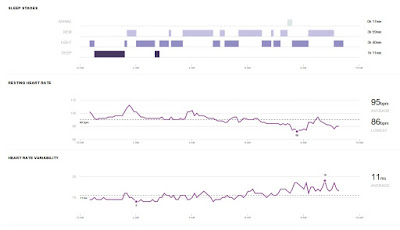
What A Night of Sleep Looks Like During MCS Reaction

I'm not keeping up with this blog, so long story short, I've been using an Oura Ring since August. I want to give some detailed attention to this at some point, but I can't right now. Way too exhausted. In short, it is a highly advanced sleep tracker that has generally received good ratings as far as accuracy goes, but I'll dig into that topic later. It's not like a Fit Bit or other trackers - it uses different technology and can read a lot more. 


I want to show you what a night after a chemical exposure looks like for me. I came home from work feeling angry, fidgety, uncomfortable, and wanting to beat something up and smash it to pieces. I'm not totally sure what I was reacting to - normally I know right away if something is causing me reactivity, then will get a the worst reaction later on (delayed.) The fact that I was off my pills for 1.5 weeks and had only taken bare minimum to get by at work in the past 4 days has meant more reactions and reacting to lower exposures. Regardless, I was definitely reacting and was very uncomfortable. I went to bed with a resting heart rate jumping constantly between 95-120 while just laying still in bed.

https://drive.google.com/file/d/1olRRgWgc-rXaF2KlDJ6Zi238W9sXiQ-zeA/view?usp=sharing

You will need to click the link below the photo to see it full size to be able to read it. Blogger has some serious formatting limitations and will not allow me to turn the image into a link unless I feel like coding it in HTML, but their HTML is one wall of text, not formatted so that I can easily find where to edit. I'm feeling way too lazy to deal with that.

First problem: 4 hours of REM sleep!? I've read that high REM can mean high stress levels on the body. More than 2 hours tends to be high, from what I've read. I'll link to the articles when I have the energy.

Second problem: Heart rate. Okay, my resting heart rate tends to be high anyway (and I'm getting officially tested for POTS soon, but a few medical practitioners have told me they've seen it when reading my pulse), but this is a bit absurd. During the first two weeks of my menstrual cycle my lowest heart rate of the night tends to be in the upper 60's to low 70's, with average in the 70's, sometimes low 80's. My lowest last night was 86 BPM. Average was 95 BPM. Highest was just below 110 (I wish it would give an exact number.) My body managed to lower my resting heart rate during sleep, but it still stayed too high. And I took pills that should calm my heart rate down - I did need herbs to fall asleep last night.

Third problem: My heart rate variability is super LOW. The higher the number, the better off you are. In my Oura Ring user group many people are reporting that they are generally in the 70's - 90's for average HRV. I have never been above 30 for as long as I've been recording, but 11!? My body was clearly very stressed.

The ring also showed me that my average respiration rate was 18.0, which is high, but I'm usually that high. And it told me that my body temp dropped half a degree Celsius last night, but my body temp is different every night. My temp is up and down and all over the place.


To compare, here's a couple more average nights when I wasn't feeling abnormally terrible:


https://drive.google.com/file/d/1H1-ljVIHp1_0d0Ay58z0qUjQkC8yI5LIcA/view?usp=sharing

https://drive.google.com/file/d/1KChhS7TcjuJ5GWrrGPXEU8rTp4xMiCgX4w/view?usp=sharing

Something to keep in mind with REM: it's not restful. It's called Rapid Eye Movement because the body is working to repair and reset during that time. The more you need, the more your body is trying to repair. That's how it was explained to me. So when I have these nights with high REM, even though I got 9 hours of sleep, it was not restful sleep. If I can at least get and hour of deep sleep I do okay, regardless of REM. So I'm exhausted. I couldn't bring myself out of bed until 11 am. I just wanted to lay there. But eventually I started to shiver and I realized I needed food really badly, so I forced myself up.

Beef Bacon is amazing, by the way. I'm sick of turkey bacon (had it too often), and I can't have pork. I actually hate pork, so I don't mind not being able to have it. But a local grass-fed (mostly) beef company makes beef bacon with just beef and sea salt. It's amazing. So incredibly delicious.