It's amazing how much I can roller coaster. For the last month I've been in the very low part of the coaster. I keep thinking I'm at the bottom and I'll start going up again soon, but in the last few days I did get lower. Oi! I'm working on my second cup of black tea this morning. I woke up at 5 am and then again at 9 am with a powerful headache on the top of my neck. It wasn't that I was struggling to keep my eyes open, it was that it was physically painful to be awake. Not grogginess, just very low energy and strain in my head and eyes. There was no going back to sleep though. I have been taking naps in the afternoon the last few days as well, and I normally (95% of the time) cannot nap during the day (or even fall asleep naturally at night). I have just been overcome with heavy weakness, brain thoughts coming to a grinding halt, and an exhaustion that lulls me to sleep. It's actually nice to feel real sleepiness - I forgot what it felt like.
45 minutes ago I wouldn't have had the strength to sit at my computer and type. I'm not feeling good yet, but I'm sitting cross-legged on my chair and reclining, which is just enough to help me manage. But you know what relieved my headache? Not caffeine this time. A shower that was as hot as I could tolerate. I sat down and let the near-scalding water hit my neck. I could feel a rush of blood to my head (but I was too tired to hear Coldplay sing in my head) and the headache lifted. Then I got out of the shower and it started to come back. Then I ate some meat and it started to go away. This feels like a low blood pressure and low blood sugar kind of day, but I've been way too tired to bother to check either. I did see a doctor a few days ago and my blood pressure was something like 90/65 - I had a narrow pulse pressure. And they had my talking a lot as they took the blood pressure, so I'm sure at rest it was lower. I also had to get labs drawn and the first nurse totally gave up on me. She couldn't find a vein, so she put a hot pack on my elbow. It didn't help, and my hands remained purple and ice cold. So she got another nurse to come in. That nurse had the same problem, but she decided to just push the needle in my elbow and move it around until blood came out. Ouch, yes, that hurt. She had to go deep too.
I'm starting to give myself a stomach ache with this tea... and energy is not affected at all. All I know is I have to be ready to go to work in 1 hour and 45 minutes. Not entirely sure if my body will cooperate. I can't stand up long without POTS kicking in and making me collapse to the floor. So here's to hoping compression socks, more salt and licorice herb, more food, more caffeine, and being forced to move a lot help.
Showing posts with label hypoglycemia. Show all posts
Showing posts with label hypoglycemia. Show all posts
Tuesday, February 4, 2020

Tuesday, December 26, 2017
December 2017 Doctor Vists and Tests Part 1
For a little over a year there has been this lingering question mark over my head asking if I have Postural Orthostatic Tachycardia Syndrome, or POTS for short, a form of Dysautonomia. I had a couple medical practitioners say that they suspected POTS. POTS is defined as your pulse going up at least 30 bpm when you stand up then sustaining a high pulse for a little while (but the length of sustaining is what confuses me.)
I got myself a pulse oxygen meter that clips onto my finger in order to see what happens to my pulse when I stand up. About half of the time my pulse does shoot up at least 30 bpm, often way more than that. Sometimes it stays that high for a minute or two, but normally what happens is my pulse shoots up, then goes down, then goes up again, then goes down again, then goes up again... it's a roller coaster. I took some videos of this happening and sent them to a Neurologist in New Hampshire who is an expert in Dysautonomia that my primary doctor referred me to. He took me on as a patient, which was a huge relief to me since he's very difficult to get into.
Why not see someone locally in North Dakota? Because POTS isn't well understood, and it takes a doctor with training in dysautonomia to be able to diagnose it. There isn't anyone in ND except for one pediatric doctor that diagnoses, and I'm not a child. There doesn't even appear to be a Tilt Table in ND. If I went through the local hospital for a referral they would have sent me to Mayo in Rochester, MN. It's an 8 hour drive from here, and very expensive. Too expensive compared to flying somewhere to see a highly rated dysautonomia specialist.
On the trip to NH I also scheduled a Tilt Table Test, a Echocardiogram, Lyme Disease testing, a visit with the Neurologist, and a visit with my primary doctor (my Naturopathic doctor.) It was a very full trip. In preparation for the visits I had to be off all my supplements for a few weeks prior. I posted a bit about that experience, but in short, I didn't do quite as badly as I expected without the supplements, but I did get worse. High adrenaline and crashing during the day, high adrenaline and interrupted poor sleep at night. My digestion became poor and my joints and muscles ached. I ended up gaining between 10-15 lbs (lots of fluctuation day-to-day.) My mood deteriorated rapidly, and my periods became irregular. My stress level was through the roof and I couldn't control it, even while relaxing.
On the first day of the trip I went to Elliot Cardiology in Manchester, NH. I started with the Tilt Table Test. I had to fast at least 4 hours before the test to make sure I didn't vomit during the test and end up choking on it. As someone who has to eat every 2 hours to stay strong enough to function, that was hard, and then the test took about an hour. After the test my blood sugar was 72, which was barely above hypoglycemic, so I was actually impressed with my body that it didn't get hypoglycemic after all that, but I was very shaky.
The test was... not really what I was expecting. I was strapped down to the bed. It took 3 nurses to find a vein in my arm to put an IV into - the IV was to raise my blood volume back up with saline in case my blood pressure dropped too low. They almost gave up on using my arms for the IV, but the last nurse they called in wasn't afraid to dig a little deeper and she managed to get the needle into my vein. They hooked me up to an EKG machine, and took my blood pressure. I was expecting that they would let me lay calmly for a while to get my body down to baseline, but next thing I knew, I was being tilted upright on the bed. I definitely was feeling nervous and high strung, definitely not at my baseline before they tilted me. I started to get upset because I didn't feel like they were doing the test right, but the tilting made me feel so weak that all I could do was focus on surviving the tilt. In that moment I understood why POTS patients say the TTT can be really painful and difficult to endure. During the tilt I felt this deep pressure moving downward in my body, my vision narrowed towards black, and I started crying. Tons of tears just poured out and they had to give me tissues. It was horrible - but a feeling I was familiar with. I've felt like that before when standing up too quickly, but this was the most extreme. I'm not a fainter, my body always fights the feelings like I'm about to faint. If I was a fainter, that's when I would have fainted and I would have passed that test criteria. I couldn't communicate well, Thoughts were not working well, so when the nurses asked how I was doing, I just got out the words "weak, I can't stop crying." But then I was standing there strapped to this bed at an 80º tilt. Within about 5 minutes I felt better. My body was recovering. I didn't understand what to do - I felt well supported by this bed, so my body wasn't working to stay upright. I had no idea if I was supposed to relax all my muscles and stop supporting myself or if I was to stay there, legs locked upright. I had waves of hot flashes, waves of weakness, but never fainted. One nurse told me, "You're not quite normal," and I never had a chance to ask her what the meant. After the test she had to run before I could question her.
After 30 minutes they laid me back down flat. This is the part that's as bad as the tilt itself. I was able to stand up, but was very weak and shaky. I was trembling. I talked to the nurses for about 30 seconds, then I tried to take a step. I couldn't. My leg muscles gave out and I had to fall back down on the bed. I was crying hard again, shaking almost violently, freezing cold, and felt so weak. The nurses argued a bit about if it was an anxiety attack, hypoglycemia, or adrenal issues. The one nurse was sure it was adrenal, but they're not allowed to diagnose. That's when they took my blood sugar and found I was borderline hypoglycemic. On this note, I was disappointed that they did not do the version of the TTT in which they infused adrenaline through an IV if I didn't faint, and then do blood labs to see how my adrenals react to the IV. This part of the test often makes people faint, and then they know the syncope is from adrenal issues. I know I have adrenal issues, so I wanted that part of the test done and didn't get it.
I couldn't walk on my own, so they put me in a wheelchair and delivered me to the echocardiogram room. I needed the echo to check on the status of my Pulmonary Stenosis, which I've had since birth and it never went away. It's still there. That's about all I learned from the test. I'm thinking of sending all my past echos to a cardiologist there and having them do some comparisons.
That was the end of the first day of testing. I was weak and low energy the rest of the day.
The next day I saw my Neurologist at Dartmouth-Hitchcock Medical Center. But let me back up a bit: I almost didn't a couple of times. I got a phone call from his office the day before our flight out there saying that he wanted to cancel my appointment because the Autonomic Nervous System testing equipment broke and he couldn't test me. I had to beg to keep the appointment, even just a consult, and they agreed because I was traveling. The day of, I had two major strikes against me going: I started my period that day (I have to roll my eyes at my body choosing the worst times), and the weather was horrific. 3 inches of snow in a few hours time, icy roads, and near whiteout conditions. An hour and 20 min drive took us 2 hours, and I ended up getting there 10 minutes late. 5 more minutes and he wouldn't have seen me. Or so the receptionist said, but the doctor was forgiving and spent a good amount of time with me. I didn't have time to go to the bathroom before seeing him, so I was cramping badly and was uncomfortable. My blood pressure was 120 something over 63 and my pulse was over 100, if I remember correctly, which showed just how stressed out I was about my bathroom needs, getting to see this doctor finally, and being so rushed in bad weather to get there.
He sat me down and let me talk - he had me tell him my history and all my symptoms. He gave me a good amount of time and really listened, which blew my mind. He was amazing. He took me seriously, didn't try brushing off anything I said. He even knew about the damage vitamin b6 toxicity can do and understood what I went through with my nerve pain. He had me to do some nerve conduction testing, which turned out normal. He also showed me the results of the TTT:

I went up over 30 bpm, the criteria for POTS. But it doesn't say if it was sustained. It could also be POTS symptoms caused by something else. So he needs more information.We decided that since he wasn't able to do the autonomic nervous system testing that he would have me wear a heart monitor for 14 days - a Zio XT Patch...

...Which meant not being able to go back on my supplements. My doctor and I agreed that we need to measure my heart without the medical aids to show how I am without support. Today marked 14 days, so I ripped the monitor off and took a hot shower and my supplements. The patch was itchy the whole time and it left me this pretty rash:

I'll tell the rest of the story in Part 2, as I have to go to work now. :)
Thursday, July 20, 2017
Don't Tell Me, "Just Exercise!"
I get pretty upset when people tell me, "Just exercise more! Exercise cures everything!" It shows they have no understanding of my illness. It also shows that they don't notice how much exercise I do get and how proud I am about it. I lift weights at home, use my Pilates ring, go on 1-2 mile walks a couple times a week, and work at a job in which I'm on my feet the whole time. I also do 50-100 jumping jacks at a time when I have adrenaline rushes to burn off, and that's almost daily. To you this might sound like a joke, but to me it's more than I was able to do a couple of years ago and I'm very proud of my progress.
On a day like today I can't simply just get up and exercise to fix my symptoms. My head feels like a hot air balloon, like it might float away. It's making me dizzy, and when I get up the POTS symptoms kick in. I instantly get clammy with sweat, my heart rate skyrockets, my heart palpitates, I see colors spinning all around me and my vision blurs, and my muscles loose strength. It's as though I'm on the verge of fainting, but I don't faint easily. PMS made me faint once, but I'm not PMSing right now. I must let myself sit down or drop to the floor until my heart calms down and my vision returns. Then when I stand back up again I have to do it very slowly, and I might start feeling the symptoms again if I start walking too soon. As long as I'm still I feel okay, but I can't stay still for too long without my blood pressure getting too low and I crash.
I'm not feeling like this every day. I don't feel the POTS symptoms every day. Other days I can just have fatigue so strong that even walking around the house makes the fatigue worse. On days like that I have to do nothing. My body is begging for time to rest and repair, and if I dare try to exert myself it's going to give me the equivalent of the Blue Screen of Death (the worst error message your computer can give you.) On days like this I don't necessary get dizzy with high heart rate when getting up. I just have to force my muscles to move, because they really really don't want to. It's more than just willpower to move my legs, it's necessity. If I don't walk to the kitchen I won't eat. If I don't eat I'll get hypoglycemic again. If I get hypoglycemic I might be so far gone that I'll go into a coma. Of course I get terribly anxiety on these days, so I can't just lay in bed resting. I have to somehow shut off my brain with homeopathic pellets and pills. They can leave my brain too numb to enjoy anything, but not let me just fall asleep.
Some days I think I'm having a good enough day and I do go out for that long walk, only to come home and measure my blood sugar in the 60's or so. I get symptomatic when my blood sugar falls below 85 - and before you argue that's a healthy number, you need to understand that my body can't handle being below 85 even if your body feels best at that number. When I'm at about 85 I start to feel the tremors and shakes, the low dull headache, the mild tunnel vision, and the deep cold start to settle into my body. We all have different bodies with different needs.
I'm not getting low blood sugar quite as easily these days, but my diet is so careful and I still take my chromium with pancreas glandular. I'm also having fewer days with the severe chronic fatigue that forces me to do nothing all day. I'm recovering faster from over excretion, and I'm finding that I have more days where going for that long walk doesn't make me crash. I never come home from that long walk feeling better than before I went, it does take a lot of energy for me, but I'm finding I crash less often after my walks. That said, what if I over exercise to try to improve my health and end up going backwards by overspending myself? I don't want to lose any progress I've made with my health. I need to be careful with how I spend my energy.
...But I am having more and more days when I go to work not feeling rested enough to handle the shift without some sort of boost. I used to only add matcha to my water bottle on days when I really needed the caffeine, but it's turned into needing that matcha every shift, 4 days a week. I haven't had a shift in a few months in which I've felt able to work without the caffeine. So I can feel myself sliding backwards from over extending myself. Ideally, I'd take a few weeks off of work to let my body fully rest, but financially I cannot afford to do that. It also wouldn't be fair to my co-workers. And that job is physical. It is exercise for me. Being on my feet for 4 hours, walking around the store all day, lifting heavy boxes, going up and down from bottom shelf to top shelf... I feel my best in jobs like this. My blood needs to keep moving to feel well. I'd do so much worse at a desk job. But it's very draining. I do so little at home because I save up all my energy and strength for being at work.
I'm getting so sick of hearing, "Just exercise!" If you're able to say that to me, you clearly have never experienced this level of fatigue. Don't argue with me. Arguing makes me angry and drains me way too quickly. Anger doesn't settle down for hours in my body. My body can't processes strong emotions well. My adrenals can't keep up with the energy strong emotions take. All I'm asking is that if you want to give me a suggestion then please don't give it to me as a demand. Don't tell me what to do. Respect my needs. I'm very open to suggestions when they're given to me in a gentle non-judgmental manor after I've been listened to. But don't come on strong barking orders at me when you haven't listened to what I'm going through. I'm likely to shut you out of my life and ignore you as a defense.
On a day like today I can't simply just get up and exercise to fix my symptoms. My head feels like a hot air balloon, like it might float away. It's making me dizzy, and when I get up the POTS symptoms kick in. I instantly get clammy with sweat, my heart rate skyrockets, my heart palpitates, I see colors spinning all around me and my vision blurs, and my muscles loose strength. It's as though I'm on the verge of fainting, but I don't faint easily. PMS made me faint once, but I'm not PMSing right now. I must let myself sit down or drop to the floor until my heart calms down and my vision returns. Then when I stand back up again I have to do it very slowly, and I might start feeling the symptoms again if I start walking too soon. As long as I'm still I feel okay, but I can't stay still for too long without my blood pressure getting too low and I crash.
I'm not feeling like this every day. I don't feel the POTS symptoms every day. Other days I can just have fatigue so strong that even walking around the house makes the fatigue worse. On days like that I have to do nothing. My body is begging for time to rest and repair, and if I dare try to exert myself it's going to give me the equivalent of the Blue Screen of Death (the worst error message your computer can give you.) On days like this I don't necessary get dizzy with high heart rate when getting up. I just have to force my muscles to move, because they really really don't want to. It's more than just willpower to move my legs, it's necessity. If I don't walk to the kitchen I won't eat. If I don't eat I'll get hypoglycemic again. If I get hypoglycemic I might be so far gone that I'll go into a coma. Of course I get terribly anxiety on these days, so I can't just lay in bed resting. I have to somehow shut off my brain with homeopathic pellets and pills. They can leave my brain too numb to enjoy anything, but not let me just fall asleep.
Some days I think I'm having a good enough day and I do go out for that long walk, only to come home and measure my blood sugar in the 60's or so. I get symptomatic when my blood sugar falls below 85 - and before you argue that's a healthy number, you need to understand that my body can't handle being below 85 even if your body feels best at that number. When I'm at about 85 I start to feel the tremors and shakes, the low dull headache, the mild tunnel vision, and the deep cold start to settle into my body. We all have different bodies with different needs.
I'm not getting low blood sugar quite as easily these days, but my diet is so careful and I still take my chromium with pancreas glandular. I'm also having fewer days with the severe chronic fatigue that forces me to do nothing all day. I'm recovering faster from over excretion, and I'm finding that I have more days where going for that long walk doesn't make me crash. I never come home from that long walk feeling better than before I went, it does take a lot of energy for me, but I'm finding I crash less often after my walks. That said, what if I over exercise to try to improve my health and end up going backwards by overspending myself? I don't want to lose any progress I've made with my health. I need to be careful with how I spend my energy.
...But I am having more and more days when I go to work not feeling rested enough to handle the shift without some sort of boost. I used to only add matcha to my water bottle on days when I really needed the caffeine, but it's turned into needing that matcha every shift, 4 days a week. I haven't had a shift in a few months in which I've felt able to work without the caffeine. So I can feel myself sliding backwards from over extending myself. Ideally, I'd take a few weeks off of work to let my body fully rest, but financially I cannot afford to do that. It also wouldn't be fair to my co-workers. And that job is physical. It is exercise for me. Being on my feet for 4 hours, walking around the store all day, lifting heavy boxes, going up and down from bottom shelf to top shelf... I feel my best in jobs like this. My blood needs to keep moving to feel well. I'd do so much worse at a desk job. But it's very draining. I do so little at home because I save up all my energy and strength for being at work.
I'm getting so sick of hearing, "Just exercise!" If you're able to say that to me, you clearly have never experienced this level of fatigue. Don't argue with me. Arguing makes me angry and drains me way too quickly. Anger doesn't settle down for hours in my body. My body can't processes strong emotions well. My adrenals can't keep up with the energy strong emotions take. All I'm asking is that if you want to give me a suggestion then please don't give it to me as a demand. Don't tell me what to do. Respect my needs. I'm very open to suggestions when they're given to me in a gentle non-judgmental manor after I've been listened to. But don't come on strong barking orders at me when you haven't listened to what I'm going through. I'm likely to shut you out of my life and ignore you as a defense.
Saturday, March 18, 2017
Adrenal Fatigue Test Results
My adrenals are so bad. I knew it, but I didn't have specifics. I really needed an official adrenal test done, so I bought a Diagnostechs 4 point cortisol and DHEA test when it was on sale for $120.

I'm very low, very low, low, slightly high. According to Stop The Thyroid Madness, cortisol should be at the top of the range in the morning, upper part of the range at noon, middle of range in the afternoon, and at the absolute bottom at night.
The problem with this test is that I turned out to be abnormally exhausted - I actually fell asleep that night without herbs. That's normally impossible for me. I know that my cortisol is usually too high at night between what my doctor has told me and how I feel, but here it's only slightly high.

No, I refuse to take DHEA supplements. They might make me feel good while on them, but they will ruin my body's ability to make its own DHEA. It will mess me up in the long term. It also can convert into extra estrogen, which I do not want. Not worth it!
Stop the Thyroid Madness has a great page explaining the stages of adrenal fatigue. According to this I'm probably in about stage 5, despite my DHEA being so low. I have A LOT of healing left to do, but I'm better than I was 3 years ago. I was bedridden then!
The hardest part about taking this test was trying to recover from 3 days without supplements. It took me about 3 weeks to stabilize again. I was miserable, dropping everything, fighting insomnia, not able to form energy during the day, getting rashes and stomach aches, fighting brain fog... it was not easy. Acupuncture helped the most to calm me back down.
Life has also been really stressful! One of coritsol's jobs is to eat up adrenaline so that adrenaline doesn't do damage. I don't have enough cortisol, so I create adrenaline too easily and can't control it. This is why I have very little tolerance for stress: stress causes adrenaline that I can't control, and the adrenaline physically hurts. This week I had to work every day of the week (co-worker had the flu, so I was covering) when I normally only work 3-4 days a week, my husband needed to prepare for a business trip that required some complicated planning, and I had to file taxes. I had really bad insomnia the night before last, which left me very fried. I say "fried" because I seriously felt like I had electricity flowing through me. Totally frazzled! Last night I did sleep, but woke up at 5 am with the feeling of electric currents flowing through me again. The only way for me to sleep well again is to have a few days without any stress so my body can stabilize.
Adrenal fatigue is no joke! I have to manage it very carefully every day. I have to take extra adrenal supplements during stressful times, so I must be very in-tune with my body.
When I am very adrenal, normally mornings, I feel very tired with jello-like muscles, wired and on high alert, shaky so I drop things all the time, very clumsy, low blood pressure with high heart rate, hypoglycemic if I haven't taken care of myself to avoid low blood sugar, unable to take a deep satisfying breath, paranoid and anxious, irritated and extremely focused on one thing or unable to focus on anything, angry, and unable to escape danger. This list fits me really well:

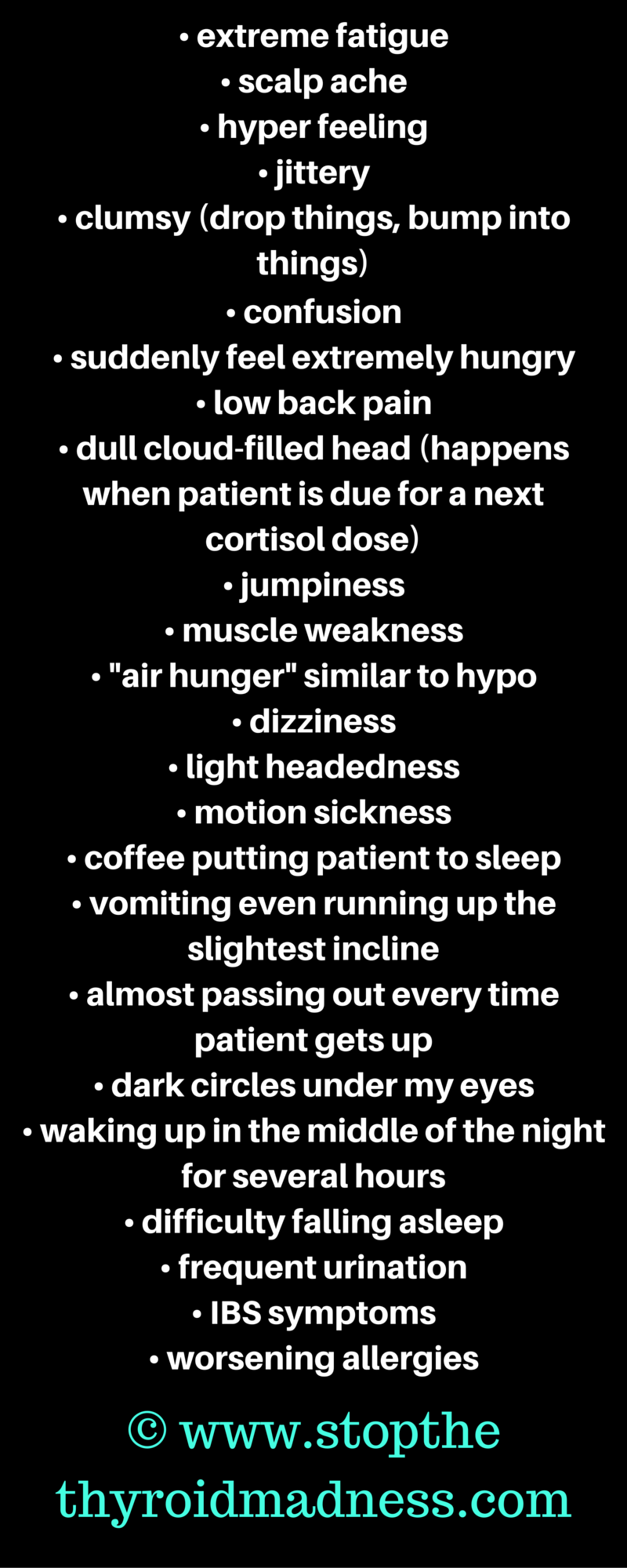
As you can see, this isn't easy. It's very difficult to manage adrenal fatigue, and it's stressful to keep up with what I need to do to manage it.
What do I do to treat? Well what I have been doing has obviously been working since I've improved in the last 3 years, but it's working very slowly. I'm also worried I'm regressing. I would like to improve my protocol, but I'm not sure what is right for me. I simply just need to see my doctor in person. What I am doing is taking adrenal cortex (which adds coritisol to the body), high dose of vitamin b5, a few herbs like cordyceps, and licorice root (I have low blood pressure so I'm able to take licorice root.) I also have to avoid stress and caffeine like they're poison. I didn't work for a year and a half, and that's when I did my best healing. Since working for the last 2 years (even at 12-15 hours a week) I've stopped making progress, and I've had to drink some caffeine to make it through shifts. I also have to address my high night cortisol by taking tons of relaxing herbs to literally overpower my adrenals (I take about 12-15 pills a night.)
A support group with nurses and "experts" told me my cortisol is so low I should go on hydrocortisone, which would mean adding actual cortisol to my body. I know this works well for many patients, but it's not without risk. It also has to be prescribed, and I don't have insurance. They said if I continue to treat with adrenal cortex I'll need to raise my dose substantially - they said I'm not taking nearly enough to make a difference. That will get expensive. I don't know if they're right or not, but I do know that I need to change something so I can make progress while working. Quitting my job is not an option (unless someone would like to pay me to stay at home, but even then I'm good friends with my co-workers and enjoy the social aspect, which is important.)
I'm stressing myself out just writing this post! It's too much to deal with.
So I know there's a few posts that I've promised to write. Please be patient with me. I'm having a rough time. I expect that once spring arrives and I can go for walks outside again that I'll start to feel better. This has been a really rough stressful winter (36" of snow within two consecutive weekends!)
And, if you get time, please read this post written by a doctor with chronic illness: https://themighty.com/2017/02/doctor-with-chronic-illness-things-to-know/
Saturday, February 4, 2017
Results of New Supplements and Going Off All Supplements
I've had a rough month. Winter is never easy for me, but I chose to do some experimenting despite winter. I want to record some of what I've learned here.
1. Lithium Orotate
My doctor suggested I try this based on my gene data (23andMe.com). Lithium Carbonate has been traditionally used to treat bipolar disorder, but I've been taking Lithium Orotate. The difference is that carbonate isn't stable and a person has to take over 1,000 mg of it at a time to absorb enough to make a difference. Orotate, on the other hand, is highly absorbable and can be taken in small doses. I'm taking 5 mg a day.
For the first couple of weeks it made me feel a bit high - giddy, could laugh really easily, smiled for no reason at all, and had pleasant dreams. That effect wore off and I went back to "normal," except that I've noticed I haven't had nearly as many dark, depressing, lethargic, and apathetic thoughts. I originally started on inositol powder to help with my mood and energy. It did make a mild positive difference, but the lithium has done more.
I have also had regular large, deep, painful cystic acne since starting the lithium. I thought it was from taking the liver glandular, thinking it was detoxing me through my skin, but the problem has continued. I then learned from someone else that lithium gave them the same kind of acne. I'm now trying to decide if the better mood from lithium is worth this painful large acne.
2. Selenium
My doctor also suggested I try selenium for the same reason as trying lithium. Low selenium contributes to thyroid disorders, and my thyroid is disordered. I started and stopped the selenium twice. The first time I tried it turned me into a total zombie: very lightheaded and weak, dizzy, and unable to focus. I developed these symptoms immediately. A few weeks later I tried it again. It took 2 weeks before I developed the same symptoms. It gave me vertigo so strong that at times I couldn't walk in a straight line. So I stopped taking it. I didn't notice any other effect or benefit.
They say that the soil here in North Dakota is rich in selenium. I eat mostly locally grown organic foods, so I'm hoping this simply means that I'm getting enough regularly through my diet.
3. 4-point Saliva Cortisol Test/ Going off all supplements for 2 1/2 days.
I am very likely going to write a post on the results and preparation process when I get them. This is about the results of quitting all supplements for 2 1/2 days in order to do the test. I joined an adrenal fatigue support group on facebook based on the book Stop The Thyroid Madness. They say that it's very important to be off all supplements for 2 full weeks before doing the cortisol test, because you have to get all adaptions and other things that affect cortisol levels totally out of your body to see how your body does without support. I couldn't handle being off my supplements for 2 1/2 days, so I went ahead and did the test. I understand that some people think this will ruin the test results, but I honestly do not think it is safe for me to be off supplements any longer.
What happened?
- My blood sugar plummeted. With supplements it stays between 95-115 most of the time. Off supplements (I measured about once an hour for 2 days) I was staying between 72-98, most of the time I was in the 80's. I start to get symptomatic of hypoglycemia when I'm below 90, but below 80 I can't function. I was hypoglycemic a lot in the last 2 1/2 days. I did not change my diet of eating protein every 2 hours. (Keeping in mind that the adrenal glands do heavily affect blood sugar, and I stopped supporting my adrenals.) This morning (now that I can go back on my supplements) I did a test. My blood sugar was 84 when I got up, then after a protein shake including licorice (which affects the adrenals) it shot up to 124!!! That's a huge difference very quickly! I'm looking forward to going back on my pancreas glandular with chromium, which really helps keep my blood sugar stable.
- Heavy menstrual bleeding just 2 weeks into my cycle. My diva cup was full, and it was very dark and clotted.
- Blood pressure got wonky. I didn't see it ever dip below 95/58, which isn't much lower than I occasionally get even when on my supplements, but my pulse pressure narrowed by about 10 points on average. Pulse pressure is the distance between systolic and diastolic, and a healthy pulse pressure is about 40. My pulse pressure was often 25-30, but I had one reading of it at 55. This isn't stable for me. I'm generally around 30-40 when on supplements, even if my overall blood pressure is on the low end.
- Disturbed sleep. I couldn't take any sleeping aids for 2 nights, which was torture. Both nights it took hours of just laying there to fall asleep, even though I was exhausted from work. Once I got to sleep I found myself waking up every couple of hours. Small sounds in the house would also wake me up. I wouldn't feel rested during the day. Last night, after finishing the coritosl test, I took my sleep pills. They normally take about hour to kick in, but they made my whole body tingle and shut down within about 10 minutes. I felt like I was fighting sleep, but after shutting the light off and trying to sleep I couldn't fall asleep for probably an hour. Once I did fall asleep I stayed asleep, thankfully.
- Couldn't find joy in doing anything, even things I liked. The first day wasn't so bad, but the second day (yesterday) was awful. Everything felt like work, most things annoyed me, and nothing was enjoyable to do. I was apathetic, but worse than that, I felt emotionally muted.
- Poor memory. I found it hard to recall information, remember how and when something happened, and found it hard to retain the instructions I was reading over and over. After only 2 1/2 days without supplements! This shows how sensitive my body is.
- Poor vision and balance. A big part of this was being hypoglycemic, but even when my blood sugar was in the 90's I would have sensations of the floor moving below me, me swaying when I was not, and objects in the distance vibrating when they were not.
- Joint aches, but surprisingly no fibromyalgia. I was feeling very inflammed.
- Digestion plugged up. I gained about 5 pounds in bloat in the last 2 days, and my IBS is acting up. I did actually take my digestive enzymes to help, but they didn't help much. I was having regular bowel movements, but staying bloated and food wouldn't move through me well.
- Intense fatigue, but not constantly. I was able to work for the first 1/2 day and the second full day without supplements, but I was dragging and "flight mode" was kicking in a lot when I was encountering minor problems. At times it took willpower to lift my legs to walk. Yesterday I had trouble getting up and moving at times, but had weird spurts of jittery energy in which I was able to run up and downstairs to do laundry.
What did I learn from all this? That my supplements really are doing me good! I was able to write this post because I'm finally able to drink a cup of green tea, which tastes like heaven right now. My adrenal glands still have A LOT of healing to do, even after 3 years of trying to repair them. I don't need the test results to feel this, but I'm very curious about how my results will look.
1. Lithium Orotate
My doctor suggested I try this based on my gene data (23andMe.com). Lithium Carbonate has been traditionally used to treat bipolar disorder, but I've been taking Lithium Orotate. The difference is that carbonate isn't stable and a person has to take over 1,000 mg of it at a time to absorb enough to make a difference. Orotate, on the other hand, is highly absorbable and can be taken in small doses. I'm taking 5 mg a day.
For the first couple of weeks it made me feel a bit high - giddy, could laugh really easily, smiled for no reason at all, and had pleasant dreams. That effect wore off and I went back to "normal," except that I've noticed I haven't had nearly as many dark, depressing, lethargic, and apathetic thoughts. I originally started on inositol powder to help with my mood and energy. It did make a mild positive difference, but the lithium has done more.
I have also had regular large, deep, painful cystic acne since starting the lithium. I thought it was from taking the liver glandular, thinking it was detoxing me through my skin, but the problem has continued. I then learned from someone else that lithium gave them the same kind of acne. I'm now trying to decide if the better mood from lithium is worth this painful large acne.
2. Selenium
My doctor also suggested I try selenium for the same reason as trying lithium. Low selenium contributes to thyroid disorders, and my thyroid is disordered. I started and stopped the selenium twice. The first time I tried it turned me into a total zombie: very lightheaded and weak, dizzy, and unable to focus. I developed these symptoms immediately. A few weeks later I tried it again. It took 2 weeks before I developed the same symptoms. It gave me vertigo so strong that at times I couldn't walk in a straight line. So I stopped taking it. I didn't notice any other effect or benefit.
They say that the soil here in North Dakota is rich in selenium. I eat mostly locally grown organic foods, so I'm hoping this simply means that I'm getting enough regularly through my diet.
3. 4-point Saliva Cortisol Test/ Going off all supplements for 2 1/2 days.
I am very likely going to write a post on the results and preparation process when I get them. This is about the results of quitting all supplements for 2 1/2 days in order to do the test. I joined an adrenal fatigue support group on facebook based on the book Stop The Thyroid Madness. They say that it's very important to be off all supplements for 2 full weeks before doing the cortisol test, because you have to get all adaptions and other things that affect cortisol levels totally out of your body to see how your body does without support. I couldn't handle being off my supplements for 2 1/2 days, so I went ahead and did the test. I understand that some people think this will ruin the test results, but I honestly do not think it is safe for me to be off supplements any longer.
What happened?
- My blood sugar plummeted. With supplements it stays between 95-115 most of the time. Off supplements (I measured about once an hour for 2 days) I was staying between 72-98, most of the time I was in the 80's. I start to get symptomatic of hypoglycemia when I'm below 90, but below 80 I can't function. I was hypoglycemic a lot in the last 2 1/2 days. I did not change my diet of eating protein every 2 hours. (Keeping in mind that the adrenal glands do heavily affect blood sugar, and I stopped supporting my adrenals.) This morning (now that I can go back on my supplements) I did a test. My blood sugar was 84 when I got up, then after a protein shake including licorice (which affects the adrenals) it shot up to 124!!! That's a huge difference very quickly! I'm looking forward to going back on my pancreas glandular with chromium, which really helps keep my blood sugar stable.
- Heavy menstrual bleeding just 2 weeks into my cycle. My diva cup was full, and it was very dark and clotted.
- Blood pressure got wonky. I didn't see it ever dip below 95/58, which isn't much lower than I occasionally get even when on my supplements, but my pulse pressure narrowed by about 10 points on average. Pulse pressure is the distance between systolic and diastolic, and a healthy pulse pressure is about 40. My pulse pressure was often 25-30, but I had one reading of it at 55. This isn't stable for me. I'm generally around 30-40 when on supplements, even if my overall blood pressure is on the low end.
- Disturbed sleep. I couldn't take any sleeping aids for 2 nights, which was torture. Both nights it took hours of just laying there to fall asleep, even though I was exhausted from work. Once I got to sleep I found myself waking up every couple of hours. Small sounds in the house would also wake me up. I wouldn't feel rested during the day. Last night, after finishing the coritosl test, I took my sleep pills. They normally take about hour to kick in, but they made my whole body tingle and shut down within about 10 minutes. I felt like I was fighting sleep, but after shutting the light off and trying to sleep I couldn't fall asleep for probably an hour. Once I did fall asleep I stayed asleep, thankfully.
- Couldn't find joy in doing anything, even things I liked. The first day wasn't so bad, but the second day (yesterday) was awful. Everything felt like work, most things annoyed me, and nothing was enjoyable to do. I was apathetic, but worse than that, I felt emotionally muted.
- Poor memory. I found it hard to recall information, remember how and when something happened, and found it hard to retain the instructions I was reading over and over. After only 2 1/2 days without supplements! This shows how sensitive my body is.
- Poor vision and balance. A big part of this was being hypoglycemic, but even when my blood sugar was in the 90's I would have sensations of the floor moving below me, me swaying when I was not, and objects in the distance vibrating when they were not.
- Joint aches, but surprisingly no fibromyalgia. I was feeling very inflammed.
- Digestion plugged up. I gained about 5 pounds in bloat in the last 2 days, and my IBS is acting up. I did actually take my digestive enzymes to help, but they didn't help much. I was having regular bowel movements, but staying bloated and food wouldn't move through me well.
- Intense fatigue, but not constantly. I was able to work for the first 1/2 day and the second full day without supplements, but I was dragging and "flight mode" was kicking in a lot when I was encountering minor problems. At times it took willpower to lift my legs to walk. Yesterday I had trouble getting up and moving at times, but had weird spurts of jittery energy in which I was able to run up and downstairs to do laundry.
What did I learn from all this? That my supplements really are doing me good! I was able to write this post because I'm finally able to drink a cup of green tea, which tastes like heaven right now. My adrenal glands still have A LOT of healing to do, even after 3 years of trying to repair them. I don't need the test results to feel this, but I'm very curious about how my results will look.
Monday, August 22, 2016
New Blood Sugar Meter
Do you know that feeling where your body is feeling stimulated and it wants to move, but you're feeling very spacey and internally fatigued to the point where it's hard to focus your vision on anything? Yeah, me too. I thought this was due to low blood sugar (because I can get hypoglycemic easily if I don't eat correctly,) but as it turns out, it's not. It makes sense, because when I'm actually low in blood sugar I have a whole host of other symptoms. My blood sugar can be over 120 and I still feel this way. I think it's my thyroid and adrenals actually causing this problem. That's another issue.
I finally bought a blood sugar monitor for home use. What I'm learning is that I start to get spacey, brain fogged, and extra fatigued when I'm below 95, either before or after eating a meal, but I can still use my body and function. I've tested around 80 when I've gone too long without food (meaning more than 2 hours), and I did feel drained and light headed during those times, to the point where it's hard to move if I want to. Most interestingly of all is the fact that I'm testing relatively highest first thing in the morning. My morning blood sugar has almost always been above 115, once it was 127! Mornings are the messiest time of day for me. I typically wake up feeling groggy, then once I'm fully awake I typically feel loaded with adrenaline. I'm guessing my cortisol is high, but I really need to get a 24 hour cortisol test done to confirm that. What I do know is that my blood sugar is highest during those times. An hour or so after breakfast is when my blood sugar drops. It's not a struggle to keep it above 100 through the day IF I eat meat every 2 hours. When I don't eat meat this often I tend to stay in the lower 90's, even if I eat every 2 hours. My doctor is right, again. (He's the one having me eat protein every 2 hours.)
The other interesting issue I have is that I have a very difficult time getting enough blood for the reading when my blood sugar is low. I can hold my hands under hot water, jump up and down, shake my arms, and rub my arms down into my hands. It's very difficult to get enough blood after lancing myself. When my blood sugar is above 100, it's not even half as difficult to get a good amount of blood.
Which meter did I buy? The best looking one on the shelf - I didn't really research it ahead of time. Let me tell you a quick story first:
I went out and finally bought the monitor based on a really scary situation I had a couple of weeks ago. I was PMSing like something terrible. My sugar craving was out of control. I ended up eating an entire bag of organic dried apple and bananas with cinnamon. In one sitting. It was about 50 mg of sugar in that bag. I haven't done anything like that in the last 3 years on this diet! I've splurged on 85% dark chocolate bars, but I think the caffeine affected me more than the sugar. This was the first time I've had this kind of binge on a high sugar food. I felt jittery and stimulated for about an hour and even had a headache some of that time. Then I sat down with my husband and started laughing about something with him. Mid laughing I crashed. HARD. All the energy drained from me, my right arm went completely numb and I couldn't move it, my heart started palpating down into my stomach, I couldn't see straight or focus on anything, and I started crying uncontrollably while struggling to take breaths. My husband thought I was having a stroke, and he told me I got very pale white. My husband gave me some apple juice. It did help. It took about 5 minutes to start improving, about 30 minutes to feel recovered enough to eat lots of jerky. My biggest problem is that eating sugar makes my blood sugar drop too much, and this case I ate wwwaaaayyyy too much sugar. This was definitely a hypoglycemic/ adrenal crash.
This scared me so much that I went to CVS the next chance I had to buy a glucose meter. After talking to the pharmacist and reading all the boxes, I decided on the CVS Advanced Glucose Meter. The reason is because the test strips are affordable. $12 for 50 and I can buy them without insurance. The pharmacist convinced me it's accurate enough and is easiest to use. I've never used a meter before, so I have nothing to compare it to outside of labs at the hospital.
What I like about this one:
-The fact that it tells me my blood sugar level at home.
-Easy to use, very intuitive
-Large memory bank for my readings
What I don't like about this one:
-I tend to go through about 5 strips before it gives me a reading and not an error message. Part of the problem is that I have a hard time getting enough blood to squeeze out of my fingers, and this meter doesn't need much blood. The main problem is that this machine is very finicky. I read some reviews on the machine and tons of people said that it's accurate enough and the strips are cheap, but they too gets lots of error messages. It's so much fun having to lance myself 3-5 times just to get one reading. Sigh.
-It doesn't come with the specific USB cable needed to upload my results to my computer. Not just any USB cable will work. I had to call CVS customer service, sit on hold for 20 minutes, and request they send me a free cable in the mail. No, you can't just go to CVS and get a cable. No, it doesn't come with the cable. You must call them and ask them to send it to you for free. I'm rolling my eyes about this.
-I question the results a little bit. I don't have confidence in its accuracy. The few times I've retested myself immediately after the first test I got a different reading, usually within 5 points of the first reading. That's not a big deal. Once I had a reading of 122, then when I retested I was 111. That big of a difference bothers me.
Anyway, I want to go take a nice hot bath now. :)
I finally bought a blood sugar monitor for home use. What I'm learning is that I start to get spacey, brain fogged, and extra fatigued when I'm below 95, either before or after eating a meal, but I can still use my body and function. I've tested around 80 when I've gone too long without food (meaning more than 2 hours), and I did feel drained and light headed during those times, to the point where it's hard to move if I want to. Most interestingly of all is the fact that I'm testing relatively highest first thing in the morning. My morning blood sugar has almost always been above 115, once it was 127! Mornings are the messiest time of day for me. I typically wake up feeling groggy, then once I'm fully awake I typically feel loaded with adrenaline. I'm guessing my cortisol is high, but I really need to get a 24 hour cortisol test done to confirm that. What I do know is that my blood sugar is highest during those times. An hour or so after breakfast is when my blood sugar drops. It's not a struggle to keep it above 100 through the day IF I eat meat every 2 hours. When I don't eat meat this often I tend to stay in the lower 90's, even if I eat every 2 hours. My doctor is right, again. (He's the one having me eat protein every 2 hours.)
The other interesting issue I have is that I have a very difficult time getting enough blood for the reading when my blood sugar is low. I can hold my hands under hot water, jump up and down, shake my arms, and rub my arms down into my hands. It's very difficult to get enough blood after lancing myself. When my blood sugar is above 100, it's not even half as difficult to get a good amount of blood.
Which meter did I buy? The best looking one on the shelf - I didn't really research it ahead of time. Let me tell you a quick story first:
I went out and finally bought the monitor based on a really scary situation I had a couple of weeks ago. I was PMSing like something terrible. My sugar craving was out of control. I ended up eating an entire bag of organic dried apple and bananas with cinnamon. In one sitting. It was about 50 mg of sugar in that bag. I haven't done anything like that in the last 3 years on this diet! I've splurged on 85% dark chocolate bars, but I think the caffeine affected me more than the sugar. This was the first time I've had this kind of binge on a high sugar food. I felt jittery and stimulated for about an hour and even had a headache some of that time. Then I sat down with my husband and started laughing about something with him. Mid laughing I crashed. HARD. All the energy drained from me, my right arm went completely numb and I couldn't move it, my heart started palpating down into my stomach, I couldn't see straight or focus on anything, and I started crying uncontrollably while struggling to take breaths. My husband thought I was having a stroke, and he told me I got very pale white. My husband gave me some apple juice. It did help. It took about 5 minutes to start improving, about 30 minutes to feel recovered enough to eat lots of jerky. My biggest problem is that eating sugar makes my blood sugar drop too much, and this case I ate wwwaaaayyyy too much sugar. This was definitely a hypoglycemic/ adrenal crash.
This scared me so much that I went to CVS the next chance I had to buy a glucose meter. After talking to the pharmacist and reading all the boxes, I decided on the CVS Advanced Glucose Meter. The reason is because the test strips are affordable. $12 for 50 and I can buy them without insurance. The pharmacist convinced me it's accurate enough and is easiest to use. I've never used a meter before, so I have nothing to compare it to outside of labs at the hospital.
What I like about this one:
-The fact that it tells me my blood sugar level at home.
-Easy to use, very intuitive
-Large memory bank for my readings
What I don't like about this one:
-I tend to go through about 5 strips before it gives me a reading and not an error message. Part of the problem is that I have a hard time getting enough blood to squeeze out of my fingers, and this meter doesn't need much blood. The main problem is that this machine is very finicky. I read some reviews on the machine and tons of people said that it's accurate enough and the strips are cheap, but they too gets lots of error messages. It's so much fun having to lance myself 3-5 times just to get one reading. Sigh.
-It doesn't come with the specific USB cable needed to upload my results to my computer. Not just any USB cable will work. I had to call CVS customer service, sit on hold for 20 minutes, and request they send me a free cable in the mail. No, you can't just go to CVS and get a cable. No, it doesn't come with the cable. You must call them and ask them to send it to you for free. I'm rolling my eyes about this.
-I question the results a little bit. I don't have confidence in its accuracy. The few times I've retested myself immediately after the first test I got a different reading, usually within 5 points of the first reading. That's not a big deal. Once I had a reading of 122, then when I retested I was 111. That big of a difference bothers me.
Anyway, I want to go take a nice hot bath now. :)
Sunday, October 25, 2015
How I Respond to MCS: Before, During, and After.
I have learned that I need to use my sauna and neti pot after ever shift at work. If I do not, I have agitated sleep full of angry and annoying dreams and I wake up feeling exhausted. I have a headache and some pain while at work, but the real reaction tends to be delayed (like many reactions for me) and hits me hours later. Yesterday I did go for a hike through the trees along the river, a little ways outside of town and away from any car exhaust. I was hoping the fresh crisp air would help as much as the sauna, but it didn't. It just left me feeling very exhausted. I'm still very fatigued this morning.
I attended my university's Jazz Band, Vocal Jazz, and Steel Drum Band concert a few days ago because I was craving to do something "normal" with my husband and this sounded like fun. When my husband and I were students, he was in both Jazz Band and Steel Drum band, so it was nice to go to reminisce. It was located at the main concert call downtown, where the local symphony performs. I knew that many ladies wear heavy perfume at those concerts, as they're dressy affairs, and I know that cloth seating tends to absorb perfume. This was not a dressy event, mostly college students in the audience, so I thought there was a chance I could get away with going. Unfortunately, I had heart palpitations the entire time. I could feel something inside my ear twitching every so often too. I wore my ionizer necklace during the concert. It helped some, and I know this because I had to shut it off for the last 15 because the battery was running low, causing it to hum loudly. I developed a headache and some eye pain after I shut it off. Because we got home late, I did not use my sauna. I just took an extra glutathione and NAC, which helped a little. I had agitated sleep that night too. Was it worth going? I'm undecided. It was honestly so nice to feel "normal" and get out of the house with my husband that I think this feeling overshadowed the MCS reactions.
MCS is so frustrating. It hinders my ability to be me - I can't go places I want, I can't do things I want, and I can't spend time with people I can't trust to be safe. My reactions are not as severe as many people with MCS. I survived the concert hall with lots of discomfort, whereas others would be sent to the ER by it. It doesn't mean I'm not hurting, and I don't want to go to places or do things that cause pain.
This is what I've learned to do before, during, and after exposures in order to recover the fastest:
1. Take glutathione and NAC throughout the day every day. I take 1 of each with breakfast, lunch, and dinner. I take my Naturopathic doctor's brand, but there are other brands on the market. I can't speak to the quality of these brands, sorry.
2. Take extra glutathione and NAC right before going somewhere risky, like church.
3. Wearing a mask (I use Vog Mask) helps some, but some things that cause reactions still bother my eyes, ears, and skin. They stick to my clothes, hair, and skin. It's best to just avoid. There's no armor that works. But if I need to go somewhere risky, such as on an airplane, wearing a mask does help some. (See my review of my Vog Mask here.)
4. Eat protein and fat every 2 hours. I get hypoglycemic, and I've noticed that keeping my blood sugar as stable as possible helps me avoid feeling faint and overly dizzy during a reaction. I used to get the feeling of very low blood sugar, blood pressure, and faintness fairly often, definitely made a lot worse by reactions, but I haven't experienced this much in the last year.
5. I wash my clothes very often. If I go to a risky place, like church or work, I put the clothes I wore in that place in the laundry as soon as possible. Toxins tend to stick to clothes and I don't want to keep wearing what I was reacting to. (I don't know that I have to say this, but make sure you're using natural plant-based detergent that doesn't cause more clothing toxicity. I really like Biokleen's Free & Clear line, both the powder and liquid.)
6. Getting directly in the shower helps, but I recover much faster and tend to suffer less bad reactions when I use my far infrared sauna often. The more often I use it, the more I can tolerate toxin exposure. I've learned to get in the sauna after each shift at work. I sit in it and sweat for 30-40 minutes, pushing out toxins in my skin and increasing my circulation so my body can clean it self out better, then get right into the shower. I bought a $200 portable sauna on Amazon about 2 years ago. It's made in China, and some people with MCS are likely to react to it. A real, full-sized, wooden sauna is always better (they work better too,) but I have no idea which one on the market is best, safe, most effective, etc - the one I linked to is just an example. But I have no problems with it at this point (when I first bought it I probably reacting constantly and didn't understand that MCS was the problem, so I don't remember how it made me feel when it was new - it was when I first started seeing my doctor who's done so much good for me.)
7. Sometimes I opt to take a hot bath instead. I can add salt, clay, ginger, and other good stuff to detox when I take a hot bath (see previous post for more details on my favorite detox baths.) I make sure the water is as hot as I can stand it so that I sweat a lot. I then take a full shower after my bath.
8. Neti Pot. Seriously: Neti Pot. (The ceramic kind - NOT plastic!) I know many of you that I've talked to are afraid of them. Normally I would accept this and help you find a different solution, but in this case, I'm going to keep pushing it. Use a Neit Pot! They do not hurt, you can breath while using it, and it's a very low cost solution for something that helps so incredibly much! I always use reverse osmosis filtered water that's been slightly warmed on the stove. Do not use tap water - you do not want to pour all sorts of contaminates through your nose, such as live bacteria or organisms that didn't get cleaned out at the water processing plant. Pushing the water through my nasal passages simply helps clean out a lot of crap that I've breathed in. Furthermore, the salt that I add to the water stays in the nasal passages for about 30 minutes afterwords. It soaks up mucus and clumps it up so that I can spit or blow it out. Mucus is what traps toxins, so getting rid of the mucus is very important to detoxing. Yes, the water only flows through the nasal passages, but the salt absorbs mucus from all of the sinuses, even my ears. My Neti Pot is a staple for me!
9. Rest. If I don't give my body rest so that it can recover, repair, and recuperate, my body doesn't let me push forward. I can't simply go back to work the next day. Reactions take a lot of energy, energy that I'm short on anyway (chronic fatigue!) I MUST let my body rest for as long as it takes if I plan to keep moving forward in life. Sometimes I only need half a day. Sometimes I need a few days of doing nothing. I have to listen to my body and do as it says.
10. I have to keep my home as safe as possible at all times. I never bring anything into my living space that's risky for me. I don't invite people over. I use my own cloth shopping bags and wash them regularly so that I'm not bringing home the store's bags that are infused with the smell of the store. I vacuum, sweep, mop, and clean regularly. I run an air purifier regularly. I dust regularly. This is not to say my house looks organized: it's not. I don't spend energy picking up after myself, it's poorly decorated, and sometimes looks like I just don't care. I just focus on keeping the home environment safe enough. I only have so much energy to spend.
11. I do have many houseplants. Mold and fungus has been an occasional problem with them, but I stay proactive with my plants. I keep a close watch for the mold and fungus and clean it out the moment I spot any. Otherwise, they're great. Certain houseplants clean the air. Check out this article for more details.
12. I practice a lot of escapism. Instead of giving in to the feelings of anger, agitation, pain, discomfort, anxiety, depression, and other unpleasantness I experience during reactions and periods of poor health, I try to do something that allows me to mentally escape. I do something really risky: I bring my phone into the bath with me so I can read or watch videos while bathing. I watch Netflix while I use the sauna. The reason for this is that if I don't have a distraction, my thoughts get really anxious and dark, and I feel a lot worse and more fatigued. Negative thoughts take a lot of energy, and often times I don't have enough power over the negative mental feeling. So I distract myself with something until the reaction calms down. I spend a lot of time playing video games, reading easy books and graphic novels, and watching my favorite series. These things occupy my mind, which is a huge blessing.
Note about 12: Lots of people have argued that I should be practicing mindfulness, guided meditation, or prayer instead of using distractions. I'm sorry. These things simply do not work for me. At all. I don't have the energy to control my thoughts - these things take a lot more work and stamina than I have to give. If these things work for you, yes, you're probably going to recover faster employing them. They allow for a deeper rest and a better calm. They train us to have better control over our mental and spiritual states. These things are important! But I'm sorry, they're not enough to combat my anxiety and reaction agitation. I tried praying the rosary while in the sauna during a really nasty reaction once. I was shaking with anxiety and desperate to calm down. The rosary should be very calming, reflective, and meditative - it simply called attention to all my problems that I wanted to share with God. It caused me to think about how hard life is, how much suffering we go through, and how I just wanted to be dead to end the suffering. Prayer is a very powerful thing. I strongly believe in God and I strongly believe in the importance of prayer. But I've learned that my prayer isn't effective during my deep anxiety times - it makes me feel worse. I pray when I'm feeling strong so that I can actually calm my mind enough to listen to God. It's a big reason why I'm struggling so much with church - church causes me to react, and I can't focus or be worshipful when I'm reacting.
13: I take care of my health to the best of my ability. I'm taking a ton of supplements , eating a very strict diet, exercising the best I can, practicing avoidance to the best of my ability, avoiding as much stress as possible, etc. I'm doing what I can to heal my chronic illnesses, weak organs, etc. My issues are my own. You need to learn your body and address your body's needs. The stronger our body's health, the better it can tolerate environmental toxins... or at least recover from reactions.
14. I try to spend plenty of time in nature, in the trees or by the sea, away from car exhaust, cigarette smoke, toxic people, city pollution... you get the idea. Nature is the ultimate air purifier. It's the ultimate stress reliever. It also helps me adjust to the changing seasons better. The more time I spend outside, the less traumatic seasonal changes are for me (despite that winter is horrible anyway.)

(Isn't it just calming thinking about being in nature?)
15. Therapies help. I can't say enough about how much chiropractic, acupuncture, and massage helps me. All of these help the body work optimally, all of which will relieve body tension, stress, and toxin build up.
16. I do use a Himalayan Salt Lamp. This is one of my favorite items to sell at the store I work at. It is not enough on its own to help with a reaction, but it does serve an important role for me. The salt releases negative ions into the air to counter the positive ions. Positive ions are harsh on our bodies: electricity/ lightning, environmental toxins, etc. The negative ions clear the air so our bodies don't have to fight the environment as much. They are very calming. My favorite time to use it is right before bed. I read to the light of it. I feel less agitated around it, which is really important in the process of falling asleep.
The ionizer necklace I use works very similarly: it puts out negative ions near my body to help me breathe a little better. It does help some.
(Note: There's a lot of New Age spirituality tied to them, and this has turned some of my customers off from buying one. I've never used it to call spirits, work magic, fortune telling, etc - I don't believe in this stuff, and the lamp has never drawn me in to any type of witch craft. Keep in mind that you can tie spirituality into any object, such as gemstones and minerals. I don't believe in the spiritual properties of gemstones, but they're really pretty and I wear them. Salt is a natural product of the earth, it was around long before humans even existed.)
I encourage you to share with me what helps you! Leave comments on this blog so others can read them too.
I attended my university's Jazz Band, Vocal Jazz, and Steel Drum Band concert a few days ago because I was craving to do something "normal" with my husband and this sounded like fun. When my husband and I were students, he was in both Jazz Band and Steel Drum band, so it was nice to go to reminisce. It was located at the main concert call downtown, where the local symphony performs. I knew that many ladies wear heavy perfume at those concerts, as they're dressy affairs, and I know that cloth seating tends to absorb perfume. This was not a dressy event, mostly college students in the audience, so I thought there was a chance I could get away with going. Unfortunately, I had heart palpitations the entire time. I could feel something inside my ear twitching every so often too. I wore my ionizer necklace during the concert. It helped some, and I know this because I had to shut it off for the last 15 because the battery was running low, causing it to hum loudly. I developed a headache and some eye pain after I shut it off. Because we got home late, I did not use my sauna. I just took an extra glutathione and NAC, which helped a little. I had agitated sleep that night too. Was it worth going? I'm undecided. It was honestly so nice to feel "normal" and get out of the house with my husband that I think this feeling overshadowed the MCS reactions.
MCS is so frustrating. It hinders my ability to be me - I can't go places I want, I can't do things I want, and I can't spend time with people I can't trust to be safe. My reactions are not as severe as many people with MCS. I survived the concert hall with lots of discomfort, whereas others would be sent to the ER by it. It doesn't mean I'm not hurting, and I don't want to go to places or do things that cause pain.
This is what I've learned to do before, during, and after exposures in order to recover the fastest:
1. Take glutathione and NAC throughout the day every day. I take 1 of each with breakfast, lunch, and dinner. I take my Naturopathic doctor's brand, but there are other brands on the market. I can't speak to the quality of these brands, sorry.
2. Take extra glutathione and NAC right before going somewhere risky, like church.
3. Wearing a mask (I use Vog Mask) helps some, but some things that cause reactions still bother my eyes, ears, and skin. They stick to my clothes, hair, and skin. It's best to just avoid. There's no armor that works. But if I need to go somewhere risky, such as on an airplane, wearing a mask does help some. (See my review of my Vog Mask here.)
4. Eat protein and fat every 2 hours. I get hypoglycemic, and I've noticed that keeping my blood sugar as stable as possible helps me avoid feeling faint and overly dizzy during a reaction. I used to get the feeling of very low blood sugar, blood pressure, and faintness fairly often, definitely made a lot worse by reactions, but I haven't experienced this much in the last year.
5. I wash my clothes very often. If I go to a risky place, like church or work, I put the clothes I wore in that place in the laundry as soon as possible. Toxins tend to stick to clothes and I don't want to keep wearing what I was reacting to. (I don't know that I have to say this, but make sure you're using natural plant-based detergent that doesn't cause more clothing toxicity. I really like Biokleen's Free & Clear line, both the powder and liquid.)
6. Getting directly in the shower helps, but I recover much faster and tend to suffer less bad reactions when I use my far infrared sauna often. The more often I use it, the more I can tolerate toxin exposure. I've learned to get in the sauna after each shift at work. I sit in it and sweat for 30-40 minutes, pushing out toxins in my skin and increasing my circulation so my body can clean it self out better, then get right into the shower. I bought a $200 portable sauna on Amazon about 2 years ago. It's made in China, and some people with MCS are likely to react to it. A real, full-sized, wooden sauna is always better (they work better too,) but I have no idea which one on the market is best, safe, most effective, etc - the one I linked to is just an example. But I have no problems with it at this point (when I first bought it I probably reacting constantly and didn't understand that MCS was the problem, so I don't remember how it made me feel when it was new - it was when I first started seeing my doctor who's done so much good for me.)
7. Sometimes I opt to take a hot bath instead. I can add salt, clay, ginger, and other good stuff to detox when I take a hot bath (see previous post for more details on my favorite detox baths.) I make sure the water is as hot as I can stand it so that I sweat a lot. I then take a full shower after my bath.
8. Neti Pot. Seriously: Neti Pot. (The ceramic kind - NOT plastic!) I know many of you that I've talked to are afraid of them. Normally I would accept this and help you find a different solution, but in this case, I'm going to keep pushing it. Use a Neit Pot! They do not hurt, you can breath while using it, and it's a very low cost solution for something that helps so incredibly much! I always use reverse osmosis filtered water that's been slightly warmed on the stove. Do not use tap water - you do not want to pour all sorts of contaminates through your nose, such as live bacteria or organisms that didn't get cleaned out at the water processing plant. Pushing the water through my nasal passages simply helps clean out a lot of crap that I've breathed in. Furthermore, the salt that I add to the water stays in the nasal passages for about 30 minutes afterwords. It soaks up mucus and clumps it up so that I can spit or blow it out. Mucus is what traps toxins, so getting rid of the mucus is very important to detoxing. Yes, the water only flows through the nasal passages, but the salt absorbs mucus from all of the sinuses, even my ears. My Neti Pot is a staple for me!
9. Rest. If I don't give my body rest so that it can recover, repair, and recuperate, my body doesn't let me push forward. I can't simply go back to work the next day. Reactions take a lot of energy, energy that I'm short on anyway (chronic fatigue!) I MUST let my body rest for as long as it takes if I plan to keep moving forward in life. Sometimes I only need half a day. Sometimes I need a few days of doing nothing. I have to listen to my body and do as it says.
10. I have to keep my home as safe as possible at all times. I never bring anything into my living space that's risky for me. I don't invite people over. I use my own cloth shopping bags and wash them regularly so that I'm not bringing home the store's bags that are infused with the smell of the store. I vacuum, sweep, mop, and clean regularly. I run an air purifier regularly. I dust regularly. This is not to say my house looks organized: it's not. I don't spend energy picking up after myself, it's poorly decorated, and sometimes looks like I just don't care. I just focus on keeping the home environment safe enough. I only have so much energy to spend.
11. I do have many houseplants. Mold and fungus has been an occasional problem with them, but I stay proactive with my plants. I keep a close watch for the mold and fungus and clean it out the moment I spot any. Otherwise, they're great. Certain houseplants clean the air. Check out this article for more details.
12. I practice a lot of escapism. Instead of giving in to the feelings of anger, agitation, pain, discomfort, anxiety, depression, and other unpleasantness I experience during reactions and periods of poor health, I try to do something that allows me to mentally escape. I do something really risky: I bring my phone into the bath with me so I can read or watch videos while bathing. I watch Netflix while I use the sauna. The reason for this is that if I don't have a distraction, my thoughts get really anxious and dark, and I feel a lot worse and more fatigued. Negative thoughts take a lot of energy, and often times I don't have enough power over the negative mental feeling. So I distract myself with something until the reaction calms down. I spend a lot of time playing video games, reading easy books and graphic novels, and watching my favorite series. These things occupy my mind, which is a huge blessing.
Note about 12: Lots of people have argued that I should be practicing mindfulness, guided meditation, or prayer instead of using distractions. I'm sorry. These things simply do not work for me. At all. I don't have the energy to control my thoughts - these things take a lot more work and stamina than I have to give. If these things work for you, yes, you're probably going to recover faster employing them. They allow for a deeper rest and a better calm. They train us to have better control over our mental and spiritual states. These things are important! But I'm sorry, they're not enough to combat my anxiety and reaction agitation. I tried praying the rosary while in the sauna during a really nasty reaction once. I was shaking with anxiety and desperate to calm down. The rosary should be very calming, reflective, and meditative - it simply called attention to all my problems that I wanted to share with God. It caused me to think about how hard life is, how much suffering we go through, and how I just wanted to be dead to end the suffering. Prayer is a very powerful thing. I strongly believe in God and I strongly believe in the importance of prayer. But I've learned that my prayer isn't effective during my deep anxiety times - it makes me feel worse. I pray when I'm feeling strong so that I can actually calm my mind enough to listen to God. It's a big reason why I'm struggling so much with church - church causes me to react, and I can't focus or be worshipful when I'm reacting.
13: I take care of my health to the best of my ability. I'm taking a ton of supplements , eating a very strict diet, exercising the best I can, practicing avoidance to the best of my ability, avoiding as much stress as possible, etc. I'm doing what I can to heal my chronic illnesses, weak organs, etc. My issues are my own. You need to learn your body and address your body's needs. The stronger our body's health, the better it can tolerate environmental toxins... or at least recover from reactions.
14. I try to spend plenty of time in nature, in the trees or by the sea, away from car exhaust, cigarette smoke, toxic people, city pollution... you get the idea. Nature is the ultimate air purifier. It's the ultimate stress reliever. It also helps me adjust to the changing seasons better. The more time I spend outside, the less traumatic seasonal changes are for me (despite that winter is horrible anyway.)

(Isn't it just calming thinking about being in nature?)
15. Therapies help. I can't say enough about how much chiropractic, acupuncture, and massage helps me. All of these help the body work optimally, all of which will relieve body tension, stress, and toxin build up.
16. I do use a Himalayan Salt Lamp. This is one of my favorite items to sell at the store I work at. It is not enough on its own to help with a reaction, but it does serve an important role for me. The salt releases negative ions into the air to counter the positive ions. Positive ions are harsh on our bodies: electricity/ lightning, environmental toxins, etc. The negative ions clear the air so our bodies don't have to fight the environment as much. They are very calming. My favorite time to use it is right before bed. I read to the light of it. I feel less agitated around it, which is really important in the process of falling asleep.
The ionizer necklace I use works very similarly: it puts out negative ions near my body to help me breathe a little better. It does help some.
(Note: There's a lot of New Age spirituality tied to them, and this has turned some of my customers off from buying one. I've never used it to call spirits, work magic, fortune telling, etc - I don't believe in this stuff, and the lamp has never drawn me in to any type of witch craft. Keep in mind that you can tie spirituality into any object, such as gemstones and minerals. I don't believe in the spiritual properties of gemstones, but they're really pretty and I wear them. Salt is a natural product of the earth, it was around long before humans even existed.)
I encourage you to share with me what helps you! Leave comments on this blog so others can read them too.
Friday, February 20, 2015
Positives and Improvements
There are a few topics I've been really wanting to write about, but simply haven't had the energy. It's really frustrating me. I want to write about endocrine disruption, do a product review on my far infrared sauna and a caulk product that didn't cause a reaction for me, write about how much removing plastics from my life helped me, and more. I have a lot to say and share, but it's so exhausting. I've been on the biggest roller coaster ride in the past couple of weeks, and it's been nearly debilitating at times. I might write more about this later, but because my health problems have been dominating my life, I want to focus on something different right now.
In the past year and a few months, what are the noticeable positive health improvements I've experienced? Keep in mind that I was in very bad shape - a total zombie who had no idea how I was going to survive all the pain, fatigue, and depression.
1. Substantially reduced pain!
"Fibromyaliga" no more! I used to feel pain all over from head to toe, in my stomach, and in my gut. I used to get flares that were nearly debilitating. When I'm in pain now, it's in very specific areas and it's usually tolerable. Pain now isn't overwhelming. It's actually indicative of something that's wrong. My pain tends to always flare on the qi median that goes to my liver and spleen.
2. No more bloody noses!
I used to get bloody noses all the time, and a doctor once told me I was a perfect candidate to get a surgery to thicken the skin in my nostrils to prevent bleeding. I never did the surgery. There were two instances where I had bloody noses so bad at work that it was impossible for me to work. The general manager at the grocery store I was working at when I was 18 actually took 45 minutes out of his day to sit with me and try to get my nose to stop bleeding. He watched as I spit out a blood clot a little larger than a golf ball, which was just gross and embarrassing. He even paid me for the time I spent fighting that nose bleed - he was such an amazing boss. In the other instance, I was the secretary at a mental health clinic. Both nostrils were dripping blood and I was really struggling to breathe. My boss, the clinic's head psychologist, took me into the bathroom, had me sit so the blood would drain into the toilet, and he pinched my nose and put an ice pack on my forehead. He held that position for at least 10 minutes with me, meanwhile he chatted with a patient on the phone (lol!!) Once it stopped bleeding he said, "Don't worry about how you look. Just go meet my new patient who I sent to your office." Haha!
I don't think I've had a bloody nose in close to 6 months now, but they've at least become rare within the last year. I was getting them occasionally before our bathroom got renovated last year (our skylight was leaking and we had a mold problem because of it.) Mold has always given me bloody noses.
3. My menstrual issues are actually manageable now!
This is a really super big deal to me. My life used to be 100% controlled by my periods because the pain was so intense and I was so overly heavy that I couldn't help myself on those days. I had to plan my entire life around when my period was due. I used to lay in bed screaming in pain, even after 12 ibuprofen. I used to lose about 7-8 ounces of blood a day (the average healthy woman loses 1-2 ounces during her whole cycle.) So not only was I in extreme pain, but I had to manage the mess somehow. It left me totally exhausted and I always had to recover.
My period still causes problems, but they feel like easy problems now. I'm losing about 5 ounces of blood during my whole cycle now, which is still considered heavy, but it's way less than it used to be. I can get painful cramps the week before, but my periods themselves are hardly painful at all now. They still knock me out, turning me into a total zombie the day before and the first day of, but I just sleep those days off and I'm okay. This is a true miracle for me.
4. I have some days with energy now!
I still have plenty of days where I'm tired all day long, but for the most part, I'm no longer regularly so exhausted that it's hard to function. Even on days when I'm tired I have enough energy to get some stuff done. I occasionally have days when I have a good amount of energy and I feel somewhat normal. Today, for instance, I've been oddly energetic. I've worked out, did the dishes, did two loads of laundry, chatted on the phone and laughed for a while, played my video game, am writing this post, and started bone broth in the crock pot. I feel a little spent, but I'm not exhausted. It has felt good!
5. I've learned how to cook a variety of meals with my limited diet!
My strict diet has made my life so much easier. I have a list of foods I'm allowed to eat, and I've learned the best and worst times to eat specific foods. Food makes me feel good now (usually - there have been cases where eating anything at all has cause pain and problems,) whereas food used to be very hit-and-miss for me. Before this diet, food would either hurt me or help me, and most of the time it was hurting me. Food never hurts me now, but sometimes it aggravates digestive problems. Food is wayyyyy easier and better these days!
6. Mental clarity, creativity, critical thinking skills, and good moods have returned!
Oh, I've definitely had my set backs in this area. I'm still getting days where I can't think straight. I'm still getting days where I have no mental energy to work with, and I find myself at a loss for words when trying to communicate. Most days have been good for me in this area lately. I'm not struggling to read books anymore. I'm really enjoying researching (which obviously takes lots of mental energy.) I'm able to have fun conversations with friends. I've been able to draw, work on my Zazzle shop, and write (all creative things.) I may not have my body working well, but at least I have my mind back on most days. As long as my mind is functioning well I will never complain. The loss of a functioning mind was the most grievous experience for me last year. I felt completely worthless and I hated my life.
7. Chemical sensitivities are a blessing just as much as a curse!
Any readers with MCS might be really confused by this. How could MCS, a condition making it nearly impossible to spend time in public without getting really sick, be a blessing in any way? Well, first of all, understanding my body and why it reacts is a major blessing. I know what's going on now, so I know how to avoid triggers that cause reactions that make me miserable. Second, MCS is helping me stay healthy. Because I cannot get away with putting myself in toxic situations, I don't. I can be reaction-free for days to weeks now because I've learned what to avoid. It's amazing. The problem is when I'm unable to avoid something toxic - such as getting on an airplane. There is nothing good about that bad unavoidable situation that will make me sick.
8. I've made some great friends!
Naturally, I've gravitated towards finding support groups online. I've met many people online who are very much like me with poor health. We commiserate together, help each other, laugh together, and see life from the same perspective together. It's wonderful. (But then I get really sad, because sometimes their situations are so bad that they talk about suicide, and it brings me down because I can't deal with that kind of stress, but I feel compelled to get involved because I've felt like them before and suicide is the worst possible thing.) For the most part, these groups have been very very helpful. At the very least, they help me feel less isolated. I don't feel unique or crazy. They provide me with an outlet to talk about my issues, because I know my husband can't stand hearing about my bad health all the time.
9. More stability
Overall I'm more stable than I was a year ago. My blood sugar issues are less drastic, my blood pressure is more stable, my mental state is more stable (and my anxiety is a lot less extreme,) my appetitate is regular, and my moods are not as wild. Yes, I still have stability problems in all regards, but I'm much more stable than I was. If I used to be an 8.0 earthquake daily, I'm now a 4.5 earthquake daily.
10. I look so much better!
I've lost over 30 lbs, I look a few years younger, I have way less acne, my skin glows when I'm feeling well (it's often pale with poor circulation,) my hair is way stronger and naturally shiny, my nails no longer split and crack and they grow quickly, and I'm not embarrassed to present myself anymore. I still have bags under my eyes, get rashes, fight some occasional acne, have slightly yellowing skin (been wondering about mild jaundice for a while,) and can look totally exhausted. I also still fight major bloating issues (I can look pregnant at times.) For the most part, I feel thin and beautiful, and I'm proud of it. Make-up feels a lot more optional to me now, lol.
I'm sure I'm missing some positives, but is what I thought of without really trying. :)
In the past year and a few months, what are the noticeable positive health improvements I've experienced? Keep in mind that I was in very bad shape - a total zombie who had no idea how I was going to survive all the pain, fatigue, and depression.
1. Substantially reduced pain!
"Fibromyaliga" no more! I used to feel pain all over from head to toe, in my stomach, and in my gut. I used to get flares that were nearly debilitating. When I'm in pain now, it's in very specific areas and it's usually tolerable. Pain now isn't overwhelming. It's actually indicative of something that's wrong. My pain tends to always flare on the qi median that goes to my liver and spleen.
2. No more bloody noses!
I used to get bloody noses all the time, and a doctor once told me I was a perfect candidate to get a surgery to thicken the skin in my nostrils to prevent bleeding. I never did the surgery. There were two instances where I had bloody noses so bad at work that it was impossible for me to work. The general manager at the grocery store I was working at when I was 18 actually took 45 minutes out of his day to sit with me and try to get my nose to stop bleeding. He watched as I spit out a blood clot a little larger than a golf ball, which was just gross and embarrassing. He even paid me for the time I spent fighting that nose bleed - he was such an amazing boss. In the other instance, I was the secretary at a mental health clinic. Both nostrils were dripping blood and I was really struggling to breathe. My boss, the clinic's head psychologist, took me into the bathroom, had me sit so the blood would drain into the toilet, and he pinched my nose and put an ice pack on my forehead. He held that position for at least 10 minutes with me, meanwhile he chatted with a patient on the phone (lol!!) Once it stopped bleeding he said, "Don't worry about how you look. Just go meet my new patient who I sent to your office." Haha!
I don't think I've had a bloody nose in close to 6 months now, but they've at least become rare within the last year. I was getting them occasionally before our bathroom got renovated last year (our skylight was leaking and we had a mold problem because of it.) Mold has always given me bloody noses.
3. My menstrual issues are actually manageable now!
This is a really super big deal to me. My life used to be 100% controlled by my periods because the pain was so intense and I was so overly heavy that I couldn't help myself on those days. I had to plan my entire life around when my period was due. I used to lay in bed screaming in pain, even after 12 ibuprofen. I used to lose about 7-8 ounces of blood a day (the average healthy woman loses 1-2 ounces during her whole cycle.) So not only was I in extreme pain, but I had to manage the mess somehow. It left me totally exhausted and I always had to recover.
My period still causes problems, but they feel like easy problems now. I'm losing about 5 ounces of blood during my whole cycle now, which is still considered heavy, but it's way less than it used to be. I can get painful cramps the week before, but my periods themselves are hardly painful at all now. They still knock me out, turning me into a total zombie the day before and the first day of, but I just sleep those days off and I'm okay. This is a true miracle for me.
4. I have some days with energy now!
I still have plenty of days where I'm tired all day long, but for the most part, I'm no longer regularly so exhausted that it's hard to function. Even on days when I'm tired I have enough energy to get some stuff done. I occasionally have days when I have a good amount of energy and I feel somewhat normal. Today, for instance, I've been oddly energetic. I've worked out, did the dishes, did two loads of laundry, chatted on the phone and laughed for a while, played my video game, am writing this post, and started bone broth in the crock pot. I feel a little spent, but I'm not exhausted. It has felt good!
5. I've learned how to cook a variety of meals with my limited diet!
My strict diet has made my life so much easier. I have a list of foods I'm allowed to eat, and I've learned the best and worst times to eat specific foods. Food makes me feel good now (usually - there have been cases where eating anything at all has cause pain and problems,) whereas food used to be very hit-and-miss for me. Before this diet, food would either hurt me or help me, and most of the time it was hurting me. Food never hurts me now, but sometimes it aggravates digestive problems. Food is wayyyyy easier and better these days!
6. Mental clarity, creativity, critical thinking skills, and good moods have returned!
Oh, I've definitely had my set backs in this area. I'm still getting days where I can't think straight. I'm still getting days where I have no mental energy to work with, and I find myself at a loss for words when trying to communicate. Most days have been good for me in this area lately. I'm not struggling to read books anymore. I'm really enjoying researching (which obviously takes lots of mental energy.) I'm able to have fun conversations with friends. I've been able to draw, work on my Zazzle shop, and write (all creative things.) I may not have my body working well, but at least I have my mind back on most days. As long as my mind is functioning well I will never complain. The loss of a functioning mind was the most grievous experience for me last year. I felt completely worthless and I hated my life.
7. Chemical sensitivities are a blessing just as much as a curse!
Any readers with MCS might be really confused by this. How could MCS, a condition making it nearly impossible to spend time in public without getting really sick, be a blessing in any way? Well, first of all, understanding my body and why it reacts is a major blessing. I know what's going on now, so I know how to avoid triggers that cause reactions that make me miserable. Second, MCS is helping me stay healthy. Because I cannot get away with putting myself in toxic situations, I don't. I can be reaction-free for days to weeks now because I've learned what to avoid. It's amazing. The problem is when I'm unable to avoid something toxic - such as getting on an airplane. There is nothing good about that bad unavoidable situation that will make me sick.
8. I've made some great friends!
Naturally, I've gravitated towards finding support groups online. I've met many people online who are very much like me with poor health. We commiserate together, help each other, laugh together, and see life from the same perspective together. It's wonderful. (But then I get really sad, because sometimes their situations are so bad that they talk about suicide, and it brings me down because I can't deal with that kind of stress, but I feel compelled to get involved because I've felt like them before and suicide is the worst possible thing.) For the most part, these groups have been very very helpful. At the very least, they help me feel less isolated. I don't feel unique or crazy. They provide me with an outlet to talk about my issues, because I know my husband can't stand hearing about my bad health all the time.
9. More stability
Overall I'm more stable than I was a year ago. My blood sugar issues are less drastic, my blood pressure is more stable, my mental state is more stable (and my anxiety is a lot less extreme,) my appetitate is regular, and my moods are not as wild. Yes, I still have stability problems in all regards, but I'm much more stable than I was. If I used to be an 8.0 earthquake daily, I'm now a 4.5 earthquake daily.
10. I look so much better!
I've lost over 30 lbs, I look a few years younger, I have way less acne, my skin glows when I'm feeling well (it's often pale with poor circulation,) my hair is way stronger and naturally shiny, my nails no longer split and crack and they grow quickly, and I'm not embarrassed to present myself anymore. I still have bags under my eyes, get rashes, fight some occasional acne, have slightly yellowing skin (been wondering about mild jaundice for a while,) and can look totally exhausted. I also still fight major bloating issues (I can look pregnant at times.) For the most part, I feel thin and beautiful, and I'm proud of it. Make-up feels a lot more optional to me now, lol.
I'm sure I'm missing some positives, but is what I thought of without really trying. :)
Wednesday, January 28, 2015
A detailed retelling of my break down. What it was like to work while chronically sick.
Every time I go through a period where my gut is irritated and unhappy, I'm reminded of how horrible my health was just over a year ago. I didn't know it back then, but my gut health was one of my most significant problems, causing issues in the rest of my body. I haven't detailed just how terrible my health was on this blog because it's not a time in my life that I like to revisit. I've only said as much as I needed to in order to make my point in that post. I think I will revisit it, to some degree, in this post as a way of connecting with my readers who are currently suffering. The best time to write about this topic is when I'm not feeling my best, because I want to express the pain in some way. (I'm okay- don't worry. What I'm experiencing at the moment will pass in an hour or two. I knew something was wrong when I woke up this morning because my dreams were very hostile and angry, and sure enough, my gut isn't in good shape today.)
Most people would assume that when you're deeply suffering you have two options: you either fight to survive, or you break down in tears and give in. What if neither option works for you? That's where I was at for a few months in late 2013. I simply didn't have the energy, strength, or mental capacity to fight or cry. I wasn't sure if I wanted to keep living, because I couldn't see the point when I was a total vegetable. Crying wouldn't have helped because it would have taken up the tiny bit of energy I needed to stay alive. I was blank. My brain didn't work right: I couldn't think well, my memory wasn't working, I didn't feel time passing, and my dreams were so weak they couldn't even form a story. My body wouldn't respond to my will: I spent my days mostly in bed because I couldn't support myself, getting up and going to the bathroom felt like I was training to run a marathon, cooking and eating felt futile and unimportant because of how much energy it took, and everything hurt all the time.
Some days were better than others. I was at my weakest after 13 days on Cymbalta. It made me so much worse! Before that horrible anti-depressant experiment, I was functioning on some level. I was still going to my 30 hour per week secretarial job, but I wasn't holding myself together. I couldn't remember the names of people who came into the office regularly, my eyes were crossing as if I hadn't slept in days, I took much longer to complete a basic task than I should have needed, and I just couldn't get excited about things happening in the office that I should have been excited about. During the year I was at that job I got worse and worse. When I first started the job in 2012 I did feel exhausted, but capable of working. Shortly after starting the job, I got a MRSA abscess on an area of my body with extremely delicate skin and tons of nerve endings. I took 2 weeks of sick time to recover from that (much of that time was spent in the doctor's office and in the ER screaming at the top of m lungs in sheer pain.) A few months after that I lost all motion in my right wrist and thumb, finding myself in a splint and brace for 4 weeks. I had to do my job with my left hand, which wore it out. I then found my left hand in a splint and brace for 4 weeks. By that point, my exhaustion had turned into physical pain, and after several months of seeing doctors, I was finally diagnosed with fibromyalgia. It's a wonder they ever put up with me - I'm shocked they didn't fire me for being too sick all the time. It was then that I was put on Cymbalta, which forced me to be bed ridden. I missed about 3 weeks of work because it was impossible to get out of bed, even after I quit the Cymbalta. That's when my parents brought me out to New Hampshire to see a naturopathic doctor who could help me, and he's been the greatest blessing for me (along with my husband and parents, who I love very very much!) I quit my job after I came home from seeing him, because I finally learned, in detail, just how poor my health was. I knew I needed to put all my energy into recovering, not working. And frankly, I no longer had the strength to work. It was no surprise to anyone that I quit my job.
What was it like in detail?
Oh my goodness. Try going to work every day with a foggy cloud wrapped around your head and your eyes. I was always a bit dizzy. My speech was mumbled and slurred, and I couldn't find the right words to say. I had a difficult time focusing my vision because everything I looked at was a little on the blurry side. My legs and arms had a constant dull ache which would turn into sharp jabbing pains when I moved them. I had to go to the bathroom every 5-20 minutes because my bladder muscles felt too weak. I was nearly constantly clenching so I wouldn't leak. My gut gurgled and churned on a regular basis. I could often feel it pulsing (the same type of feeling as when a nerve twitches under your skin.) My skin was almost always icy cold and pale, and I hated touching my body because it felt achy and cold. My brain refused to work, even when I tried as hard as I could to focus it. Every thought I wanted to have turned into a blurry, floating, dreamy image that would linger for a second then fly away, leaving my brain blank. I found myself thinking out loud to people, because I really didn't have the ability to think about my response before responding to them. I'm sure I said a lot of things that made no sense to people. I caught myself not breathing fairly often, and when I was breathing it was very short and shallow breaths. I caught myself staring at my computer screen for minutes at a time, having no clue how much time had just passed while I was zoned out. My coworker/ office mate would often start talking to me and I would be so zoned out that I didn't even notice. I got scared very easily, and my adrenaline and heart rate would sky rocket when someone unexpectedly walked into my office. I was also growing more and more dyslexic, in that I was often typing the last letter of a word first, or writing a number different from the number someone told me to write down. I couldn't trust that I took accurate notes. Oh my goodness, then there were the times when I was teaching Faith Formation classes as a substitute or even leading the classes of 1-8th graders through the hallways or to the church - I found myself sweating and panting from all the stairs and long hallways through the church education building. It was embarrassing to look like I was working out at the YMCA every time I needed to physically work with the kids.
When I could no longer work and I quit my job, the time I spent my days laying in bed was miserable, but better. I didn't have to work, didn't have to impress anyone, didn't have to think straight, didn't have to be coherent to anyone... I was free of the burden of being a functioning member of society. The problem was that it allowed me to focus only on my pain all day long. I couldn't see anything other than my own misery. In a way I felt better because I wasn't spending my energy on things other than my health, but in a way I felt worse because I wasn't using my body anymore. It was a true "break down." I laid there with my whole stomach and gut churning and throbbing, my legs and arms aching and stabbing, my muscles building tension like they were violin strings getting tuned, my bones cracking and swelling with every motion, and my brain lost in the twilight zone.
I didn't know how to fight.
I didn't have the energy or care to cry.
A year a few months later, I'm writing this post while feeling about 50-60% better on average (though I have occasional periods of time where I feel 70% better.) I now have the knowledge and tools I need to fight, and so I'm spending every day fighting. The effort is paying off. I now have the energy and care to cry, but I haven't felt like it. The feeling of hope that has developed has me too happy and excited to want to return to how dark and painful those times were.
I sincerely hope that my story reaches your heart and helps build a sense of empathy within you. It's so easy to make assumptions about people who are sick. It's so easy to say, "Gee, maybe he'd feel a lot better if he didn't eat fast food all the time," when in reality that person is overweight and lethargic even though he's eating only whole foods and goes for daily walks. It's so easy to say, "Well you know that person just wants attention and isn't trying to do anything about their perceived pain; I mean, if you're in pain, go to a doctor and fix it," when in reality that person has spent $10,000 on doctors who haven't been able to help. It's so easy to say, "That person is useless to society, look at the way she brings everyone around her down with her depression and weak body," when in reality that person might be desperately trying to hold on to friendships and a social life so she feels like she does have meaning in her life, despite her constant pain. Please, avoid judgment. While many people do actually make themselves miserable by eating a stereotypical fast food diet and refuse to see doctors, many people are sick despite their best efforts to be well.
I ate mostly organic non-processed foods before I got that sick. I did get some regular exercise in (in that I wasn't a couch potato.) I did see doctors. I did try to get help. I still had a complete break down.
You should know that my memory was very bad during the time when I was my most sick. There's a lot that I simply cannot recall because my brain wasn't healthy enough to form memories. This post is probably lacking a lot of detail because of this. I sincerely hope that you cannot relate to this problem, but as I've been reaching out I've been meeting many people who, unfortunately, can relate. If you're one of the people who can relate, do not give up. Healing is possible. You probably won't find the help you need through western medicine, surgery, or drugs (as you probably have already learned,) but help is out there in other forms. That is what this blog is about. Don't give up.
Most people would assume that when you're deeply suffering you have two options: you either fight to survive, or you break down in tears and give in. What if neither option works for you? That's where I was at for a few months in late 2013. I simply didn't have the energy, strength, or mental capacity to fight or cry. I wasn't sure if I wanted to keep living, because I couldn't see the point when I was a total vegetable. Crying wouldn't have helped because it would have taken up the tiny bit of energy I needed to stay alive. I was blank. My brain didn't work right: I couldn't think well, my memory wasn't working, I didn't feel time passing, and my dreams were so weak they couldn't even form a story. My body wouldn't respond to my will: I spent my days mostly in bed because I couldn't support myself, getting up and going to the bathroom felt like I was training to run a marathon, cooking and eating felt futile and unimportant because of how much energy it took, and everything hurt all the time.
Some days were better than others. I was at my weakest after 13 days on Cymbalta. It made me so much worse! Before that horrible anti-depressant experiment, I was functioning on some level. I was still going to my 30 hour per week secretarial job, but I wasn't holding myself together. I couldn't remember the names of people who came into the office regularly, my eyes were crossing as if I hadn't slept in days, I took much longer to complete a basic task than I should have needed, and I just couldn't get excited about things happening in the office that I should have been excited about. During the year I was at that job I got worse and worse. When I first started the job in 2012 I did feel exhausted, but capable of working. Shortly after starting the job, I got a MRSA abscess on an area of my body with extremely delicate skin and tons of nerve endings. I took 2 weeks of sick time to recover from that (much of that time was spent in the doctor's office and in the ER screaming at the top of m lungs in sheer pain.) A few months after that I lost all motion in my right wrist and thumb, finding myself in a splint and brace for 4 weeks. I had to do my job with my left hand, which wore it out. I then found my left hand in a splint and brace for 4 weeks. By that point, my exhaustion had turned into physical pain, and after several months of seeing doctors, I was finally diagnosed with fibromyalgia. It's a wonder they ever put up with me - I'm shocked they didn't fire me for being too sick all the time. It was then that I was put on Cymbalta, which forced me to be bed ridden. I missed about 3 weeks of work because it was impossible to get out of bed, even after I quit the Cymbalta. That's when my parents brought me out to New Hampshire to see a naturopathic doctor who could help me, and he's been the greatest blessing for me (along with my husband and parents, who I love very very much!) I quit my job after I came home from seeing him, because I finally learned, in detail, just how poor my health was. I knew I needed to put all my energy into recovering, not working. And frankly, I no longer had the strength to work. It was no surprise to anyone that I quit my job.
What was it like in detail?
Oh my goodness. Try going to work every day with a foggy cloud wrapped around your head and your eyes. I was always a bit dizzy. My speech was mumbled and slurred, and I couldn't find the right words to say. I had a difficult time focusing my vision because everything I looked at was a little on the blurry side. My legs and arms had a constant dull ache which would turn into sharp jabbing pains when I moved them. I had to go to the bathroom every 5-20 minutes because my bladder muscles felt too weak. I was nearly constantly clenching so I wouldn't leak. My gut gurgled and churned on a regular basis. I could often feel it pulsing (the same type of feeling as when a nerve twitches under your skin.) My skin was almost always icy cold and pale, and I hated touching my body because it felt achy and cold. My brain refused to work, even when I tried as hard as I could to focus it. Every thought I wanted to have turned into a blurry, floating, dreamy image that would linger for a second then fly away, leaving my brain blank. I found myself thinking out loud to people, because I really didn't have the ability to think about my response before responding to them. I'm sure I said a lot of things that made no sense to people. I caught myself not breathing fairly often, and when I was breathing it was very short and shallow breaths. I caught myself staring at my computer screen for minutes at a time, having no clue how much time had just passed while I was zoned out. My coworker/ office mate would often start talking to me and I would be so zoned out that I didn't even notice. I got scared very easily, and my adrenaline and heart rate would sky rocket when someone unexpectedly walked into my office. I was also growing more and more dyslexic, in that I was often typing the last letter of a word first, or writing a number different from the number someone told me to write down. I couldn't trust that I took accurate notes. Oh my goodness, then there were the times when I was teaching Faith Formation classes as a substitute or even leading the classes of 1-8th graders through the hallways or to the church - I found myself sweating and panting from all the stairs and long hallways through the church education building. It was embarrassing to look like I was working out at the YMCA every time I needed to physically work with the kids.
When I could no longer work and I quit my job, the time I spent my days laying in bed was miserable, but better. I didn't have to work, didn't have to impress anyone, didn't have to think straight, didn't have to be coherent to anyone... I was free of the burden of being a functioning member of society. The problem was that it allowed me to focus only on my pain all day long. I couldn't see anything other than my own misery. In a way I felt better because I wasn't spending my energy on things other than my health, but in a way I felt worse because I wasn't using my body anymore. It was a true "break down." I laid there with my whole stomach and gut churning and throbbing, my legs and arms aching and stabbing, my muscles building tension like they were violin strings getting tuned, my bones cracking and swelling with every motion, and my brain lost in the twilight zone.
I didn't know how to fight.
I didn't have the energy or care to cry.
A year a few months later, I'm writing this post while feeling about 50-60% better on average (though I have occasional periods of time where I feel 70% better.) I now have the knowledge and tools I need to fight, and so I'm spending every day fighting. The effort is paying off. I now have the energy and care to cry, but I haven't felt like it. The feeling of hope that has developed has me too happy and excited to want to return to how dark and painful those times were.
I sincerely hope that my story reaches your heart and helps build a sense of empathy within you. It's so easy to make assumptions about people who are sick. It's so easy to say, "Gee, maybe he'd feel a lot better if he didn't eat fast food all the time," when in reality that person is overweight and lethargic even though he's eating only whole foods and goes for daily walks. It's so easy to say, "Well you know that person just wants attention and isn't trying to do anything about their perceived pain; I mean, if you're in pain, go to a doctor and fix it," when in reality that person has spent $10,000 on doctors who haven't been able to help. It's so easy to say, "That person is useless to society, look at the way she brings everyone around her down with her depression and weak body," when in reality that person might be desperately trying to hold on to friendships and a social life so she feels like she does have meaning in her life, despite her constant pain. Please, avoid judgment. While many people do actually make themselves miserable by eating a stereotypical fast food diet and refuse to see doctors, many people are sick despite their best efforts to be well.
I ate mostly organic non-processed foods before I got that sick. I did get some regular exercise in (in that I wasn't a couch potato.) I did see doctors. I did try to get help. I still had a complete break down.
You should know that my memory was very bad during the time when I was my most sick. There's a lot that I simply cannot recall because my brain wasn't healthy enough to form memories. This post is probably lacking a lot of detail because of this. I sincerely hope that you cannot relate to this problem, but as I've been reaching out I've been meeting many people who, unfortunately, can relate. If you're one of the people who can relate, do not give up. Healing is possible. You probably won't find the help you need through western medicine, surgery, or drugs (as you probably have already learned,) but help is out there in other forms. That is what this blog is about. Don't give up.
Sunday, January 25, 2015
High Fat? I'm thinking so!
...Except for the energy I gained from what I just ate. It's not much, but I'm choosing to dedicate it to this post.
As many of you already know, I've been eating a high protein diet with very low carbs and no sugar. It's been working very well for me. I wasn't paying attention to one important thing, though: fat. All along I've been using whole fat coconut milk, coconut oil, avocados, walnuts, fatty steaks, and so on. I have not been avoiding fat by any means, but I have not been focusing on it. Since reading all the success stories that other people have had by being on a high fat diet (mainly based on Wheat Belly by Dr. William Davis,) I decided to experiment.
Last night I mixed whole fat organic coconut milk fat in with organic unsweetened sunflower seed butter (I cannot tolerate almonds or peanuts, so sunbutter is my preference.) I did this because the cans of coconut milk I ordered came with the fat separated, and no amount of shaking or stirring would fix it, so I wanted a way to use the fat. This is the result:

Coconut milk fat whips the same way that heavy cream does: it turns into "whipped cream." I didn't blend the two ingredients quite long enough for it to become a thick whipped cream, I just blended until the ingredients were not separate. The result was a super rich, creamy, desert-like texture and taste. Yum! Next time I want to try adding raw organic coco powder in as well.
I ate a little bit before I went to bed last night. I normally eat a little protein before sleeping to keep my blood sugar level stable throughout the night (hypoglycemic issue.) This did not work as well as pure protein before bed. I struggled to fall asleep because I actually gained some energy, and woke up much hungrier than normal. (My blood sugar felt okay, thankfully, because hunger usually means I'm totally zoned out, and I had the ability to focus - my stomach was actually growling, which is a sound I haven't heard in over a year.)
I ate the rest of this as my afternoon snack. Within 20 minutes of eating it, I went from dragging so hard that I could barely focus on my computer screen to feeling a current of energy beneath my tired eyes and head. I have felt very satisfied for the last hour. I didn't feel like I ate much food (so I didn't feel "full" when I was done,) but I've had no desire to eat more and I'm still feeling satisfied.
This was not my first experiment with focusing on high fat foods in my diet. Over the past 2 weeks I've stopped cutting the fat off my meat. I hate the texture of animal fat, but I've been eating it anyway. I've had whole avocados as snacks (I can't have them too often because they're starchy, so I limit to 3 a week.) I've been adding coconut oil into my tea and I've been choosing to cook with it instead of olive oil. I've felt less hungry than normal these past two weeks, and the bloating in my gut went away. I haven't lost more weight yet, but my inflammation is down, so I look slimmer.
In other words, eating high fat is complimenting my high protein diet very well. Food is more filling, satisfies for longer, gives me more energy, and has been very gentle on my delicate gut. It sure beats eating extra vegetables to feel more satisfied, which in turn bloat me and give me a bit of a sugar high because vegetables are so high in carbs! I don't know why I keep eating so many vegetables. They don't do me any favors. I just like the taste of them. Sigh.
There's a lot to know about what fat does for the body. Rather than explaining it myself, since I'm a little too tired to care to get into the details, watch this testimony. She has done some serious research (and is a nutrition major in college,) and explains why our bodies need fat in an easy-to-understand way:
Thursday, November 20, 2014
Hypoglycemia
When news stories and doctors talk about blood sugar, they're almost always referring to high blood sugar. High blood sugar is what doctors are trained to look for and treat, because it is one of the most common medical problems today. It's associated with diabetes, but you don't need to have diabetes to have high blood sugar. It's so common to see articles in magazines with tips on how how lower your blood sugar, and there are even commercials on TV for drugs that claim to stabilize blood sugar by lowering it.
But what about those of us who have low blood sugar? I saw many doctors and specialists throughout 2013, and each of them checked to see if I was diabetic right away. They all wanted to know if my blood sugar was too high. When my numbers came back, they all told me my blood sugar was "great!" My blood sugar was always around 80, sometimes even lower. At the time, I didn't know anything about blood sugar levels, though I know that low blood sugar was a bad thing because I had heard that somewhere. No doctor ever said my blood sugar was low, but I was told, "the lower the better."
On a side note, to further my point, my blood pressure was also much too low, but all the doctors said that my blood pressure was, again, "great!" I often had numbers such as 90/50 (I remember the top number being 87 once,) which should have been concerning to them, and apparently that was "the golden image of health." Doctors simply are not trained for low numbers. They are only taught to look out for high numbers when it comes to blood sugar and pressure.
My local chiropractor was the first person to ask if my blood sugar was too low. He planted the seed of doubt in my head, making me want to find out more about blood sugar issues. It wasn't long after then that I saw my out-of-state Naturopathic doctor for the first time, and he explained that my blood sugar was too low and we needed to work on stabilizing it. Of course, he found so many other issues to work on too - I was a little overwhelmed, but willing and able to follow his instructions to improve my health regardless of that. So while I did as he said, I forgot about really digging into what low blood sugar meant for a while. Several months later, my local acupuncturist (I say local because my ND specializes in acupuncture and chiropractic manipulations, but he's out-of-state) said I really appeared to be hypoglycemic. It was the first time I had heard the word associated with me, and I didn't really understand the meaning. He explained it's low blood sugar, any number below 80. I already knew that I had come in below 80 in the past. So I asked my ND if I was hypoglycemic, to which he said "Oh you're definitely hypoglycemic!"
And so I finally decided to learn about hypoglycemia, since it was one of my most outwardly obvious health issues. Hypoglycemia is when a person produces too much insulin. Insulin "eats up" (so-to-speak) sugar in the blood, reducing the person's blood sugar levels. When blood sugar levels are too low from insulin being too high, this results in all sorts of side-effects: dizziness/ inability to focus, memory loss, more vision problems such as seeing floating colors, extreme fatigue, brain fog, lack of strength, and more. Scary stuff! I experienced all of this. Doctors (who actually recognize low blood sugar issues) recommend eating a candy bar when blood sugar is too low. The sugar in the candy bar is supposed to increase the sugar in the blood. The problem with this, however, is that it only temporarily addresses the symptom, not the cause. By increasing blood sugar with a candy bar, insulin is also increased, because insulin production is in response to blood sugar. It doesn't take long before that candy bar wears off and causes the person to crash hard.
So what was it that my ND is having my do to stabilize my blood sugar? Obviously, it isn't eating candy bars! Quite the opposite. I'm avoiding all sugar, in every form. No fruit, no honey, no unrefined palm sugar - no sugar, period. I even avoid sugary vegetables, such as beets. I can have carrots in small amounts no more than 3 times a week, but I get pretty jittery with carrots now, so I don't have them too often. We're also working to repair my digestive organs through supplements and diet. By avoiding all sugar, I keep my digestive organs calm, allowing them to heal.
Instead of increasing blood sugar by eating sugar, I'm eating a diet based on my blood type and my specific health situation. This is where it gets very complicated to explain, and it's a different topic I'm not comfortable blogging about at this time. It's my ND's specialty, not mine, and I won't speak for him. You should see him yourself if you want to know more. What I don't know, because I'm not a health care professional, is whether the diet I'm on is recommended for anyone with hypoglycemia, or if it's working for me due to my specific needs. If I've learned anything from this experience, it's that each person has very different needs, and that includes dietary needs! I'm willing to explain my diet, but I'm not going to recommend it as the "the answer." I hope that it leads you to finding the right answer for you. I highly recommend my ND (comment or message me for details.)
I'm not on this diet only to address hypoglycemia, but it is working to stabilize me. My diet is very high protein, with a good amount of fats, very low-carb, with no sugar. I eat every two hours. I eat meat at least 3 times a day (always clean grass-fed pasture-raised red meat, free-range pasture-raised poultry, and wild caught low-mercury fish - very clean pure meat.) I snack on nuts and seeds that are not starchy or sugary, mainly just walnuts, almonds, sunflower seeds, pepitas/ pumpkin seeds, and pine nuts. I struggle with vegetables because they're very rough on my gut, but that's another story. The vegetables I do eat are non-sugary and non-starchy and non-moldy (no mushrooms or peanuts,) and I strictly eat organic vegetables. I also drink a protein shake with coconut or almond milk twice a day. That's it. I don't eat anything else. No sugar, no grain, no dairy, no starch, no alcohol. It's not as hard as it sounds - I'm actually feeling very freed by this diet, not constricted! I'm free from cravings, temptation, and too many bad food choices. It's wonderful! Meat tastes delicious, and I honestly have no issue eating it so often. I feel so much better on this diet that I don't miss any other foods! When I'm feeling low, I eat some jerky, and I perk up. It's awesome!
I have a loose understanding of why this diet works for stabilizing blood sugar. Sugar and some types of carbohydrates break down very quickly in the digestive system, causing changes to blood sugar and metabolism soon after eating them. They leave a person hungry soon after eating them. Proteins and fats break down the slowest. This means that they provide energy slowly, over a long period of time. They do not affect blood sugar quickly, but instead provide a slow release of sugar into the blood. This allows blood sugar to stay stable. Since I'm not doing anything to increase insulin, blood sugar can slowly build up over time.
I have not been checking my blood sugar numbers since starting my ND's regimen a year ago. I've wanted to - I've been curious. I've never thought it necessary enough to spend money on a test kit, and I definitely see no point in going to a doctor. So while I can't tell you what my blood sugar number is at, I can tell you that I've been much more stable. It's been more and more rare that I feel hypoglycemic, and more and more common that I'm feeling strong enough to stay in control most of the time. Chronic Fatigue and MCS can cause similar symptoms to hypoglycemia, so while I still do get dizzy, overly spacy, and brain fog, I haven't been feeling that weakness associated with low blood sugar. Even when my energy has been very low, I can still find the strength to move. I can get up and walk if I need to. When I'm hypoglycemic, walking is difficult.
It's been several months - maybe even longer - since the last time I've fought hypoglycemia. It's been long enough that I've forgotten about it, and have been able to focus on other health concerns. Until this week. 3 days ago, I started to feel that weakness settling in, but it was minor, and I figured I just needed to eat more. For some reason I've been less interested in eating lately. I try to eat every 2 hours, but it's been more like every 3-4 hours, and then I eat a little too light. I'm think I've gained too much mental energy and am letting myself get too preoccupied with projects other than my health. I felt much worse yesterday. My blood sugar was definitely too low. I felt very weak all day. I was dizzy, seeing floating colors, having memory lapses, severe brain fog, and fatigue that almost bound me to my chair and bed. I got up and drove myself to my acupuncture appointment anyway - which I shouldn't have done. I was not fit to be driving. My reaction time way way too slow and my vision wasn't clear enough. I did make it without hurting myself or anyone. Acupuncture helped a lot. I felt much more stable and clear-headed, and then a good dinner helped stabilize me more than it would have without acupuncture. I know this from experience.
I'm still feeling rather hypoglycmic today. My skin is pasty white from poor circulation too. It's a lesson learned! I need to eat enough often enough, so I'm eating sunflower seed butter as I write this. Just because I have a system that keeps me stable doesn't mean I'm strong enough to let go of the system, even if just for a few days. I'm actually quite amazed at how quickly I turned hypoglycemic just by eating too lightly for a few days.
But what about those of us who have low blood sugar? I saw many doctors and specialists throughout 2013, and each of them checked to see if I was diabetic right away. They all wanted to know if my blood sugar was too high. When my numbers came back, they all told me my blood sugar was "great!" My blood sugar was always around 80, sometimes even lower. At the time, I didn't know anything about blood sugar levels, though I know that low blood sugar was a bad thing because I had heard that somewhere. No doctor ever said my blood sugar was low, but I was told, "the lower the better."
On a side note, to further my point, my blood pressure was also much too low, but all the doctors said that my blood pressure was, again, "great!" I often had numbers such as 90/50 (I remember the top number being 87 once,) which should have been concerning to them, and apparently that was "the golden image of health." Doctors simply are not trained for low numbers. They are only taught to look out for high numbers when it comes to blood sugar and pressure.
My local chiropractor was the first person to ask if my blood sugar was too low. He planted the seed of doubt in my head, making me want to find out more about blood sugar issues. It wasn't long after then that I saw my out-of-state Naturopathic doctor for the first time, and he explained that my blood sugar was too low and we needed to work on stabilizing it. Of course, he found so many other issues to work on too - I was a little overwhelmed, but willing and able to follow his instructions to improve my health regardless of that. So while I did as he said, I forgot about really digging into what low blood sugar meant for a while. Several months later, my local acupuncturist (I say local because my ND specializes in acupuncture and chiropractic manipulations, but he's out-of-state) said I really appeared to be hypoglycemic. It was the first time I had heard the word associated with me, and I didn't really understand the meaning. He explained it's low blood sugar, any number below 80. I already knew that I had come in below 80 in the past. So I asked my ND if I was hypoglycemic, to which he said "Oh you're definitely hypoglycemic!"
And so I finally decided to learn about hypoglycemia, since it was one of my most outwardly obvious health issues. Hypoglycemia is when a person produces too much insulin. Insulin "eats up" (so-to-speak) sugar in the blood, reducing the person's blood sugar levels. When blood sugar levels are too low from insulin being too high, this results in all sorts of side-effects: dizziness/ inability to focus, memory loss, more vision problems such as seeing floating colors, extreme fatigue, brain fog, lack of strength, and more. Scary stuff! I experienced all of this. Doctors (who actually recognize low blood sugar issues) recommend eating a candy bar when blood sugar is too low. The sugar in the candy bar is supposed to increase the sugar in the blood. The problem with this, however, is that it only temporarily addresses the symptom, not the cause. By increasing blood sugar with a candy bar, insulin is also increased, because insulin production is in response to blood sugar. It doesn't take long before that candy bar wears off and causes the person to crash hard.
So what was it that my ND is having my do to stabilize my blood sugar? Obviously, it isn't eating candy bars! Quite the opposite. I'm avoiding all sugar, in every form. No fruit, no honey, no unrefined palm sugar - no sugar, period. I even avoid sugary vegetables, such as beets. I can have carrots in small amounts no more than 3 times a week, but I get pretty jittery with carrots now, so I don't have them too often. We're also working to repair my digestive organs through supplements and diet. By avoiding all sugar, I keep my digestive organs calm, allowing them to heal.
Instead of increasing blood sugar by eating sugar, I'm eating a diet based on my blood type and my specific health situation. This is where it gets very complicated to explain, and it's a different topic I'm not comfortable blogging about at this time. It's my ND's specialty, not mine, and I won't speak for him. You should see him yourself if you want to know more. What I don't know, because I'm not a health care professional, is whether the diet I'm on is recommended for anyone with hypoglycemia, or if it's working for me due to my specific needs. If I've learned anything from this experience, it's that each person has very different needs, and that includes dietary needs! I'm willing to explain my diet, but I'm not going to recommend it as the "the answer." I hope that it leads you to finding the right answer for you. I highly recommend my ND (comment or message me for details.)
I'm not on this diet only to address hypoglycemia, but it is working to stabilize me. My diet is very high protein, with a good amount of fats, very low-carb, with no sugar. I eat every two hours. I eat meat at least 3 times a day (always clean grass-fed pasture-raised red meat, free-range pasture-raised poultry, and wild caught low-mercury fish - very clean pure meat.) I snack on nuts and seeds that are not starchy or sugary, mainly just walnuts, almonds, sunflower seeds, pepitas/ pumpkin seeds, and pine nuts. I struggle with vegetables because they're very rough on my gut, but that's another story. The vegetables I do eat are non-sugary and non-starchy and non-moldy (no mushrooms or peanuts,) and I strictly eat organic vegetables. I also drink a protein shake with coconut or almond milk twice a day. That's it. I don't eat anything else. No sugar, no grain, no dairy, no starch, no alcohol. It's not as hard as it sounds - I'm actually feeling very freed by this diet, not constricted! I'm free from cravings, temptation, and too many bad food choices. It's wonderful! Meat tastes delicious, and I honestly have no issue eating it so often. I feel so much better on this diet that I don't miss any other foods! When I'm feeling low, I eat some jerky, and I perk up. It's awesome!
I have a loose understanding of why this diet works for stabilizing blood sugar. Sugar and some types of carbohydrates break down very quickly in the digestive system, causing changes to blood sugar and metabolism soon after eating them. They leave a person hungry soon after eating them. Proteins and fats break down the slowest. This means that they provide energy slowly, over a long period of time. They do not affect blood sugar quickly, but instead provide a slow release of sugar into the blood. This allows blood sugar to stay stable. Since I'm not doing anything to increase insulin, blood sugar can slowly build up over time.
I have not been checking my blood sugar numbers since starting my ND's regimen a year ago. I've wanted to - I've been curious. I've never thought it necessary enough to spend money on a test kit, and I definitely see no point in going to a doctor. So while I can't tell you what my blood sugar number is at, I can tell you that I've been much more stable. It's been more and more rare that I feel hypoglycemic, and more and more common that I'm feeling strong enough to stay in control most of the time. Chronic Fatigue and MCS can cause similar symptoms to hypoglycemia, so while I still do get dizzy, overly spacy, and brain fog, I haven't been feeling that weakness associated with low blood sugar. Even when my energy has been very low, I can still find the strength to move. I can get up and walk if I need to. When I'm hypoglycemic, walking is difficult.
It's been several months - maybe even longer - since the last time I've fought hypoglycemia. It's been long enough that I've forgotten about it, and have been able to focus on other health concerns. Until this week. 3 days ago, I started to feel that weakness settling in, but it was minor, and I figured I just needed to eat more. For some reason I've been less interested in eating lately. I try to eat every 2 hours, but it's been more like every 3-4 hours, and then I eat a little too light. I'm think I've gained too much mental energy and am letting myself get too preoccupied with projects other than my health. I felt much worse yesterday. My blood sugar was definitely too low. I felt very weak all day. I was dizzy, seeing floating colors, having memory lapses, severe brain fog, and fatigue that almost bound me to my chair and bed. I got up and drove myself to my acupuncture appointment anyway - which I shouldn't have done. I was not fit to be driving. My reaction time way way too slow and my vision wasn't clear enough. I did make it without hurting myself or anyone. Acupuncture helped a lot. I felt much more stable and clear-headed, and then a good dinner helped stabilize me more than it would have without acupuncture. I know this from experience.
I'm still feeling rather hypoglycmic today. My skin is pasty white from poor circulation too. It's a lesson learned! I need to eat enough often enough, so I'm eating sunflower seed butter as I write this. Just because I have a system that keeps me stable doesn't mean I'm strong enough to let go of the system, even if just for a few days. I'm actually quite amazed at how quickly I turned hypoglycemic just by eating too lightly for a few days.
Saturday, November 15, 2014
The Importance of Inspiration
Chronically ill people have it rough. First, they're in pain and suffering. Second, their brains don't work as well as they used to. Third, people around them typically don't believe them and may even assume they're hypochondriacs. Fourth, it's hard for them to find the energy to fight to get their life back.
Finding inspiration to fight to get my life back was very important in my healing process. At first, when I finally collapsed from sickness last fall, nothing mattered. I was so deprived of energy that I couldn't think well enough to gain inspiration. The only things on my mind were: fibromyalgia, chronic fatigue, arthritis, aching joints, and pain. Lots of pain, and no energy. All I had was raw willpower. It was all that got me out of bed to eat, go to the bathroom, and stay alive.
My first wave of inspiration came from my parents when they invited me out to to their state to see a doctor who came highly recommended by a friend who suffered similar issues to me. Someone else had recovered from fibromyalgia and was able to work a full-time job? This doctor actually understands fibromyalgia and successfully treated someone? The hope this gave me helped me get on a plane and travel - I didn't know I had it in me to travel. After meeting the doctor, I was even more hopeful. Being a naturopathic doctor, he treats differently from conventional western medicine. His regimen for me didn't include drugs, but did include a lot of effort on my part. I was willing to take the challenge. I had hope, and I was very inspired by my parent's friend who got better.
After a few months of the regimen, I was feeling better enough to start enjoying myself, even when I was too lazy to move. I couldn't manage to read books - that took too much brain power. I would read a sentence over and over before I finally was able to form the image in my head - if an image came at all. I decided to try something much more simple: graphic novels. I found many of them were still way too heavy, so I went even more simple: manga. As a kid, I was obsessed with Sailor Moon - the cartoon. I loved it to no end. I never had the chance to read much of the manga it was based on, though. Coincidentally, the manga series was being re-released with a new translation that same month that I was looking for a manga to read. Inspiration! I got a hold of both box sets and dug in.
I found myself absorbing the story in Sailor Moon, easy as drinking a milkshake. It was easy to read, easy to follow, and highly enjoyable. For the first time in a long time (maybe a year?) I was really enjoying reading (and I've always been in love with books - you should see the library in our living room.) It could just be that I really wanted to read it. I was actually excited about something. It could also be that it was actually easy to read. Either way, I found a way to really enjoy myself while laying in bed in pain. Better yet, the story of Sailor Moon was inspiring. I could write a whole dissertation on the brilliance of the story (the children's anime was very loosely based on the original manga, which were not written for little kids as they contain mature subject matter - it's Harry Potter quality in that all ages can really dig into the rich vibrant story with lots of morals and messages.) In particular, I was inspired by one character: Hotaru. Her life was miserable - way worse than mine. Her house burned down and killed her mother. She was also almost killed, but her father made a deal with an evil entity in order to save their lives. Hotaru was turned into a cyborg in order to stay alive, though was in poor health all the time, and her father had to do this evil entity's will. Hotaru, though, had a greater purpose than to barely stay alive with the help of machines. She was a Sailor Soldier - a mythological goddess reborn on earth as a human in order to fulfill her soldier's mission. She had to find a way to fight the illness, break free of the machine, and save the world - essentially. Her spirit led the way to her recovery, and things eventually worked out - though there was a lot of pain and suffering first. I won't spoil. I needed a story like that. Fictional or not - super hero or not - it was inspiring. I too had a more important mission in life that I needed fulfill. I took my supplements, ate my diet, and continued to do my pathetic little work outs with a renewed sense of importance and vigor.
I found myself drawn to more manga stories with inspiring messages of hope and purpose. Within the past year, I've read and really enjoyed Legend of Basara, Vinland Saga, From Far Away, A Bride's Story, and Tsubasa Reservoir Chronicles. Each of these stories were about characters who stepped up to take on a higher purpose, finding the wisdom, strength, and inspiration to succeed.
A few months ago, I attempted to read a novel again. No pictures to do the imagining for me - an actual novel with only words to tell the story. I picked up Donita K Paul's latest book, One Realm Beyond. I loved her other series, Dragon Keeper Chronicles. It was slow going at first, but I managed the first chapter. It was tiring to read - it really wore me out. I read the next chapter the next night. Eventually, after a few months, I did finish the whole book and LOVED it. It was a slow read, but I did read, and it was so worth it! I renewed my hope with this book!
In the mean time, I was also attempting to take on video games again. I've always been a big gamer. I'm a nerd, and I have no shame. There was no way I could handle action, platform, or any type of game that involved getting my adrenaline up. Anything with a timer was off-limits. I didn't have the energy, but I also didn't want to ruin all the work I've been doing to heal my adrenal glands. I pulled out my Nintendo DS and played Pokemon in bed. Great games, for the record. They let me rest while giving my brain something to work on. Recently, I decided to replay an old computer game of mine: The Longest Journey. It's an adventure game, meaning it operates under a "point-and-click" system. You can't die, nothing is timed, and the point is to work your way though a story by solving puzzles in order to move forward. Simple, but a great story line and a system that kept my brain working. This game also gave me a renewed sense of inspiration. The main character, April Ryan, is an 18-year-old girl art student at a college who is living paycheck-to-paycheck and doesn't know what to do with her life. She slowly uncovers that she has a special destiny to give up her life for 1,000 years in order to keep the balance of both worlds. Sounds cheesy when I put it that simply! Anyway, I had to navigate this young girl through a gigantic crisis of the worlds until she could fulfill her purpose in life. This girl, with seemingly no hope to make a good successful life for herself, ended up being a hero that the worlds praised through stories for the rest of history. Totally beyond the realm of my possibilities for my life - but getting to play a girl who struggles greatly in order to achieve a higher purpose is very satisfying. It definitely inspired me to fight for my higher purpose. I can't believe that that my higher purpose is to remain sick forever.
I love stories. They're my favorite form of entertainment. I play video games for the story. I read books and graphic novels for the stories. I watch movies for the story. If it doesn't have a good story, I'm unlikely to care about it. So for me, finding these stories, no matter the medium they came in, was the best way for me to find inspiration and hope.
This inspiration and hope motivated me to stick carefully and diligently to my doctor's difficult regimen. It got me out the door and into the YMCA for work outs. It kept me away from temptations that I know will poison me, like too much chocolate. It got me to go out with friends every so often and pretend I was well. It got me to take on necessary house repair projects. It got me to work harder on being a good wife to my husband instead of a pile of skin and bones he felt obligated to care for. It got me to feel better. It's the reason I worked so hard on getting my life back, and I'm half-way there!
In the past month, the need for money is my newest source of inspiration. I've been trying to refocus my slightly higher levels of energy onto projects that will make money. I've graduated from resting in bed most of the time to actually being up and around the house most of the time, so it seems right that my entertainment graduates to a new level too. One of those projects has been looking for a job in town that won't make me sick. Another project has been starting a Zazzle shop. It's giving me the need to get back into drawing and designing, something I used to love to do. I don't have much up right now (one of my two designs was removed for being too similar to something copyrighted - oops!) I am, however, working on more and will build up my items for sale soon. Please support me by checking out my shop: http://www.zazzle.com/paper_constructions*
I encourage you to never give up. Please remember what you used to love to do, and find a way to involve yourself in those things. Find inspiration. Renew your vision of a good future for yourself. Give yourself purpose again. Don't remain a slave to your chronic illness. You CAN do this. Mental willpower and prayer (lots and lots of prayer!) are more powerful than any drug on the market. If I could work my way out of the hardest health slump of my life, you can too.
Finding inspiration to fight to get my life back was very important in my healing process. At first, when I finally collapsed from sickness last fall, nothing mattered. I was so deprived of energy that I couldn't think well enough to gain inspiration. The only things on my mind were: fibromyalgia, chronic fatigue, arthritis, aching joints, and pain. Lots of pain, and no energy. All I had was raw willpower. It was all that got me out of bed to eat, go to the bathroom, and stay alive.
My first wave of inspiration came from my parents when they invited me out to to their state to see a doctor who came highly recommended by a friend who suffered similar issues to me. Someone else had recovered from fibromyalgia and was able to work a full-time job? This doctor actually understands fibromyalgia and successfully treated someone? The hope this gave me helped me get on a plane and travel - I didn't know I had it in me to travel. After meeting the doctor, I was even more hopeful. Being a naturopathic doctor, he treats differently from conventional western medicine. His regimen for me didn't include drugs, but did include a lot of effort on my part. I was willing to take the challenge. I had hope, and I was very inspired by my parent's friend who got better.
After a few months of the regimen, I was feeling better enough to start enjoying myself, even when I was too lazy to move. I couldn't manage to read books - that took too much brain power. I would read a sentence over and over before I finally was able to form the image in my head - if an image came at all. I decided to try something much more simple: graphic novels. I found many of them were still way too heavy, so I went even more simple: manga. As a kid, I was obsessed with Sailor Moon - the cartoon. I loved it to no end. I never had the chance to read much of the manga it was based on, though. Coincidentally, the manga series was being re-released with a new translation that same month that I was looking for a manga to read. Inspiration! I got a hold of both box sets and dug in.
I found myself absorbing the story in Sailor Moon, easy as drinking a milkshake. It was easy to read, easy to follow, and highly enjoyable. For the first time in a long time (maybe a year?) I was really enjoying reading (and I've always been in love with books - you should see the library in our living room.) It could just be that I really wanted to read it. I was actually excited about something. It could also be that it was actually easy to read. Either way, I found a way to really enjoy myself while laying in bed in pain. Better yet, the story of Sailor Moon was inspiring. I could write a whole dissertation on the brilliance of the story (the children's anime was very loosely based on the original manga, which were not written for little kids as they contain mature subject matter - it's Harry Potter quality in that all ages can really dig into the rich vibrant story with lots of morals and messages.) In particular, I was inspired by one character: Hotaru. Her life was miserable - way worse than mine. Her house burned down and killed her mother. She was also almost killed, but her father made a deal with an evil entity in order to save their lives. Hotaru was turned into a cyborg in order to stay alive, though was in poor health all the time, and her father had to do this evil entity's will. Hotaru, though, had a greater purpose than to barely stay alive with the help of machines. She was a Sailor Soldier - a mythological goddess reborn on earth as a human in order to fulfill her soldier's mission. She had to find a way to fight the illness, break free of the machine, and save the world - essentially. Her spirit led the way to her recovery, and things eventually worked out - though there was a lot of pain and suffering first. I won't spoil. I needed a story like that. Fictional or not - super hero or not - it was inspiring. I too had a more important mission in life that I needed fulfill. I took my supplements, ate my diet, and continued to do my pathetic little work outs with a renewed sense of importance and vigor.
I found myself drawn to more manga stories with inspiring messages of hope and purpose. Within the past year, I've read and really enjoyed Legend of Basara, Vinland Saga, From Far Away, A Bride's Story, and Tsubasa Reservoir Chronicles. Each of these stories were about characters who stepped up to take on a higher purpose, finding the wisdom, strength, and inspiration to succeed.
A few months ago, I attempted to read a novel again. No pictures to do the imagining for me - an actual novel with only words to tell the story. I picked up Donita K Paul's latest book, One Realm Beyond. I loved her other series, Dragon Keeper Chronicles. It was slow going at first, but I managed the first chapter. It was tiring to read - it really wore me out. I read the next chapter the next night. Eventually, after a few months, I did finish the whole book and LOVED it. It was a slow read, but I did read, and it was so worth it! I renewed my hope with this book!
In the mean time, I was also attempting to take on video games again. I've always been a big gamer. I'm a nerd, and I have no shame. There was no way I could handle action, platform, or any type of game that involved getting my adrenaline up. Anything with a timer was off-limits. I didn't have the energy, but I also didn't want to ruin all the work I've been doing to heal my adrenal glands. I pulled out my Nintendo DS and played Pokemon in bed. Great games, for the record. They let me rest while giving my brain something to work on. Recently, I decided to replay an old computer game of mine: The Longest Journey. It's an adventure game, meaning it operates under a "point-and-click" system. You can't die, nothing is timed, and the point is to work your way though a story by solving puzzles in order to move forward. Simple, but a great story line and a system that kept my brain working. This game also gave me a renewed sense of inspiration. The main character, April Ryan, is an 18-year-old girl art student at a college who is living paycheck-to-paycheck and doesn't know what to do with her life. She slowly uncovers that she has a special destiny to give up her life for 1,000 years in order to keep the balance of both worlds. Sounds cheesy when I put it that simply! Anyway, I had to navigate this young girl through a gigantic crisis of the worlds until she could fulfill her purpose in life. This girl, with seemingly no hope to make a good successful life for herself, ended up being a hero that the worlds praised through stories for the rest of history. Totally beyond the realm of my possibilities for my life - but getting to play a girl who struggles greatly in order to achieve a higher purpose is very satisfying. It definitely inspired me to fight for my higher purpose. I can't believe that that my higher purpose is to remain sick forever.
I love stories. They're my favorite form of entertainment. I play video games for the story. I read books and graphic novels for the stories. I watch movies for the story. If it doesn't have a good story, I'm unlikely to care about it. So for me, finding these stories, no matter the medium they came in, was the best way for me to find inspiration and hope.
This inspiration and hope motivated me to stick carefully and diligently to my doctor's difficult regimen. It got me out the door and into the YMCA for work outs. It kept me away from temptations that I know will poison me, like too much chocolate. It got me to go out with friends every so often and pretend I was well. It got me to take on necessary house repair projects. It got me to work harder on being a good wife to my husband instead of a pile of skin and bones he felt obligated to care for. It got me to feel better. It's the reason I worked so hard on getting my life back, and I'm half-way there!
In the past month, the need for money is my newest source of inspiration. I've been trying to refocus my slightly higher levels of energy onto projects that will make money. I've graduated from resting in bed most of the time to actually being up and around the house most of the time, so it seems right that my entertainment graduates to a new level too. One of those projects has been looking for a job in town that won't make me sick. Another project has been starting a Zazzle shop. It's giving me the need to get back into drawing and designing, something I used to love to do. I don't have much up right now (one of my two designs was removed for being too similar to something copyrighted - oops!) I am, however, working on more and will build up my items for sale soon. Please support me by checking out my shop: http://www.zazzle.com/paper_constructions*
I encourage you to never give up. Please remember what you used to love to do, and find a way to involve yourself in those things. Find inspiration. Renew your vision of a good future for yourself. Give yourself purpose again. Don't remain a slave to your chronic illness. You CAN do this. Mental willpower and prayer (lots and lots of prayer!) are more powerful than any drug on the market. If I could work my way out of the hardest health slump of my life, you can too.
Subscribe to:
Posts (Atom)