Showing posts with label health history. Show all posts

Friday, July 31, 2026

Upcoming Surgery

I now have 3 blogs that are almost finished, but I'm starting another new one. Why? Because this topic is overwhelming me, so I want to write about it now. 

I need another surgery for endometriosis. I am scheduled for an endo-specific MRI in 3 weeks, and then I'll schedule the surgery after that. My last surgery was in 2018. Now in 2026 my surgery will be more advanced. I learned a few things to share here:

1. The last time I had surgery, I had an ultrasound first. That ultrasound did show possible adenomyosis, but my doctor never talked to me about it. It's likely she wasn't trained in it. My new doctor told me about it after reading the notes. I also learned that my ovary was tied to my fallopian tube with endo adhesive, and it's possible that they are stuck together again. So I had another ultrasound a few weeks ago, and it still shows probable adenomyosis. I was becoming suspicious of adenomyosis on my own because 1-3 times per year I do tend to bleed heavily for more than a week during ovulation. Last month I bleed through 2 periods and two ovulations before it finally stopped. 

My ultrasound also showed free fluid in a place where I had endo removed before, so it's probably endo. It also showed that my right ovary is 3x larger than my left, and the cyst that was previously removed must have grown back. My last surgeon warned me that she couldn't remove all of the endo on my ovary without removing the ovary, and when endo isn't fully removed, it grows back. 

2. My doctor suggested this new type of MRI that's specific for finding endometriosis. It can't see it all, but it should help locate some of it before she does surgery. She said this helps her prepare, and possibly schedule a second doctor to help if the MRI shows it on my colon. Regular MRIs cannot see endometriosis, but this new version might. It might also help diagnose what type of adenomyosis I have, which could help me choose treatment plans. 
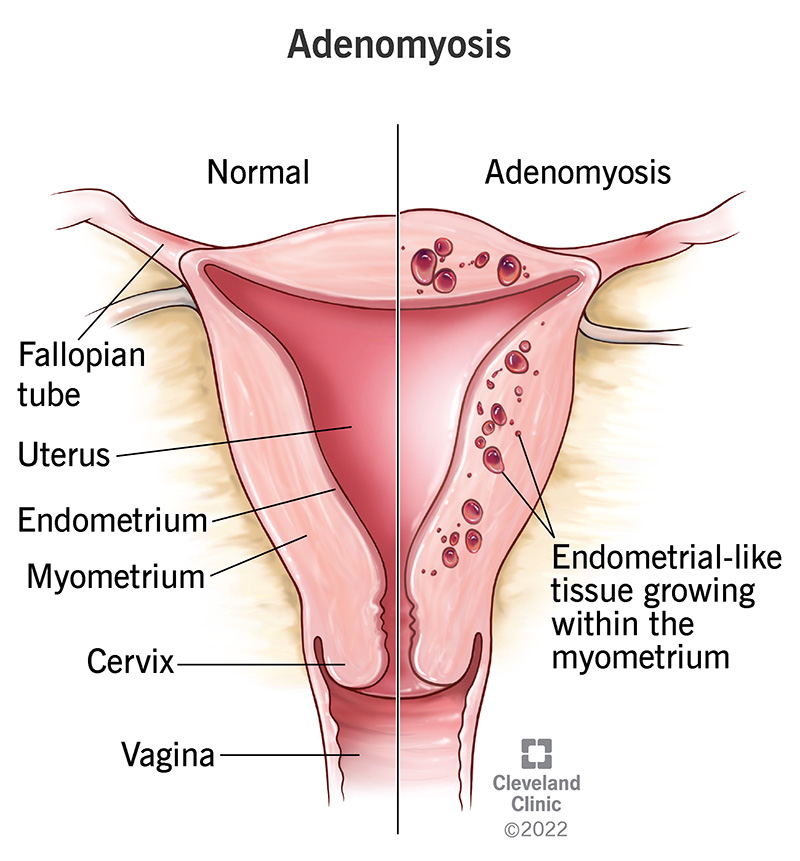
So what is adenomyosis? Basically, it's like endometriosis (it's not identical, it's more of a cousin), but growing inside of the uterus instead of outside of it. It cannot be seen during surgery. Modern imaging might be able to detect it. Apparently the only official way to diagnose it is by surgically removing the uterus and opening it up to see if it's in there. Adeno causes extremely heavy bleeding and increased pain with contractions (like during the period). It's also a known cause of chronic fatigue, like endo is.


3. After the MRI I'll have surgery, but I hope to delay it if possible. I'm going to attend a wedding and work my job for a couple of weeks because it's a busy time of year at work. Then I'll do the surgery, and I'm expecting I'll need at least 3 weeks of recovery time, maybe more. If they find something very urgent that needs to be surgically handled, then I suppose I can't wait. My pain really has increased too much and I know something is wrong, so we'll see what they find. But I have to wait weeks for the MRI anyway. 

My new doctor is much more advanced in endo surgery than my last (I'm not saying my last doctor was bad - she did as good of a job as possible in that situation), and she told me that if I choose to travel to one of the best surgeons that she will help refer me and get me in. I'm torn on this one, because she may be capable of doing a really good job for me and she's right here in town. I really don't want to have to travel. She was trained at Mayo and is using the latest techniques, and she gets all the continuing education available. She isn't an endo-specific surgeon, but she is much more focused on endo and more highly trained than the average gynecologist. The surgeon we choose is extremely important, because if the surgeon isn't capable of removing ALL of the endo, the endo will come back and we'll need more surgeries. That's what happened to me, and it's normal. The best surgeons reduce the risk of needing multiple surgeries. 

This doctor, if I choose her (and I probably will, depending on the MRI results,) will do a different surgical method than my previous surgery called a Peritonectomy, or Peritoneal Stripping. I understand that the recovery period is longer.  In this version, she will remove the top layer of my internal skin. That will help remove the roots of the endo that might be invisible to our eyes and cameras. The tissue will regenerate, but I understand it's going to be a slow and painful process. 

I can't find a good website to explain the peritonectomy surgery, just various studies about it which are not in lay-people terms. I did find this video that briefly explains why it should be done:

4. Treating the adenomyosis? This is what I'm really unsure about, especially since I've been trying to treat it naturally for so many years, and because of where I live I've lost access to treatments that were helping (like acupuncture!) I have 2 medical options: remove the uterus, or insert a progestin-only IUD like Mirena. I'm not willing to remove my uterus unless it's trying to kill me, and it's not that bad right now. I'm really uncomfortable with the idea of the IUD, but I understand it. I already use bioidentical progesterone, but it can't make it into the uterus where it's needed to treat the adenomyosis. An IUD is used because it can release Progestin inside the uterus where it can do its job. Natural progesterone can't be used because the half-life is too short. I would need to replace the IUD very frequently, which is unsustainable and very painful. Synthetic Progestin has a much longer half-life, so it makes the IUD sustainable. 

But am I willing to use Progestin? I really don't want to because I'm too familiar with the side effects, and I tend to be extra sensitive. I don't know for sure, but I think I prefer the heavy bleeding and pain over the change of personality from the Progestin. I don't like the increased risk of ovarian cysts from it too. I don't like how it changes our sense of smell and cause weight gain too. I'm not a fan of the risks. 

I have read that there are newer treatments for specific types of adeno, such as a new type of ultrasound machine that can help shed it off. I don't know what type mine is, and I don't know if anyone locally offers that treatment. I need the MRI results first. 

What can I do naturally? Well, maybe I need to stop eating goat cheese and be totally dairy-free again. Maybe I need to increase my fiber. Maybe I need to go totally carnivore. Maybe I need to reduce my sugar intake to zero again. Maybe I need glutathione IVs again. Maybe I need to drink more red raspberry leaf and hibiscus, except that my blood pressure already runs low. Maybe I need to do daily castor oil packs. Maybe I need to go back on my previous herbal blend pills. Maybe I need to travel for an acupuncturist who knows what they're doing. The thing is, I've done all this since 2013. I was able to improve about 50% at best (which is really good!) If I've slipped into some bad habits and that's why my symptoms are increasing, then I can fix that. But the fact is, I was never able to fully manage naturally. And I was working with excellent natural doctors. 

So, I'm undecided on what to do about the adenomyosis. My head is too tired, and I think I'd prefer to get the MRI results first anyway. 

There's more and more research about endo coming out - such as the estrogen and histamine link, the mast cell link, the new saliva biomarker, and so on. Maybe adeno will be similar and we'll find ways to help manage it soon. 


Alexia Evellyn - Hold On


Sometimes we just need power ballads to help us find our strength to continue being women,,, because this isn't easy. I'm numb to the emotions of the pain after all these years, but I still have to feel the pain. I just surrender to my period every month and don't try to live my life until the worst passes. I'm a veteran at this, but I'm so tired of it. I'm scheduling my whole life around my periods, and so I don't like to plan my future because I never know if I can really be available for it. 

I dreamed last night that I was locked in a prison cell with no way to manage my period, so I laid on the floor and let it all bleed out into a giant pond in my cell. It actually felt like a pretty good analogy for my life. And so, am I crazy to want to keep my uterus? What if I explored the idea of letting them remove it so I can be free? And then I'll never be able to have children... that's not the life I want. All I ever wanted in this life was a loving husband and children. I'm not ready to abandon that dream. Can you understand the distress this puts me under? It's enough to break a woman. And I think I did break a few times already. And yet, I don't stop dreaming of the life I wish I was living. A simple life full of love and family. Maybe, just maybe, after this surgery I can make it reality. 


Wednesday, March 4, 2026

Endometriosis Awareness Month: A Glimpse Into My Reality with Endo

It's endometriosis awareness month. 

First, here is an awesome Facebook post with some info about what Endo is and what it is not:

I'd like to write about my current cycle in honor of raising awareness. 


A little personal history, for context.


I've had extreme periods since I was 17. When I started to use menstrual cups, I counted how much I bled on the first day of period over years. I normally filled my size 2 Diva Cup 3-7 times full in the first day of my period. The average person fills their cup 1-2 times full through their entire period. Along with this heavy bleeding was excruciating pain. Full body pain. I could move a toe and feel it cramp up my leg and trigger pelvic pain that felt like someone stabbing me with a knife repeatedly. I also had relentless diarrhea, which was super painful. I could sit on the toilet and feel my heart rate skyrocket to the point where I was seeing stars, seeing my vision slowly go black, and I would gasp for air. All while my body purged itself beyond my control. Yes, I've fainted from all this. I took up to 12 ibuprofen on the first day of my period for years, and it didn't work well. I kept taking more hoping for any pain relief at all. I was like this for years and years. Finally, a doctor told me my liver was in poor condition, and I admitted taking all these painkillers (and a daily Allegra D) to him - he warned me to stop because that was causing a lot of damage to my liver. So I was left with no real option for managing my allergies and pain in the conventional way. (I always refused birth control as an option for religious reasons, but also because I read all the side effects and didn't want them. Doctors did drop me because I refused birth control.) 

In 2013 I started to work with a Naturopathic Doctor in New Hampshire. We did a lot of work to improve my health. By following his advice, over a few years my periods slowly became about 50% less intense. My bleeding reduced down to 1-3 full Diva cups on the first day (still heavy, but manageable.) My pain was still intense, but he made a tincture for me that actually worked. It blocked estrogen receptors, which did reduce my pain a ton, but it also knocks me out. So when I take it, I sleep for hours through the worst of my symptoms. He put me on natural progesterone and hormone-balancing herbs, which made a big difference over time too. He changed my diet, which made a big difference. My PMDD was not as long or severe, my cycles were more regular, I didn't bleed as heavily, I was more stable during my periods with less fainting issues, and my level of fatigue wasn't as strong anymore. But I stopped getting better. Everything improved about 50%, which was miraculous to me, but I stopped improving more. 

In 2018 I was first diagnosed with POTS, and the next week I had a $14,000 laparoscopic surgery to look for Endometriosis. My surgeon was a local gynecologist doing the Davinci Robotic surgery. She was sure she wouldn't find endo - in fact, she was doing the surgery just to help me stop feeling convinced that I had it. She told me it would be a 30-minute surgery. She was wrong. It was 3.5 hours long, and she did find endo. She took a biopsy and confirmed it in the report, but refused to give me a "diagnosis" in my chart. Why? I don't understand that part, seriously. So when doctors see my medical records they only see the surgery, but not the result. Anyway, she removed endo from my Pouch of Douglas / Cul-De-Sac, which was probably where the majority of my pain was coming from. She also found it on my uterus and ovary. She was unable to fully remove it from my ovary without removing the whole ovary. The problem with endo is that if you don't have it fully removed, it grows right back. She also found that my uterus was tilted backwards. In the year after the surgery, my periods were the lightest they had been in my life. My pain was a little better too. But the results didn't last longer than a year. 

After my surgery, I was still bloated from all the air they pumped into me and my scars were bruising. 

In the last few years, my periods have been slowly getting worse and worse again. My PMS has been turning back into PMDD again. My cycles are less regular. What has changed? Well, a lot of stress in my life. I've stopped using the herbs as regularly. My diet has loosened up a little. And I think, most importantly, I've been unable to have regular acupuncture treatments in the past 2.5 years. Acupuncture made a huge difference for me.

I've always had to call in sick on the first day of my period. I never improved enough to be able to work on the first day of my period. I had to miss very important events in my life because of it. And despite all the medical care I've been though, all the extremely strict diet and lifestyle changes I stuck to for years and years now, and all the praying and therapy I've tried, nothing helped enough to give me a "normal" first day of my period. It always made me so sick that was bedridden with major pain, fatigue, and vertigo for the day. 


And now, for the present.

So let me talk about my current cycle, to give a glimpse into the turmoil I live with every month. I use the Clue app on my phone, and I pair with my Oura Ring. I'm not good at tracking all my symptoms, but I am very good at recording the first day of my period. So let's look at Clue for this month:


Each dot represents a tracked symptom per day. The red phase was my last period, and I only tracked for 3 days of it before I forgot. I bed 5 days, I think. The days with 2 dots are because of information my Oura Ring automatically sends to Clue: sleep and body temperature. Then the blue phase, which is ovulation, you can see extra dots. That's because I bleed dark purple thicky sticky blood for 3 days during ovulation. Then, when the 3 dots appear again, is when I started to record my PMS symptoms. I had symptoms for a few days before I started to record. I had acne, bloating, mood changes, scalp tenderness/ sensitivity, and fatigue issues, but they were not bothering me enough to think to record it. So I've had about 10 days of PMS symptoms. What does that mean for me? It means gaining a pants size in bloat, relentless hunger (even eating high protein with some extra carbs), very sensitive mood that causes me to feel everything too deeply, moments of unprovoked anger, days of irritability, feeling super anti-social, withdrawn into my head and difficult time being in reality, random cystic acne around my mouth and on my chest, ringing in my ears, deep fatigue that caffeine can't cure, nights of insomnia and then nights when I sleep 13 hours, very achy deep throbbing pain down my legs, vertigo and dizziness that makes me really unbalanced, sharp throbbing cramping all over my pelvis, feeling a bowling ball growing in weight in my pelvis, unpredictable bowel movements, throbbing aching teeth, swollen tender breasts that hurt to touch, sharp nerve pain in my breasts, inability to completely empty my bladder, and I'm sure there are symptoms I'm forgetting. 

 My period is late. "Late." I've had years with my average cycle lasting 30 days, and years when it was 35 days on average. I've just been in a 30 day average cycle this year, so now this looks late. 

The problem with me being late is that I've had many days of symptoms that marked what should be the beginning of my bleeding: major cramping, vertigo, and fatigue followed by an improved mood. All the symptoms that tell me it's time to lay in bed with my heating pad and stop doing anything else. Except that my bleeding didn't start. I've been in this state for about 5 days now, feeling on the verge of starting my bleeding. I had two shifts at work that were difficult for me to endure, but I didn't get bad enough to have to go home sick. I was mainly concerned about fainting, so I drank lots and lots of salt and took licorice root pills to keep my blood pressure high enough. 

Since I can't read my symptoms reliably, thankfully my Oura Ring gives me a clue that I can almost rely on:


(I recorded my period start day one day earlier last month, so the apps don't agree. That's because I started bleeding a tiny bit the day before, but without all the symptoms of my first cycle day. So I recorded a different day in each app to help me predict my next period.)

Ok, look at the body temp graph. The line is my baseline average body temp. Each day marks if I was higher or lower than my average. I tend to increase by a half degree to a full degree in the last 5 or 6 days of my PMS, and when I see my body temp drop below average, I'm usually ready to start bleeding. So you can see why this month is confusing: 3 days ago my temp dropped, but not below average. Yesterday it did drop below average, and I had all the symptoms that said my bleeding should start (including my breast pain going away.) But I only bled a tiny little drop all day. Ok, so today my temp was below average again. I checked my Diva cup this morning and it had a small stream of very dark black blood on the edge. I haven't bled more since then. 

I called in sick to work today. I am only writing this blog because I drank enough green tea to help warm me up, and I hoped the caffeine would encourage bleeding. The reality is that I'm sitting very still at my computer to type this. I'm taking lot of breaks to breathe and rest. I'm getting really dizzy at moments. I'm getting immense pain for brief moments. There's no way I can stand up for 5 hours to do my job like this. And I won't improve until I bleed. I am in limbo. I'm unable to function until I bleed. 

This is a glimpse into my reality with endometriosis. When I say it dominates my life, you can see why. I get maybe 1-2 good weeks per month where it doesn't limit me or control me. 


Florence and the Machine - You Can Have It All

This album was about her ectopic pregnancy and miscarriage that nearly killed her. She wrote many songs about the grief and the reaction of her fans. It's an album that will make you cry. This song, although about miscarriage, reminds me a lot of my experience with endometriosis. "Am I a woman now?" Is this what it means to be a woman? The loss of a child/ inability to have a child. Being controlled by our bodies. How to exist in the circumstances of our bodies?

Tuesday, January 16, 2018

Unrest Documentary by Jennifer Brea

Jennifer Brea made a documentary about her illness, but it isn't just her illness. It's an illness millions of us have. The documentary is "Unrest," and it's now streaming on PBS and Netflix. "Unrest" is about Chronic Fatigue Syndrome. 

My husband and I were able to watch it last night since Netflix now has it. PBS aired it, but not locally, so we had to wait for Netflix. If you don't have access to either streaming service, you can pay to rent it on Amazon and other streaming sites.

"Unrest" is an expansion of her powerful Ted Talk:


Many of you might prefer her Ted Talk, which has essentially the same information as in the movie, simply because the movie is much more difficult to watch. "Unrest" makes you watch people suffering with CFS/ME up close and personal. It reveals the reality of what being bedridden from fatigue is really like. It's not easy to watch, even as someone who has been bedridden from CFS/ME. I know the illness from the inside, having it myself, but watching it from the outside was still difficult for me. Her Ted Talk has the science and the facts in a more condensed format too, for those who want to learn, but don't want to commit to watching the full documentary.

As someone with Chronic Fatigue Syndrome and knows other people with it, I would like to strongly encourage you all to get everyone you know to watch "Unrest." What I hope the movie accomplishes:

1. Breaks down stereotypes about the illness. We are not lazy, we are not just tired, we are not just being selfish. With this illness, willpower doesn't work. We can't just "buck up" and push through. It doesn't work. "Tired" is normal. Chronic fatigue is not. They are not the same thing.

2. Encourages the funding of research on CFS/ME. As she explains, CFS/ ME receives the least funding of all major debilitating illnesses, and therefore very little progress is being made. As it is now, most doctors I've talked to have told me I just need to exercise more or go see a psychologist. The problem is that research that has been done shows that exercise can be detrimental to CFS patients, making their condition much worse. I know this is true from personal experience. And the illness is not a psychiatric one - that's what doctors say when they don't know how to treat you. I would so much rather hear, "I don't know."

3. Helps family members and friends to come to an understanding of what their CFS loved one is going through. It's so difficult to explain ourselves, mostly because people don't listen with the intent of understanding. Most people in my life try to tell me what to do to get better, but very few have asked me about my point of view with the illness. I hope this movie breaks assumptions and encourages real dialog between the patients and friends and family. As it is, it takes so much energy to communicate, and so much recovery time from speaking. It's extremely discouraging to have our energy wasted on words that no one truly listens to.

Please watch it. Help us to get help. Start the conversation that will open up people's minds to the reality of Chronic Fatigue Syndrome.


I would like to share a few personal thoughts:

"Unrest" serves as a great introduction to CFS/ME. I really appreciate the overview it gives. But that's just it: it's an overview of people who are bedridden from CFS. There is so much more to learn about it.

Many of us with CFS, like myself, are not bedridden. At least, I'm not anymore - not most of the time. Some days I am bedridden, but I'm mostly chair-bound these days. Not an office chair, a comfy reclining home chair. Yes, sitting up in a chair is a big improvement over laying down in bed. Back in 2013 I was bedridden for months, and then stuck in bed more than 50% of the time over a year and a half. If I didn't get lucky with finding my doctor I may still be bedridden. I got very lucky with finding a doctor who could help me... but he's not local. I fly half way across the country to see him, because all the local specialists I went to told me I was a mental patient and a hypochondriac. One of them did diagnose me with chronic fatigue syndrome after 6 months of going back to her complaining about the extreme fatigue. She also did the Tender Point Test and diagnosed me with fibromyalgia. She also diagnosed me with anxiety and depression after I came back to her to say that the Cymbalta she put me on was amplifying my pain tenfold and made me suicidal. Without running tests, she sent me to a psychologist. She didn't even send me to the ER after saying I was suicidal.  Most CFS patients are not lucky like me. They haven't found a doctor who can help them. They're stuck with doctors like I first went to, doctors that don't know what they're doing. Doctors with no training in Chronic Fatigue Syndrome.

My doctor is a Naturopathic Doctor, and a rather unique one (HumanNatureNaturalHealth.com) - I've learned that many people automatically dismiss anything a Naturopathic doctor has to say, so I'm careful who I reveal this to now. Someone even told me I'm hurting myself just because I'm seeing an ND and not MDs... as if I didn't already get worse under the care of MDs. But the fact of the matter is, no matter what your opinion on naturopathic doctors is, he's the only doctor who's made progress with me. When conventional medicine fails, I hope you can understand why we seek out the unconventional for help. Please don't dismiss what works. I'm not dismissing MDs either - they all have their specialties and play important roles in health care. They've helped me with other conditions, and I am very grateful for some MDs I've seen in my life. I'm about to go to another MD, a cardiologist. But when it comes to CFS, I couldn't find help from MDs.

Those of us who can work part-time were not featured in this film. I respect that. I understand why she didn't share our part of the story. "Unrest" needed to be convincing by showing the worst of the illness, and I was at that "worst" point for a while myself. I use the word "worst" lightly here, because I don't compare people's suffering. Suffering is suffering, no matter the level of it.

But I also think it's very important that people understand how hard we CFS patients are trying to keep living our lives. I work 12-15 hours a week. Some weeks that's too much for me. Other weeks, as long as I supplement correctly, I can handle a few more hours. Because I'm able to work part time, I find myself in this grey area of illness. Social Security Disability isn't taking me seriously, even though I can't work enough to pay my bills. Many of my friends and professional connections don't take me seriously, and I'm thankful for those who do take me seriously. They see me at my best: when I'm geared up for work, having saved my energy to spend during those hours. They don't see me when I'm back at home laying on the couch struggling to get up to go to the bathroom. They don't see me when I have to crawl up the stairs because I don't have the strength to walk up them. They don't see me when I'm stuck in bed until noon because my body won't wake up enough for me to get up, even though my eyes are open. I call in sick when I'm that weak, and sometimes I get in trouble for calling in sick - how can I be useful and reliable to the company when I call in sick? I have to carefully reserve calling in sick only on days when I'm doing badly enough that I can't drive. If I can drive, I can work, even if it's taking all my strength just to stand up. I hate this, because I believe in being an effective employee - why accept money for doing a poor job? I want to be able to always do my best at work. If I can't drive, then I'm sick enough to call in. I hide the rest of my reality from them, not entirely by choice, but more due to the nature of my illness. I also know how to supplement in order to boost my adrenaline enough to be able to keep working if I don't have the energy to make it, and my co-workers see this, so they know I have the ability to keep going sometimes... but when I do this, I pay very hard for it later. I need a lot of recovery time, and that recovery time can be painful to endure. It can mean I can't come back to work the next day. I'm typically scheduled for 4 hour shifts every other day, sometimes with 2 days between shifts. This works really well for me. Other people with CFS are not lucky enough to find an employer willing to schedule them like this... I doubt I could find another job in this town that would work with me this well. I can't express just how grateful I am for my job, and that's why I haven't quit, even when I've felt to sick to keep working.

And I know people with CFS/ME who manage to work full time, but they don't perform very well at their jobs. They're giving all they have just to be able to afford their home and food, but they make lots of mistakes at work and really struggle to maintain a professional image. Once they get home they can't clean, cook, or take care of personal business. They're drained. Their stories were not told either. I would love to see a follow up documentary to cover the rest of us who are not 100% bedridden.

Thank you for reading. Please share this along with telling people to watch "Unrest." Let's be heard. Let's get funding for medical research on CFS/ME. Let's educate doctors. Let's educate our employers, friends, and family. Let's connect with each other and bring more meaning and value to our sick lives.

If you would like to help take action, please sign the petition to get research funded:
https://www.unrest.film/nih-petition

Tuesday, December 26, 2017

December 2017 Doctor Vists and Tests Part 1


I have a lot to explain, and for the first time in months I might have what it takes to sit down and type it out. I finally took my supplements this morning, and they're helping! :)

For a little over a year there has been this lingering question mark over my head asking if I have Postural Orthostatic Tachycardia Syndrome, or POTS for short, a form of Dysautonomia. I had a couple medical practitioners say that they suspected POTS. POTS is defined as your pulse going up at least 30 bpm when you stand up then sustaining a high pulse for a little while (but the length of sustaining is what confuses me.)

I got myself a pulse oxygen meter that clips onto my finger in order to see what happens to my pulse when I stand up. About half of the time my pulse does shoot up at least 30 bpm, often way more than that. Sometimes it stays that high for a minute or two, but normally what happens is my pulse shoots up, then goes down, then goes up again, then goes down again, then goes up again... it's a roller coaster. I took some videos of this happening and sent them to a Neurologist in New Hampshire who is an expert in Dysautonomia that my primary doctor referred me to. He took me on as a patient, which was a huge relief to me since he's very difficult to get into.

Why not see someone locally in North Dakota? Because POTS isn't well understood, and it takes a doctor with training in dysautonomia to be able to diagnose it. There isn't anyone in ND except for one pediatric doctor that diagnoses, and I'm not a child. There doesn't even appear to be a Tilt Table in ND. If I went through the local hospital for a referral they would have sent me to Mayo in Rochester, MN. It's an 8 hour drive from here, and very expensive. Too expensive compared to flying somewhere to see a highly rated dysautonomia specialist.

On the trip to NH I also scheduled a Tilt Table Test, a Echocardiogram, Lyme Disease testing, a visit with the Neurologist, and a visit with my primary doctor (my Naturopathic doctor.) It was a very full trip. In preparation for the visits I had to be off all my supplements for a few weeks prior. I posted a bit about that experience, but in short, I didn't do quite as badly as I expected without the supplements, but I did get worse. High adrenaline and crashing during the day, high adrenaline and interrupted poor sleep at night. My digestion became poor and my joints and muscles ached. I ended up gaining between 10-15 lbs (lots of fluctuation day-to-day.) My mood deteriorated rapidly, and my periods became irregular. My stress level was through the roof and I couldn't control it, even while relaxing.

On the first day of the trip I went to Elliot Cardiology in Manchester, NH. I started with the Tilt Table Test. I had to fast at least 4 hours before the test to make sure I didn't vomit during the test and end up choking on it. As someone who has to eat every 2 hours to stay strong enough to function, that was hard, and then the test took about an hour. After the test my blood sugar was 72, which was barely above hypoglycemic, so I was actually impressed with my body that it didn't get hypoglycemic after all that, but I was very shaky.

The test was... not really what I was expecting. I was strapped down to the bed. It took 3 nurses to find a vein in my arm to put an IV into - the IV was to raise my blood volume back up with saline in case my blood pressure dropped too low. They almost gave up on using my arms for the IV, but the last nurse they called in wasn't afraid to dig a little deeper and she managed to get the needle into my vein. They hooked me up to an EKG machine, and took my blood pressure. I was expecting that they would let me lay calmly for a while to get my body down to baseline, but next thing I knew, I was being tilted upright on the bed. I definitely was feeling nervous and high strung, definitely not at my baseline before they tilted me. I started to get upset because I didn't feel like they were doing the test right, but the tilting made me feel so weak that all I could do was focus on surviving the tilt. In that moment I understood why POTS patients say the TTT can be really painful and difficult to endure. During the tilt I felt this deep pressure moving downward in my body, my vision narrowed towards black, and I started crying. Tons of tears just poured out and they had to give me tissues. It was horrible - but a feeling I was familiar with. I've felt like that before when standing up too quickly, but this was the most extreme. I'm not a fainter, my body always fights the feelings like I'm about to faint. If I was a fainter, that's when I would have fainted and I would have passed that test criteria. I couldn't communicate well, Thoughts were not working well, so when the nurses asked how I was doing, I just got out the words "weak, I can't stop crying." But then I was standing there strapped to this bed at an 80º tilt. Within about 5 minutes I felt better. My body was recovering. I didn't understand what to do - I felt well supported by this bed, so my body wasn't working to stay upright. I had no idea if I was supposed to relax all my muscles and stop supporting myself or if I was to stay there, legs locked upright. I had waves of hot flashes, waves of weakness, but never fainted. One nurse told me, "You're not quite normal," and I never had a chance to ask her what the meant. After the test she had to run before I could question her.

After 30 minutes they laid me back down flat. This is the part that's as bad as the tilt itself. I was able to stand up, but was very weak and shaky. I was trembling. I talked to the nurses for about 30 seconds, then I tried to take a step. I couldn't. My leg muscles gave out and I had to fall back down on the bed. I was crying hard again, shaking almost violently, freezing cold, and felt so weak. The nurses argued a bit about if it was an anxiety attack, hypoglycemia, or adrenal issues. The one nurse was sure it was adrenal, but they're not allowed to diagnose. That's when they took my blood sugar and found I was borderline hypoglycemic. On this note, I was disappointed that they did not do the version of the TTT in which they infused adrenaline through an IV if I didn't faint, and then do blood labs to see how my adrenals react to the IV. This part of the test often makes people faint, and then they know the syncope is from adrenal issues. I know I have adrenal issues, so I wanted that part of the test done and didn't get it.

I couldn't walk on my own, so they put me in a wheelchair and delivered me to the echocardiogram room. I needed the echo to check on the status of my Pulmonary Stenosis, which I've had since birth and it never went away. It's still there. That's about all I learned from the test. I'm thinking of sending all my past echos to a cardiologist there and having them do some comparisons.

That was the end of the first day of testing. I was weak and low energy the rest of the day.

The next day I saw my Neurologist at Dartmouth-Hitchcock Medical Center. But let me back up a bit: I almost didn't a couple of times. I got a phone call from his office the day before our flight out there saying that he wanted to cancel my appointment because the Autonomic Nervous System testing equipment broke and he couldn't test me. I had to beg to keep the appointment, even just a consult, and they agreed because I was traveling. The day of, I had two major strikes against me going: I started my period that day (I have to roll my eyes at my body choosing the worst times), and the weather was horrific. 3 inches of snow in a few hours time, icy roads, and near whiteout conditions. An hour and 20 min drive took us 2 hours, and I ended up getting there 10 minutes late. 5 more minutes and he wouldn't have seen me. Or so the receptionist said, but the doctor was forgiving and spent a good amount of time with me. I didn't have time to go to the bathroom before seeing him, so I was cramping badly and was uncomfortable. My blood pressure was 120 something over 63 and my pulse was over 100, if I remember correctly, which showed just how stressed out I was about my bathroom needs, getting to see this doctor finally, and being so rushed in bad weather to get there.

He sat me down and let me talk - he had me tell him my history and all my symptoms. He gave me a good amount of time and really listened, which blew my mind. He was amazing. He took me seriously, didn't try brushing off anything I said. He even knew about the damage vitamin b6 toxicity can do and understood what I went through with my nerve pain. He had me to do some nerve conduction testing, which turned out normal. He also showed me the results of the TTT:


I went up over 30 bpm, the criteria for POTS. But it doesn't say if it was sustained. It could also be POTS symptoms caused by something else. So he needs more information.We decided that since he wasn't able to do the autonomic nervous system testing that he would have me wear a heart monitor for 14 days - a Zio XT Patch...


...Which meant not being able to go back on my supplements. My doctor and I agreed that we need to measure my heart without the medical aids to show how I am without support. Today marked 14 days, so I ripped the monitor off and took a hot shower and my supplements. The patch was itchy the whole time and it left me this pretty rash:


I'll tell the rest of the story in Part 2, as I have to go to work now. :)

Thursday, October 12, 2017

What A Night of Sleep Looks Like During MCS Reaction

I'm not keeping up with this blog, so long story short, I've been using an Oura Ring since August. I want to give some detailed attention to this at some point, but I can't right now. Way too exhausted. In short, it is a highly advanced sleep tracker that has generally received good ratings as far as accuracy goes, but I'll dig into that topic later. It's not like a Fit Bit or other trackers - it uses different technology and can read a lot more. 


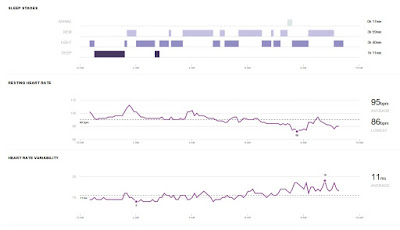
I want to show you what a night after a chemical exposure looks like for me. I came home from work feeling angry, fidgety, uncomfortable, and wanting to beat something up and smash it to pieces. I'm not totally sure what I was reacting to - normally I know right away if something is causing me reactivity, then will get a the worst reaction later on (delayed.) The fact that I was off my pills for 1.5 weeks and had only taken bare minimum to get by at work in the past 4 days has meant more reactions and reacting to lower exposures. Regardless, I was definitely reacting and was very uncomfortable. I went to bed with a resting heart rate jumping constantly between 95-120 while just laying still in bed.

https://drive.google.com/file/d/1olRRgWgc-rXaF2KlDJ6Zi238W9sXiQ-zeA/view?usp=sharing

You will need to click the link below the photo to see it full size to be able to read it. Blogger has some serious formatting limitations and will not allow me to turn the image into a link unless I feel like coding it in HTML, but their HTML is one wall of text, not formatted so that I can easily find where to edit. I'm feeling way too lazy to deal with that.

First problem: 4 hours of REM sleep!? I've read that high REM can mean high stress levels on the body. More than 2 hours tends to be high, from what I've read. I'll link to the articles when I have the energy.

Second problem: Heart rate. Okay, my resting heart rate tends to be high anyway (and I'm getting officially tested for POTS soon, but a few medical practitioners have told me they've seen it when reading my pulse), but this is a bit absurd. During the first two weeks of my menstrual cycle my lowest heart rate of the night tends to be in the upper 60's to low 70's, with average in the 70's, sometimes low 80's. My lowest last night was 86 BPM. Average was 95 BPM. Highest was just below 110 (I wish it would give an exact number.) My body managed to lower my resting heart rate during sleep, but it still stayed too high. And I took pills that should calm my heart rate down - I did need herbs to fall asleep last night.

Third problem: My heart rate variability is super LOW. The higher the number, the better off you are. In my Oura Ring user group many people are reporting that they are generally in the 70's - 90's for average HRV. I have never been above 30 for as long as I've been recording, but 11!? My body was clearly very stressed.

The ring also showed me that my average respiration rate was 18.0, which is high, but I'm usually that high. And it told me that my body temp dropped half a degree Celsius last night, but my body temp is different every night. My temp is up and down and all over the place.


To compare, here's a couple more average nights when I wasn't feeling abnormally terrible:


https://drive.google.com/file/d/1H1-ljVIHp1_0d0Ay58z0qUjQkC8yI5LIcA/view?usp=sharing

https://drive.google.com/file/d/1KChhS7TcjuJ5GWrrGPXEU8rTp4xMiCgX4w/view?usp=sharing

Something to keep in mind with REM: it's not restful. It's called Rapid Eye Movement because the body is working to repair and reset during that time. The more you need, the more your body is trying to repair. That's how it was explained to me. So when I have these nights with high REM, even though I got 9 hours of sleep, it was not restful sleep. If I can at least get and hour of deep sleep I do okay, regardless of REM. So I'm exhausted. I couldn't bring myself out of bed until 11 am. I just wanted to lay there. But eventually I started to shiver and I realized I needed food really badly, so I forced myself up.

Beef Bacon is amazing, by the way. I'm sick of turkey bacon (had it too often), and I can't have pork. I actually hate pork, so I don't mind not being able to have it. But a local grass-fed (mostly) beef company makes beef bacon with just beef and sea salt. It's amazing. So incredibly delicious. 

Sunday, June 18, 2017

Tachycardia is so Pleasant (sarcasm)

Oh how I so enjoy the tachycardia. :P

I love shivering when I'm not cold, struggling to remember to breathe, feeling my heart rate skyrocket and punch my throat in slight stress, feeling my heart rate skyrocket from just laying down, having purple mottled legs, heart burn from a digestive tract that freezes up on me when blood isn't moving well, bloating that never ends, falling over because I'm too weak to keep standing, seeing spinning colors when I stand up, saving up all my energy and strength for only the hours I go to work and ending up collapsing at home...

Yeah, I've been suspicious of POTS for years. I didn't bring up my suspicion to my doctor, but he tested my heart rate and blood pressure long enough and careful enough to find POTS symptoms.

Right now I've been laying on my back for 2 hours, talking on the phone for some of that time (talking always winds me up because it takes energy - I don't like to sit and talk anymore, too draining), and I counted my resting heart rate a few times. 92, 96, 105. Laying down!

I think I've had symptoms for years, but in the last 6 months or so symptoms have been most obvious and exagerrated. I was complaining to my doctor about how sore and achey my heart was. It hurt a lot! I wasn't used to that kind of heart pain.

I was born with a heart murmur: pulmenory stenosis. It never went away. I still have it. Cardiologists have needed me to get echocardiograms every couple of years my whole life. Every one I've seen has always been startled and confused by how loud my heart is and the gurgling noises it apparent makes. My heart has always been in good health according to the tests, but the fact that the murmur never went away and it makes weird noises worries cardiologists. After reading up on POTS I found that it's fairly common for POTS patients to have a murmur too. I have not decided what this means yet, but it's interesting.

I'm writing this on my phone out of anxiety and chest pain. Really not feeling well. I'll consider going into more depth on the subject later. 

Saturday, March 18, 2017

Adrenal Fatigue Test Results


I wasn't planning to take a long break from blogging, especially since I have two two drafts for posts started that I need to finish. I've just had a really rough year so far.

My adrenals are so bad. I knew it, but I didn't have specifics. I really needed an official adrenal test done, so I bought a Diagnostechs 4 point cortisol and DHEA test when it was on sale for $120.

To test how my body is actually functioning on its own I had to go without supplements for 2 weeks so that nothing that affects cortisol would affect my test results. I only made it 3 days before I felt extremely sick without my supplements. I couldn't tolerate it. So I went a head and did the test on the 3rd day. Want to see my results? (Click on the picture to view full size if you're struggling to read it.)


I'm very low, very low, low, slightly high. According to Stop The Thyroid Madness, cortisol should be at the top of the range in the morning, upper part of the range at noon, middle of range in the afternoon, and at the absolute bottom at night.

The problem with this test is that I turned out to be abnormally exhausted - I actually fell asleep that night without herbs. That's normally impossible for me. I know that my cortisol is usually too high at night between what my doctor has told me and how I feel, but here it's only slightly high.

My DHEA is also very low. I thought I was getting measured in the morning and afternoon, but they only measured my afternoon value. If they measured it in the morning, and if their afternoon "normal" range didn't go so low (normal doesn't necessarily mean well or optimal in labs), the chart would show me in box 8. I'm so close to box 8 as it is.

No, I refuse to take DHEA supplements. They might make me feel good while on them, but they will ruin my body's ability to make its own DHEA. It will mess me up in the long term. It also can convert into extra estrogen, which I do not want. Not worth it!

Stop the Thyroid Madness has a great page explaining the stages of adrenal fatigue. According to this I'm probably in about stage 5, despite my DHEA being so low. I have A LOT of healing left to do, but I'm better than I was 3 years ago. I was bedridden then!

The hardest part about taking this test was trying to recover from 3 days without supplements. It took me about 3 weeks to stabilize again. I was miserable, dropping everything, fighting insomnia, not able to form energy during the day, getting rashes and stomach aches, fighting brain fog... it was not easy. Acupuncture helped the most to calm me back down.

Life has also been really stressful! One of coritsol's jobs is to eat up adrenaline so that adrenaline doesn't do damage. I don't have enough cortisol, so I create adrenaline too easily and can't control it. This is why I have very little tolerance for stress: stress causes adrenaline that I can't control, and the adrenaline physically hurts. This week I had to work every day of the week (co-worker had the flu, so I was covering) when I normally only work 3-4 days a week, my husband needed to prepare for a business trip that required some complicated planning, and I had to file taxes. I had really bad insomnia the night before last, which left me very fried. I say "fried" because I seriously felt like I had electricity flowing through me. Totally frazzled! Last night I did sleep, but woke up at 5 am with the feeling of electric currents flowing through me again. The only way for me to sleep well again is to have a few days without any stress so my body can stabilize.

Adrenal fatigue is no joke! I have to manage it very carefully every day. I have to take extra adrenal supplements during stressful times, so I must be very in-tune with my body.

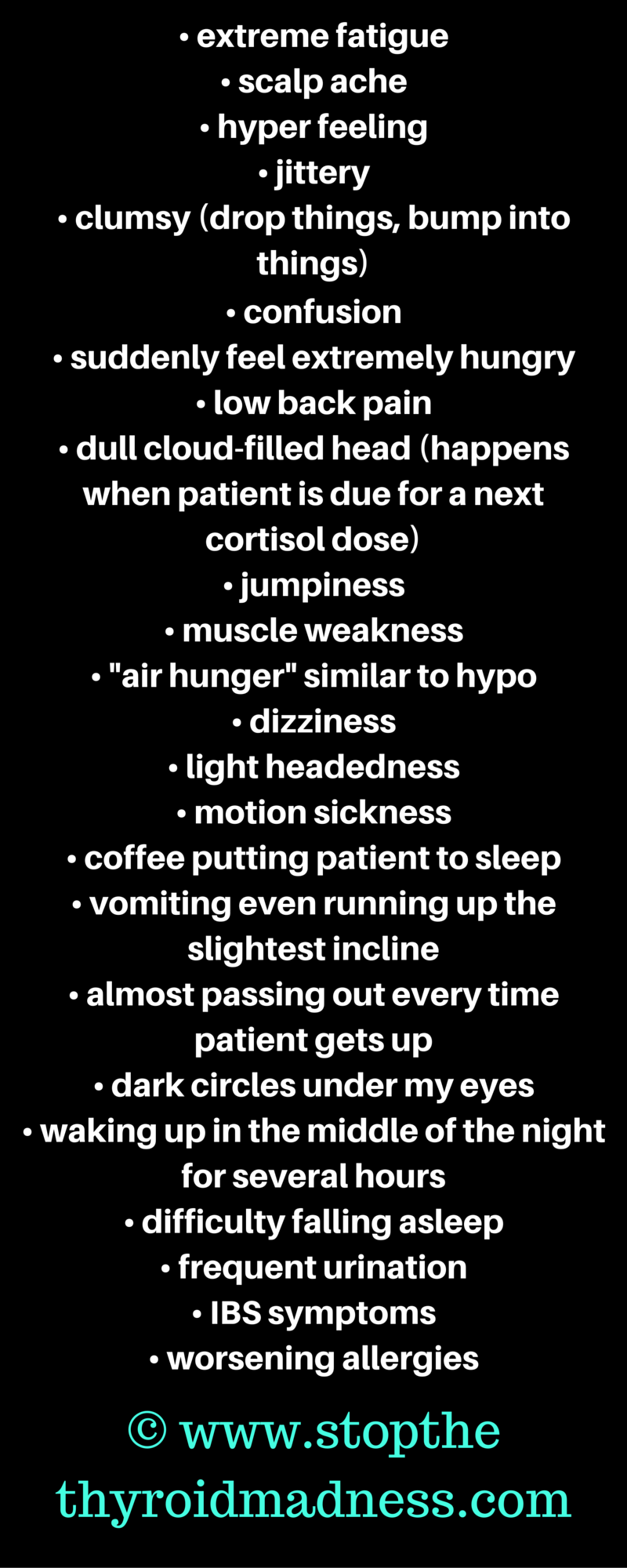
When I am very adrenal, normally mornings, I feel very tired with jello-like muscles, wired and on high alert, shaky so I drop things all the time, very clumsy, low blood pressure with high heart rate, hypoglycemic if I haven't taken care of myself to avoid low blood sugar, unable to take a deep satisfying breath, paranoid and anxious, irritated and extremely focused on one thing or unable to focus on anything, angry, and unable to escape danger. This list fits me really well:

STTM Graphic Adrenal symptoms part one BLACK BACKGROUND
https://stopthethyroidmadness.com/images/STTM-graphic-Adrenal-symptoms-part-two-BLACK-BACKGROUND.png


As you can see, this isn't easy. It's very difficult to manage adrenal fatigue, and it's stressful to keep up with what I need to do to manage it.

What do I do to treat? Well what I have been doing has obviously been working since I've improved in the last 3 years, but it's working very slowly. I'm also worried I'm regressing. I would like to improve my protocol, but I'm not sure what is right for me. I simply just need to see my doctor in person. What I am doing is taking adrenal cortex (which adds coritisol to the body), high dose of vitamin b5, a few herbs like cordyceps, and licorice root (I have low blood pressure so I'm able to take licorice root.) I also have to avoid stress and caffeine like they're poison. I didn't work for a year and a half, and that's when I did my best healing. Since working for the last 2 years (even at 12-15 hours a week) I've stopped making progress, and I've had to drink some caffeine to make it through shifts. I also have to address my high night cortisol by taking tons of relaxing herbs to literally overpower my adrenals (I take about 12-15 pills a night.)

A support group with nurses and "experts" told me my cortisol is so low I should go on hydrocortisone, which would mean adding actual cortisol to my body. I know this works well for many patients, but it's not without risk. It also has to be prescribed, and I don't have insurance. They said if I continue to treat with adrenal cortex I'll need to raise my dose substantially - they said I'm not taking nearly enough to make a difference. That will get expensive. I don't know if they're right or not, but I do know that I need to change something so I can make progress while working. Quitting my job is not an option (unless someone would like to pay me to stay at home, but even then I'm good friends with my co-workers and enjoy the social aspect, which is important.)

I'm stressing myself out just writing this post! It's too much to deal with.

So I know there's a few posts that I've promised to write. Please be patient with me. I'm having a rough time. I expect that once spring arrives and I can go for walks outside again that I'll start to feel better. This has been a really rough stressful winter (36" of snow within two consecutive weekends!)

And, if you get time, please read this post written by a doctor with chronic illness: https://themighty.com/2017/02/doctor-with-chronic-illness-things-to-know/

Saturday, February 4, 2017

Results of New Supplements and Going Off All Supplements

I've had a rough month. Winter is never easy for me, but I chose to do some experimenting despite winter. I want to record some of what I've learned here.

1. Lithium Orotate

My doctor suggested I try this based on my gene data (23andMe.com). Lithium Carbonate has been traditionally used to treat bipolar disorder, but I've been taking Lithium Orotate. The difference is that carbonate isn't stable and a person has to take over 1,000 mg of it at a time to absorb enough to make a difference. Orotate, on the other hand, is highly absorbable and can be taken in small doses. I'm taking 5 mg a day.

For the first couple of weeks it made me feel a bit high - giddy, could laugh really easily, smiled for no reason at all, and had pleasant dreams. That effect wore off and I went back to "normal," except that I've noticed I haven't had nearly as many dark, depressing, lethargic, and apathetic thoughts. I originally started on inositol powder to help with my mood and energy. It did make a mild positive difference, but the lithium has done more.

I have also had regular large, deep, painful cystic acne since starting the lithium. I thought it was from taking the liver glandular, thinking it was detoxing me through my skin, but the problem has continued. I then learned from someone else that lithium gave them the same kind of acne. I'm now trying to decide if the better mood from lithium is worth this painful large acne.


2. Selenium

My doctor also suggested I try selenium for the same reason as trying lithium. Low selenium contributes to thyroid disorders, and my thyroid is disordered. I started and stopped the selenium twice. The first time I tried it turned me into a total zombie: very lightheaded and weak, dizzy, and unable to focus. I developed these symptoms immediately. A few weeks later I tried it again. It took 2 weeks before I developed the same symptoms. It gave me vertigo so strong that at times I couldn't walk in a straight line. So I stopped taking it. I didn't notice any other effect or benefit.

They say that the soil here in North Dakota is rich in selenium. I eat mostly locally grown organic foods, so I'm hoping this simply means that I'm getting enough regularly through my diet.

3. 4-point Saliva Cortisol Test/ Going off all supplements for 2 1/2 days.

I am very likely going to write a post on the results and preparation process when I get them. This is about the results of quitting all supplements for 2 1/2 days in order to do the test. I joined an adrenal fatigue support group on facebook based on the book Stop The Thyroid Madness. They say that it's very important to be off all supplements for 2 full weeks before doing the cortisol test, because you have to get all adaptions and other things that affect cortisol levels totally out of your body to see how your body does without support. I couldn't handle being off my supplements for 2 1/2 days, so I went ahead and did the test. I understand that some people think this will ruin the test results, but I honestly do not think it is safe for me to be off supplements any longer.

What happened?

- My blood sugar plummeted. With supplements it stays between 95-115 most of the time. Off supplements (I measured about once an hour for 2 days) I was staying between 72-98, most of the time I was in the 80's. I start to get symptomatic of hypoglycemia when I'm below 90, but below 80 I can't function. I was hypoglycemic a lot in the last 2 1/2 days. I did not change my diet of eating protein every 2 hours. (Keeping in mind that the adrenal glands do heavily affect blood sugar, and I stopped supporting my adrenals.) This morning (now that I can go back on my supplements) I did a test. My blood sugar was 84 when I got up, then after a protein shake including licorice (which affects the adrenals) it shot up to 124!!! That's a huge difference very quickly! I'm looking forward to going back on my pancreas glandular with chromium, which really helps keep my blood sugar stable.

- Heavy menstrual bleeding just 2 weeks into my cycle. My diva cup was full, and it was very dark and clotted.

- Blood pressure got wonky. I didn't see it ever dip below 95/58, which isn't much lower than I occasionally get even when on my supplements, but my pulse pressure narrowed by about 10 points on average. Pulse pressure is the distance between systolic and diastolic, and a healthy pulse pressure is about 40. My pulse pressure was often 25-30, but I had one reading of it at 55. This isn't stable for me. I'm generally around 30-40 when on supplements, even if my overall blood pressure is on the low end.

- Disturbed sleep. I couldn't take any sleeping aids for 2 nights, which was torture. Both nights it took hours of just laying there to fall asleep, even though I was exhausted from work. Once I got to sleep I found myself waking up every couple of hours. Small sounds in the house would also wake me up. I wouldn't feel rested during the day. Last night, after finishing the coritosl test, I took my sleep pills. They normally take about hour to kick in, but they made my whole body tingle and shut down within about 10 minutes. I felt like I was fighting sleep, but after shutting the light off and trying to sleep I couldn't fall asleep for probably an hour. Once I did fall asleep I stayed asleep, thankfully.

- Couldn't find joy in doing anything, even things I liked. The first day wasn't so bad, but the second day (yesterday) was awful. Everything felt like work, most things annoyed me, and nothing was enjoyable to do. I was apathetic, but worse than that, I felt emotionally muted.

- Poor memory. I found it hard to recall information, remember how and when something happened, and found it hard to retain the instructions I was reading over and over. After only 2 1/2 days without supplements! This shows how sensitive my body is.

- Poor vision and balance. A big part of this was being hypoglycemic, but even when my blood sugar was in the 90's I would have sensations of the floor moving below me, me swaying when I was not, and objects in the distance vibrating when they were not.

- Joint aches, but surprisingly no fibromyalgia. I was feeling very inflammed.

- Digestion plugged up. I gained about 5 pounds in bloat in the last 2 days, and my IBS is acting up. I did actually take my digestive enzymes to help, but they didn't help much. I was having regular bowel movements, but staying bloated and food wouldn't move through me well.

- Intense fatigue, but not constantly. I was able to work for the first 1/2 day and the second full day without supplements, but I was dragging and "flight mode" was kicking in a lot when I was encountering minor problems. At times it took willpower to lift my legs to walk. Yesterday I had trouble getting up and moving at times, but had weird spurts of jittery energy in which I was able to run up and downstairs to do laundry.


What did I learn from all this? That my supplements really are doing me good! I was able to write this post because I'm finally able to drink a cup of green tea, which tastes like heaven right now. My adrenal glands still have A LOT of healing to do, even after 3 years of trying to repair them. I don't need the test results to feel this, but I'm very curious about how my results will look.

Monday, May 2, 2016

Mycotoxins and Mold

My naturopathic doctor recently had me do a mycotoxin test through BiotrekLabs.com. The reason for this is because the lab gave him a test for free, and I got to be the guinea pig and try the test out. If the test was not free, I highly doubt I would have had a mycotoxin test done. As it turns out the test showed I have "alarmingly" high levels of all mycotoxins in my body:


I was given my actual numbers over the phone, and I can tell you they up to 3x higher than the top of the range. This is alarming - I was really surprised. Many thoughts ran through my head: Why isn't the mold killing me? Since aflatoxin is one of the most carcinogenic toxins known to man, why don't I have cancer when my body is full of it? Why am I not suffering a daily bloody nose, which is my typical allergic reaction to mold (I tested very high in allergies to most molds many years ago.) Wouldn't my symptoms be A LOT worse than this? Sure, I can hardly move some days, but I'd expect to be completely bed ridden with results like these!

Let's back up a little bit. The company who makes the test is not the most reputable, and accuracy is a concern here. For a $650 test I would expect highly reliable results. These results could be very accurate, but there's reason to question it. That said, it's no surprise that mold is a major player in my illness, and I do believe I am high in the mycotoxins for several reasons.

I've had some awful mold exposures in my life. I've always been so sensitive that coming into contact with mold would give me an immediate bloody nose with mild flu-like symptoms, while people around me were just fine. I lived on the coast in Oregon for my teenage years, a place that was naturally moldy due to constant high humidity. I could never visit the city of Bend, Oregon without getting very sick. Every single time I stayed the night in Bend, which was at least once a summer, I would end up with the flu after several bloody noses. I think a big part of the problem was that I am also allergic to trees that grow in that area, so it was a double whammy. When we moved to North Dakota from Oregon, we lived in a guest house for 3 months that was not in good condition. My mom and I disrupted a big bush of black mold on a sliding glass door in that house (I call it a bush because it was at least a few inches by a few inches.) Next thing I knew, both nostrils were pouring blood and blood was flowing down my throat. Mom grabbed a mixing bowl to collect all my blood and I filled it at least half full. I wanted to go to the ER, and I was sick with flu like symptoms after that exposure. Years later my husband and I moved into an old house in Boise, Idaho. At first it was hard to tell if there was mold or not - it was old, needed repair work done, but nothing obvious as far as mold. I was getting bloody noses at least weekly, but I tend to get them in Boise anyway due to the dry air. It was in that house that I started gaining weight rapidly, developed arthritis, started to rely on coffee and energy drinks, and felt my physical decline. One day the wall of the shower fell into the tub, revealing lots of mildew. I was very stupid at the time, assuming it was just mildew and as long as the lining of the shower got resealed onto the wall it wouldn't affect us. We lived in that house for 2 years. We moved back to North Dakota into my parent's house (my parents moved out as we moved in.) The skylight in the main bathroom was occasionally leaking, thankfully into the toilet itself, ha! One day it wasn't just a drip, it was an actual stream of water and a larger hole opened up in the ceiling. The repairman said he couldn't find any mold, but when we replaced the skylight we found that the roof board below the skylight was heavily rotted. The bathroom was renovated and sealed up, and the roof was repaired. Shortly after that, we had our windows replaced, and mold was found in the window frames. Thankfully, replacing the windows took care of the mold!

(The mold test kit's results for the main bathroom when the skylight was leaking into our toilet.)

I have a history with mold, as you can read. The question today is this: Am I still living in a moldy environment? My dad hired a company to test our house for mold. The results showed that the upstairs, where my husband and I live, had half the amount of mold as the outside of our house had (which is the base range.) The downstairs, where another family member lives, had double the mold as outside of our house. They called it "slightly elevated." For me personally, "slightly elevated" can mean "not at all safe."

Another clue as my biotoxin illness was taking the VCS Test (Visual Contract Sensitivity Test.) The idea with this test is that mycotoxins build up in our eyes, making it difficult to see contrasting colors. It seems very simplistic, and I'm not going to explain it well, so I encourage you to read about on this site. Dr. Richie Shoemaker (the leader in mold illnesses) highly recommends the test. I tested positive for biotoxins based on this test (the test was free):


We had a new washer and dryer installed this week, and when the guys from Best Buy removed the old washer we saw a couple issues. The backside of the washer looked mildewy, something I couldn't have seen before. The valve for cold water was corroded and leaking, something I couldn't have seen before. They were unable to install our washer because of that valve, so they shut it off so it stopped dripping, at least. We have no way of knowing if it was dripping behind the sheet rock, but it's very possible. But that's when it dawned on me: was I washing my clothes in a moldy washing machine? It was about 30 years old, had a leak, and probably wasn't cleaned properly for years. Are ALL of my clothes contaminated with mold from that machine?

So... knowing my history, you can see why it's no surprise that mold is an issue in my health.

Normal people who get sick from mold tend to get over it and regain their health after leaving the moldy environment. This is probably the least moldy environment I've been in for most of my life. You'd think that I should be improving, but my level was still very high on that test! It was that high after 2 1/2 years of a perfect anti-candida diet (no sugar, no moldy foods, nothing to feed mold), and a 6 month long Candida cleanse (which should have killed mold too.) Either my levels were even higher and they have come down with all this work, or what I'm doing isn't working and isn't killing the mold in my body. (Or the test isn't accurate, but I don't think that's a big factor.)

When I've looked into why my body doesn't recover from mold, I keep seeing research and articles talking about the HLA genes. Apparently, only 25% of the population have these genes, and those that do are highly prone to mycotoxin illness. I've been told that the gene makes it so the body recycles mold back into the body instead of excreting it out like in normal people. I have the genes. *IF* this is true, then how can I possible fight it? I could be recycling mold from when I was a little kid, right? So what hope do I possibly have? If I do mange to kill all the mold in my body, wouldn't I just get sick all over again from new mold accumulation in my body? Mold is impossible to escape!

So I looked at mold treatment options. The first thing that came to my attention is Ozone therapy. Apparently ozone IVs can cause mold in the body to implode, killing the biofilm and the mold itself. It's impossible for mold to survive in ozone. Sounds like a miracle cure that's easy, right? Nope! Ozone is HIGHLY toxic to humans. It's so risky that it's actually illegal, but there are doctors administering it. Strong people can survive ozone IVs, but someone like me? It's extremely risky. You will find many doctors who swear by ozone and its safety, but I am very cautious. Alternatively, I get treatments in a hyperbaric chamber at my Naturopathic Doctor's clinic. This chamber is oxygen therapy, which can do the same thing as ozone, only much much much more safely. The problem is that I don't live near my doctor's clinic, and I'm unable to get treatments more than a few times a year. I have yet to find a hyperbaric chamber anywhere in the city I live in. I've been told to drink food grade 35% hydrogen peroxide, which is essentially the same thing as ozone, but supposedly more gentle. This is not something I'm willing to try without my doctor's support, especially based on what 3% hydrogen peroxide did to my mouth (check out my black hairy tongue post.)

The next option that was made aware of is the Shoemaker Protocol. I had several people tell me it's the ONLY option for treating mold, and all the mold support groups I've looked into treat this protocol like the Holy Bible of mold toxicity. It's so popular you'd think it has a high success rate, but I keep digging and digging through the internet and can't actually find much about the success rate, just people claiming to feel better and people claiming they can't tolerate the protocol. The protocol seems to be a mixed bag. From what I'm reading, there are plenty of people who do not do well on this protocol specifically because of the main prescription medication: Cholestyramine (CSM). It's a cholesterol drug. This raises red flags for me. First and foremost, my cholesterol should not be lowered! Secondly, I don't tolerate medication well - my body readily rejects most medications I've tried. Thirdly, negative reviews of this drug for mold toxicity are very negative. It causes severe constipation, and you must take it with a laxative, causing a great deal of distress for many patients. It also absorbs nutrition from your food and supplements, so you must be really careful about how to take the drug so that you don't malnourish and dehydrate yourself. I hope you can understand my hesitancy to consider this protocol! I understand that when it works for someone it works very well in that it makes them feel better. But what I don't understand is why this prescription drug could possibly be more effective than natural binders like Zeolite, Activated Charcoal, or clay?  Dr. Shoemaker claims that they don't bind to the same toxins, but why not? I plan to do a lot more reading up on this protocol since it's pushed so hard by mold patients, but I think I need to remain skeptical. Listen to or read this really wonderful interview on this protocol by Dr. Shoemaker himself.

The other option I was made aware of is a protocol by Dr. Nick Gonzalez, may he R.I.P., as outlined in Suzanne Sommer's book Tox-Sick. (I will write a separate post on this book once I finish reading it, but so far I highly recommend it.) He advocates for regular coffee enemas and far infrared sauna treatments in addition to taking food-grade bentonite clay daily. He claims that the clay's magnetic charge and honeycomb structure makes it an excellent binder to absorb mold and carry it out of the body. I'm intrigued by this, especially since I know how much better I feel when I take activated charcoal regularly. I also found this study about the effectiveness of clay on aflatoxins in humans. I see problems with this plan, though: dehydration and heavy metal toxicity. Apparently there is less lead in the clay than in some nuts and vegetables, and apparently it's not a bioavailable lead. I'm linking to Wellness Mama on this one simply because I'm having a very difficult time finding actual studies on the risks of the heavy metals in clay - even the FDA approves bentonite clay as a safe food additive. Maybe my hesitation about food grade clay isn't well founded afterall? I have been using bentonite clay on my skin and as a toothpaste for a couple of years now and absolutely love it. As for the coffee enemas, I'm interesting in trying. I get colonic irrigations a few times a year at my doctor's clinic and they are exceptionally helpful! Enemas won't be nearly as good, but I'm curious because I can do them at home. I already use my far infrared sauna many times a week at home (I haven't written a post on this - what's wrong with me!?)

I'm glad my naturopathic doctor had another option for me. He put me on a homeopathic nasal spray with oils designed to kill mold in my sinuses. This is not a full solution, but we just want to see what happens. Mold loves the sinuses because they're a dark humid place, so starting by killing the mold in my sinuses makes sense. The spray is also designed to desensitize me to mold homeopathically.  It's a bit intimidating spraying trace amounts of black mold into my sinuses, but I'm not foreign to the concept and have had good results with this type of treatment in the past. For now, I'm content to address my mold issue with this nasal spray while I work on making my house as mold-free as possible. Ideally I'd be able to do a hyperbaric chamber regularly too, but at least I can stick with my diet and my sauna to continue to kill off and sweat out the mold in my body. I might even consider the food grade bentonite clay, after a lot more research and talking about it with my doctor. I need to go slowly, and I like that this is a very gentle start to killing off the mold in my body.

Thursday, October 29, 2015

Lab Tests and Gene Mutations

I've been stalling on this post because I've been debating on how to write it, but I think it's time to tackle it. I learned a lot last month when I visited my naturopathic doctor, some of which I'm going to share with you here.

First, I think it needs to be explained that health is complicated. Very complicated. I get very frustrated when people ask me why it's been 2 years and I still don't have everything with my health figured out. This question ignores how much progress I've made. It ignores that I do understand a lot about my health. It doesn't allow for the slow, long process of healing years and years of damage to my body. In my situation, I have done a lot of healing in some ways, and in other ways I haven't done enough healing. Because of the healing that I have done, it's a lot easier to see where I still have work to do. There's layers upon layers of symptoms, all of which can have various root causes. Considering the complexity of health, especially my hyper sensitive body, I'm very impressed with how much my doctor has done for me. I'm not taking any drugs, not going through any harsh treatments like chemo, I'm not bed ridden with multiple idiopathic diagnoses, and I'm not hopeless. Supplements, diet, therapies, and exercise are repairing my body. It's incredible! It's truly amazing how the body wants to heal with the support of these natural solutions.

It started with getting several labs: Vitamin B6, Calcium, and Parathyroid. (The calcium lab was the same price as a comprehensive metabolic lab, which includes calcium, so I bought that instead - I'll say something about the results of that later on.)

Quick tangent: I went through RequestATest.com and WalkInLab.com, not a hospital, and had the blood drawn at Labcorp. My labs were significantly cheaper. For instance, my B6 cost me $67 as opposed to $200 at my local hospital. The only problem is that some states do not have a Labcorp or Quest Diagnostics - North Dakota is one of the the states that does not. I was thankful to be able to get these labs cheaply in New Hampshire.
What I found out is that my parathyroid, 4 glands on the thyroid that control calcium in the body, was on the low end of the "normal range" at 16, and should be fine. If the parathyroid is too low, it's apparently potentially deadly. Hypoparathyriod is rare. If too high, which is much more common, it causes a wide range of painful symptoms, but usually means there's a tumor on one of the glands that needs to be surgically removed. I was preparing for the result of being too high and needing to go to Florida for a surgeon - it's never bad to be mentally prepared, right? I wasn't expecting the possibility of it being too low, but thankfully it's probably okay. Calcium is critical to the entire body, so the gland that controls it is just as critical. My calcium is good, at 9.4. While I enjoyed learning about what the parathyroid does, I'm thankful that it's probably not causing my issues.

The vitamin b6 lab, however, was very revealing! Vitamin B6 is a water soluble vitamin, meaning the body should flush out any extra that it doesn't need. This is why I never see warnings about getting too much, but there's all sorts of information explaining why it's dangerous to have too little. The normal range for B6 of someone of my age and weight is 2-32.8. My number was 136.1. I received a letter with my results warning me to seek care immediately for the high level, which made me laugh. Finally, a lab test that shows something useful!!! (An MD told me that I was the "golden image of health" after I had several hundred dollars worth of labs done, that's after insurance, back in 2013, even though I was hardly capable of functioning. She said this because my blood work looked great - so to have a lab that actually reveals something is wrong is a miracle to me! I'm sure a lot of you have been though this too.)


So what does this mean? Was I taking too much B6? I was on a fair amount between a B Complex and a two small sleeping pills that had a little B6 in them, but I wasn't on enough to cause my number to get this high. I didn't take any pills with B6 in it for over 24 hours before the lab anyway. Again, B6 is water soluble - my body should flush out the excess. Something else is going on.

So my doctor brought up MTHFR. I'd heard a little about it. I knew it is a gene mutation that is one possible cause of MCS, but that's all I knew. I had no idea that gene mutations cause metabolic problems in some people, making it so these people cannot eat certain food and can't supplement with certain vitamins. It can also mean these people need to take certain supplements to stay well. There are lots of gene mutations and each mutation has several variants, meaning that there are all sorts of complicated issues with each gene mutation.

The problem with addressing gene mutations is that they were only very recently discovered. The science began with the Human Genome Project about 12 years ago. Because the science is so new, there's so much more research to be done. There's enough information on a couple of the known mutations to help people with them manage their health. For instance, we know that women with a variation of MTHFR can have infertility issues because of it. We know that we can improve fertility by having them supplement with methylfolate, whereas folic acid (what pregnant women are advised to take) can cause major health problems in these women.

What I understand MTHFR to mean is that particular gene cannot process certain B vitamins correctly. Its job is to convert one form of a B vitamin into another form, and when it can't do that, the body can't use the vitamin anymore, and the body can't get enough of the form of the vitamin it needs. This can cause the body to have many minor and major metabolic problems, such as blocking the ability to create enough glutathione (the body's natural antioxidant.) Not enough glutathione means an inability to detox - are you connecting the dots to MCS yet? Back to the gene: This inability to process the B vitamins causes the vitamin to get stored in the body since it isn't being used. This could easily explain my very high B6 level. The problem, is that high B6 in the body can cause a lot of pain. Over time it causes nerve damage, which is very painful. This could explain the electric dull aching pain in my feet (which, for the record, hasn't bothered me in about a week - could it be because I'm addressing the B6 issue?)

What I'm doing to get my B6 levels down is avoidance of B6 and a lot of sweating. I'm trying to exercise more, but I'm either using my sauna or taking a hot bath daily. I'm sweating daily, as much as I can. My doctor also put me on a multivitamin and a B12 vitamin that are MTHFR friendly, meaning I'm taking a form of the vitamins that have been methylated (processed) so the gene doesn't have to process them.

Whew, this is complicated!! I clearly don't understand it all either. I don't need to.

But wait... do we know for absolute certain that I have MTHFR? No, not yet. I'm also having my DNA tested - most of it, not just the MTHFR. The problem is, it might take up to 12 weeks to get my results. I am not having it tested through a hospital or lab, which would be much more expensive and wouldn't test all of my DNA. I'm testing through 23andMe.com. They sent me a little box with a kit in the mail. I spit into the kit, sealed it, and sent it back to them. Very easy!


Yes, 23andme.com is an ancestry company... sort of? It's what they feature, but it's not at the core of their mission. There's a lot of controversy about the company, but none of it affects their ability to give me what I need to know. The FDA shut down their "health results" feature 2 years ago, but just last week, the FDA gave them permission to give health results again through a new feature. To be clear: I DID NOT choose them to get health results. I'm very curious to see what they'll say about my health, but I'm not going to rely on those results. I chose them because they test most of my DNA for only $99, then sends me the raw data. The FDA won't let them interpret it, so I need to get it interpreted. I plan to use GeneticGenie.Org. This is incredibly cheap! I'm also excited to go through 23andMe because they're collecting DNA for research. They're trying to revolutionize how to accumulate enough DNA to learn about it on a mass scale. This will hopefully make huge advancements in our medical knowledge and ability to make medications. I'm really excited to participate in this project! No, I'm not worried about privacy issues - I'm happy to be used for research to advance health care.

If you want to learn more about gene mutations, I encourage you to do some research. There's a lot of misinformation on the internet about it, as with anything, so I recommend starting with Dr. Ben Lynch's website for information, as he's a leading researcher: MTHFR.net

Once I get the results, have them interpreted, and change my life accordingly (which I've already begun doing, just in case,) I'll write a follow up.


...Okay, I want to get back to lab results I mentioned earlier. I bought the Comprehensive Metabolic Panel. Click on the link to see everything it tests for. I had one thing that was low and another that was high, simply showing my kidneys have some trouble (which I already knew), but it's nothing we're going to worry about. Everything else was good. What I want to point is that my protein level is great:


I eat mostly animal protein in my diet and have 2 protein shakes a day. Meat is my primary food, everything else I eat in small quantities. (I've made this clear in past posts, but I'll say it again: I strictly eat grass-fed, pasture raised, clean meat from good farming practices.) I've been eating this way for 2 years. If my meat diet wasn't working for me, this result wouldn't be so good. I AM NOT advocating this diet for you. My doctor is having me eat this way because he got to know what my body needs, and he's working closely with me to make sure it's working for me. You might have very different dietary needs than me. We're all unique. I can't go vegan without getting very sick, whereas some people I know feel their absolute best on a vegan diet. The reason I'm pointing this out is because I've received a lot of criticism about my diet, mostly from people I know personally who have watched me eat this way.

Was this post too long for you? Sorry. I didn't even say half of what I could have said. :) I'm done now! Thanks for reading!